Parking Lot Sign Installation
In St. Louis Metro East, IL
Code-Compliant Parking Lot Signage
1-800-STRIPER provides professional parking lot sign installation in St. Louis Metro East, IL — installing accessible-parking signs, fire lane and no-parking signs, directional signage, and tow-away notices per the 2010 ADA Standards and the R7-8 sign Illinois adopts under 625 ILCS 5/11-301, for commercial properties across Madison, St. Clair, and Monroe counties.
1-800-STRIPER® of St Louis Metro East PROVIDes Parking Lot Sign Installation Services NEAR YOU
Are you communicating clearly?
We install new signs in adherence with local regulatory standards and can repair or replace damaged signs so you can clearly communicate your parking requirements.
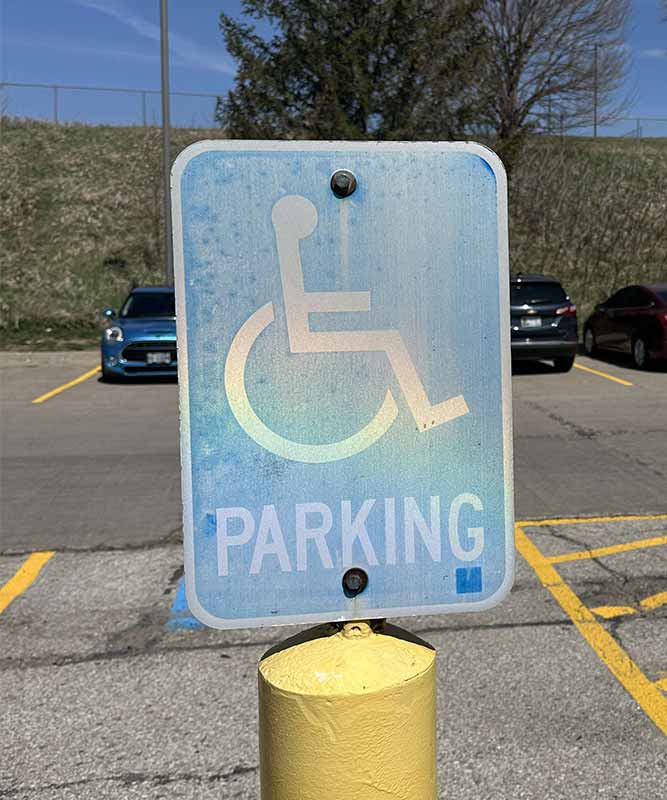
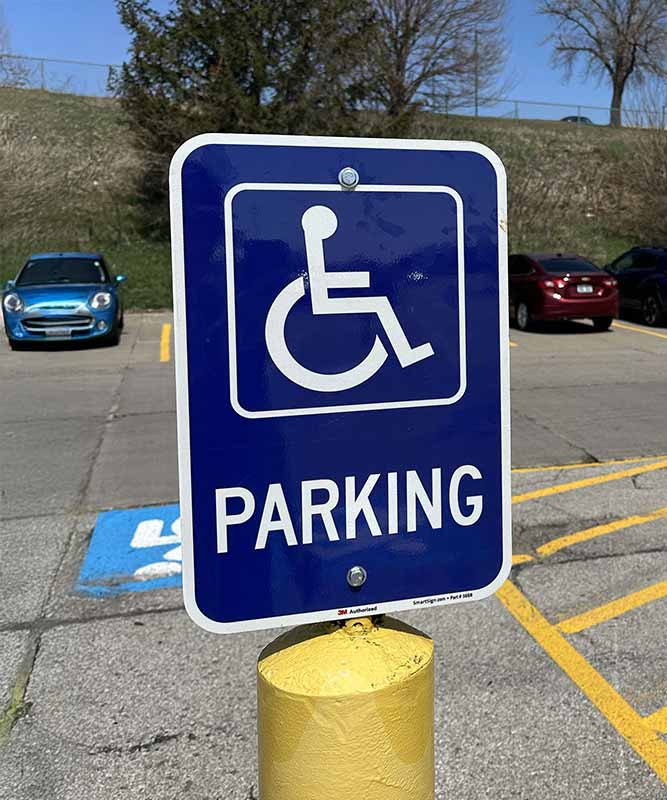
Parking Lot Sign Installation in St. Louis Metro East, IL
On an Illinois parking lot, the sign is not decoration — it is the thing that makes the rule enforceable. We install and replace parking signage for commercial properties across Belleville, Granite City, Edwardsville, O’Fallon, and the surrounding Metro East: accessible-parking signs at the head of reserved stalls, fire lane and no-parking signs where the fire official requires them, directional and one-way signs, and tow-away notices. Signage pairs with striping because a painted symbol and a posted sign are two halves of the same job — and in Illinois, only one of them actually gives the space legal force.
Why the Sign Is What Makes an Accessible Space Real
This is the single most important thing to understand about accessible parking in Illinois, and most property owners have it backwards. Painting the symbol on the pavement does not reserve the space. The statute does.
Under 625 ILCS 5/11-1301.3(a), it is prohibited to park a vehicle without the proper plates or decal in any space “specifically reserved, by the posting of an official sign as designated under Section 11-301.” And the statute says exactly where it reaches: “any parking place, including any private or public offstreet parking facility.” Your lot is covered.
Read that closely and the consequence is sharp. Reserved-by-sign is the statutory test. A blue symbol painted on asphalt with no compliant sign posted above it is a courtesy, not a reserved space — and it is a courtesy the police cannot enforce for you. The same subsection separately prohibits parking in the designated access aisle beside the space, which is the violation that actually strands a wheelchair user.
There’s a companion provision worth knowing, at 11-1301.3(b): the owner or operator of a private off-street facility may have an improperly parked vehicle removed, after notifying the police or sheriff’s department. That remedy sits on top of a properly signed space.
What Illinois Requires on the Sign
Illinois is more specific than most states here, and the details that bind your property come from the Illinois Accessibility Code (71 IAC 400) — which, per the Capital Development Board, “has the force of a building code in Illinois.” Its Section 502.6 is the one to build to, and it is more prescriptive than the federal rule:
- The sign type. Accessible spaces are “designated as reserved by providing a permanently mounted R7-8 (U.S. Department of Transportation standard) sign which contains the international symbol of accessibility.” The Illinois Vehicle Code names the same sign — 625 ILCS 5/11-301(a) directs the state manual to “include the adoption of the R 7-8 sign.”
- A fine amount has to appear on it — on its own plate. Section 502.6: “Such signs shall exhibit the dollar amount of the fine as required by the Illinois Vehicle Code… or the higher amount if required by local ordinance.” The code’s own figure note is specific about how: the R7-8 must be supplemented with the Illinois Standard R7-I101 plate, which carries the penalty amount. We don’t print fine figures on this page, and there’s a good reason beyond house style — the figure is local-ordinance-dependent and the statutory amounts have moved over the years, so the number that belongs on your plate is the one your jurisdiction currently enforces. Some Metro East municipalities have raised it by ordinance and some have not, which means neighbouring towns can carry different plates. We confirm yours before we fabricate anything.
- Mounting is specified — with a maximum, which the ADA does not have. Section 502.6: signs “shall be vertically mounted on a post or wall at front center of the parking space, no more than 6 feet horizontally from the front of the parking space and set a minimum of 5 feet and a maximum of 9 feet from finished grade to the bottom of the R7-8 sign.” This is where Illinois and the federal standard diverge, and it catches people out. The ADA sets a 60-inch floor and no ceiling. Illinois sets a floor, a 9-foot ceiling, and a horizontal placement rule. A sign mounted high on a wall behind the stall can satisfy the ADA and still miss the Illinois code.
- Older signs are grandfathered — narrowly. Section 502.6: “Existing signs may remain, but their useful lives shall not be extended by other means than normal maintenance.” 625 ILCS 5/11-301(a) says the same of non-conforming signs in use before January 1, 1985. Read the second clause either way: an old sign is allowed to finish its life; it is not allowed to be rebuilt into a new one.
- Substance beats form — for the driver, not for you. 625 ILCS 5/11-1301.3(c) provides that it is not a defense that the sign fails “the technical requirements of Section 11-301… if a reasonable person would be made aware by the sign or notice on or near the parking place that the place is reserved.” A driver cannot escape a ticket because your sign is a half-inch short. That protects enforcement — it is not permission to post a sloppy sign, because the Accessibility Code still binds the property.
The Federal Layer — ADA Signage
The 2010 ADA Standards run alongside the Illinois statute, and they govern the property rather than the driver.
Section 502.6 is the one to know: “Parking space identification signs shall include the International Symbol of Accessibility… Signs identifying van parking spaces shall contain the designation ‘van accessible.’ Signs shall be 60 inches (1525 mm) minimum above the finish floor or ground surface measured to the bottom of the sign.” That last phrase is the one people get wrong — the 60 inches is measured to the bottom of the sign, not the top and not the centre, and a sign set to the wrong datum sits too low.
Two more worth knowing:
- ⚠️ The federal small-lot exception does NOT exist in Illinois. This one catches people, and getting it wrong means skipping a sign the law requires. Federal ADA section 216.5 carries an exception: sites with four or fewer total spaces don’t have to identify the accessible space with a sign. Illinois deleted it. The Illinois Accessibility Code’s own section 216.5 reads: “Parking spaces complying with 502 shall be identified by signs complying with 502.6. EXCEPTIONS: 1. [Deleted].” The phrase “four or fewer” appears nowhere in the Illinois code. If you have an accessible space in Illinois, it gets a sign — a four-space lot behind a storefront included.
- Enforcement is local. Advisory 502.6 says it plainly: “Enforcement of motor vehicle laws, including parking privileges, is a local matter.”
Restriping Your Lot Triggers the Signage Rule
This is the part most property owners don’t see coming, and it is the reason signage and striping belong in the same conversation.
The Illinois Accessibility Code, section 202.3.3: “All changes, improvements, or maintenance of existing parking lots including sealcoating, resurfacing, remarking, fencing, curbs, walks, and/or landscaping shall provide accessible parking spaces in accordance with 208. In addition, an accessible route shall be provided within the parking lot to connect the accessible parking spaces to a path of travel that leads to an accessible entrance.”
Read what’s in that list. Remarking. Sealcoating. Resurfacing. In Illinois, routine maintenance of an existing lot pulls the accessible-parking requirements forward — the count under section 208, the space and aisle geometry under section 502, and the signage under 502.6. Restriping a lot is not a cosmetic refresh in the eyes of this code; it is the event that obliges you to get the accessible spaces right.
That cuts both ways, and we’d rather you hear it from us before you hear it from the Attorney General’s office, which is who enforces this code. It means a restripe is the natural moment to fix accessible parking — the crew is already on site, the layout is already coming up, and the signage can go in with it. It also means a restripe that reinstates a non-compliant layout is a worse position than the faded lines you started with. We plan the two together for exactly this reason.
One clarification, since it gets overstated constantly — including by people selling signs. The MUTCD does not apply to your parking lot, and it says so itself. MUTCD Section 1B.01: “The MUTCD shall not apply to the following types of facilities: … Parking areas, including the driving aisles within those parking areas, that are either publicly or privately owned.” Its own definitions repeat it: “Driving aisles are exempted from compliance with MUTCD provisions.”
So “MUTCD-compliant” is the wrong phrase for a private lot. The R7-8 reaches your property by a different route entirely: the Illinois Accessibility Code requires it, and 625 ILCS 5/11-1301.3(a) makes the section 11-301 official sign the thing that reserves the space. The sign is required because Illinois law puts it there — not because a federal highway manual applies to your asphalt. The practical difference matters: it means your obligations come from Illinois, and Illinois is the stricter of the two on mounting.
Our Sign Installation Process
We walk the lot, confirm which spaces are reserved and where the fire official wants no-parking signage, and check what’s already posted against what the current design requires. Then we set posts, mount signs at the correct height measured to the bottom, and line the signage up with the pavement markings so the two agree — a sign over a stall with no symbol, or a symbol under no sign, is the most common thing we find and fix.
Where signage is going in alongside a restripe, we sequence it so the stall layout is final before the posts go in. Where we’re replacing storm-damaged or faded signs, we check whether the old one was pre-1985 grandfathered or simply out of date, because those are different answers. And where a fire lane is involved, we mark the sign locations to the local fire department’s requirement rather than a generic spacing, since Illinois fire-code adoption happens town by town — your fire official sets it.
Why Choose 1-800-STRIPER for Sign Installation
Signage is the part of a lot most likely to be technically wrong and least likely to be noticed until it matters — at an inspection, a complaint, or a claim. We’re a striping specialist, so the signs and the markings come from one crew that knows they have to agree with each other. We’re veteran-owned: Michael Slaton spent 22 years in the U.S. Air Force and retired as a Chief Master Sergeant before he and Shannon opened this franchise, and the habit of building to the actual spec rather than the approximate one comes from there. Our Google reviews sit at five stars, and every sign quote is free and in writing. Call (618) 844-1210 and we’ll walk your lot.
For a full list of our pavement marking services, visit our parking lot striping in St. Louis Metro East page.
Businesses We Serve




How it Works

GET A FREE ESTIMATE
Contact us today and we’ll have a quote to you in 24 hours

SCHEDULE AN INSTALLATION
We’ll have your installation scheduled in less than 7 days, without affecting your business hours

GET A PARKING LOT THAT POPS
For a budget-friendly price, you’ll get a parking lot that looks like new
We proudly work with:


We proudly work with:


Frequently Asked Questions About Parking Lot Sign Installation in St. Louis Metro East, IL
Do I really need a sign, or is the painted symbol enough?
In Illinois, the sign is what makes the space enforceable. Under 625 ILCS 5/11-1301.3(a), a space is reserved “by the posting of an official sign as designated under Section 11-301,” and the statute expressly reaches “any parking place, including any private or public offstreet parking facility.” A painted symbol with no compliant sign above it is a courtesy space — the police cannot enforce it for you.
What sign does Illinois require for accessible parking?
The R7-8, and it has to show a fine amount. The Illinois Accessibility Code section 502.6 requires “a permanently mounted R7-8 (U.S. Department of Transportation standard) sign which contains the international symbol of accessibility,” and says “such signs shall exhibit the dollar amount of the fine as required by the Illinois Vehicle Code, or the higher amount if required by local ordinance.” 625 ILCS 5/11-301(a) names the same R7-8 sign. We don’t publish fine figures — the amount is local-ordinance-dependent — so we confirm what your jurisdiction currently enforces before fabricating anything.
How high does an accessible parking sign have to be mounted?
In Illinois you have to satisfy two rules, and the state one is tighter. The 2010 ADA Standards section 502.6 sets a floor: at least 60 inches above the ground, measured to the bottom of the sign. The Illinois Accessibility Code section 502.6 sets a floor and a ceiling — a minimum of 5 feet and a maximum of 9 feet from finished grade to the bottom of the R7-8 sign, mounted at front center of the space and no more than 6 feet horizontally from the front of it. A sign mounted high on a wall behind the stall can pass the ADA and still miss the Illinois code. We build to the Illinois spec.
Our lot is tiny. Do we still need accessible signage?
In Illinois, yes. The federal ADA has an exception at section 216.5 for sites with four or fewer total spaces — but Illinois deleted it. The Illinois Accessibility Code’s section 216.5 reads “EXCEPTIONS: 1. [Deleted],” and the phrase “four or fewer” appears nowhere in the code. If your Illinois lot has an accessible space, that space gets a compliant sign no matter how small the lot is. Anyone telling you otherwise is quoting the federal rule and missing the state one.
We have old signs. Do they have to be replaced?
It depends on their age, and the rule is narrower than people assume. 625 ILCS 5/11-301(a) says non-conforming signs in use before January 1, 1985 “shall not constitute a violation during their useful lives, which shall not be extended by other means than normal maintenance.” So a genuinely pre-1985 sign can finish its life — but you can’t rebuild it to extend that life. Anything newer should match the current design.
Can we tow someone parked in our accessible space?
Illinois provides for it. Under 625 ILCS 5/11-1301.3(b), a person or local authority owning or operating a public or private off-street parking facility may remove an improperly parked vehicle “after notifying the police or sheriff’s department.” That remedy depends on the space being properly signed in the first place, which is the whole reason the signage matters.
Does restriping our lot trigger any signage obligation?
In Illinois it can, and this surprises most owners. Illinois Accessibility Code section 202.3.3 says “all changes, improvements, or maintenance of existing parking lots including sealcoating, resurfacing, remarking, fencing, curbs, walks, and/or landscaping shall provide accessible parking spaces in accordance with 208” — plus an accessible route connecting them to the entrance. Remarking is on that list. So a restripe is the moment to get accessible spaces, aisles, and signs right rather than reinstate an old layout. We plan the two together.