
Warehouse Line Painting
In Chicago Suburbs, IL
Indoor Line Striping for Warehouses and Facilities
1-800-STRIPER® provides professional warehouse line painting in Chicago Suburbs, IL — marking permanent aisles, pedestrian walkways, and safety zones per OSHA 29 CFR 1910.176(a) for distribution centers and manufacturing facilities across DuPage, Cook, and Will counties.
1-800-STRIPER® of Chicago Suburbs Provides Warehouse Line Painting Services NEAR YOU
Want your indoor space to operate more efficiently?
Warehouse and interior markings ensure clear traffic lanes, organized storage zones, and designated spaces designed to help your business operate safely and efficiently.
Benefits:
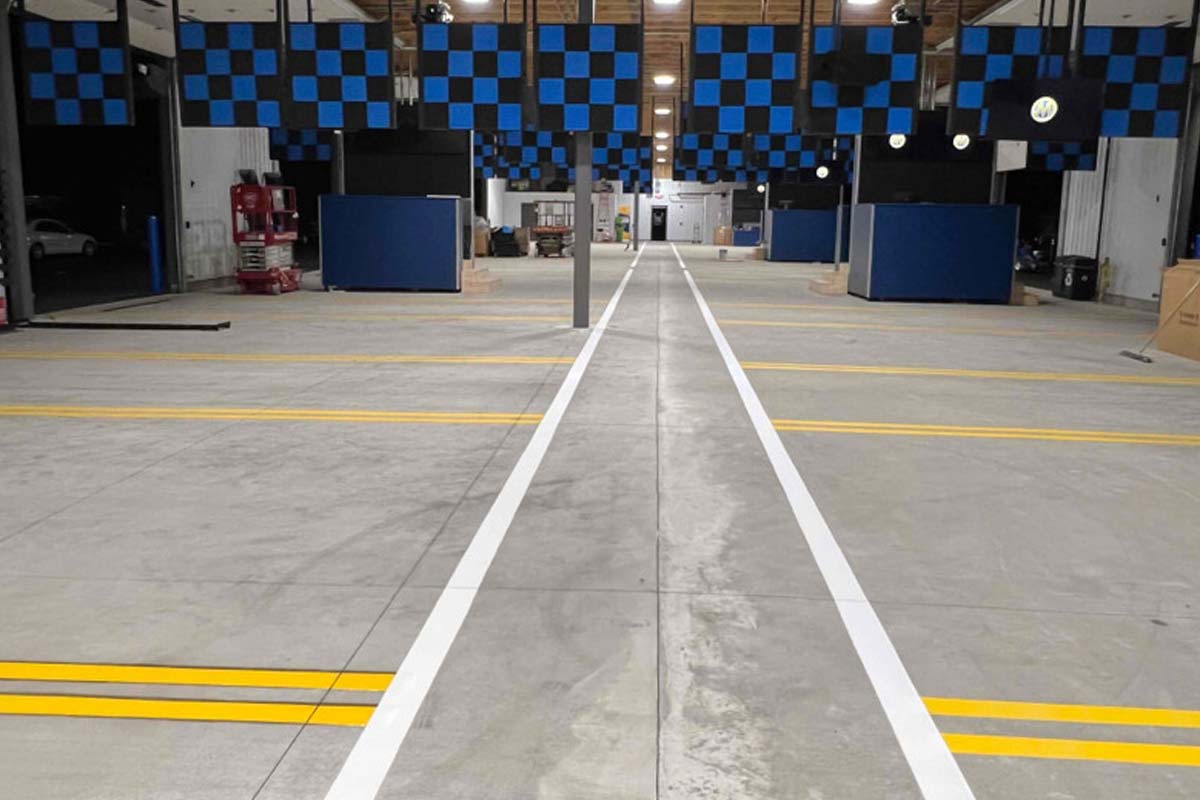
What OSHA actually requires for aisle marking
The question usually arrives after an insurance walkthrough or a near miss, and the answer is shorter than anyone expects. The federal requirement lives in one sentence of 29 CFR 1910.176(a), the OSHA standard covering the handling and storage of materials. Where mechanical handling equipment is used, the standard requires sufficient safe clearances for aisles, at loading docks, through doorways, and wherever turns or passage must be made. It requires aisles and passageways to be kept clear and in good repair, with no obstruction across or in an aisle that could create a hazard. And it closes with the line that puts paint on your floor: permanent aisles and passageways shall be appropriately marked.
Three words in that sentence do the work, and each one is worth reading carefully.
Permanent. The duty attaches to aisles that are part of how the building operates, not to a lane you tape off for one afternoon while a trailer is unloaded. If an aisle exists on your floor plan, appears on your fire plan, or is where the lift trucks always run, it is permanent for this purpose regardless of whether anyone has painted it yet.
Aisles and passageways. The standard reaches beyond the main lift-truck lanes. Passageways include the routes people take between work cells, the walkways along a pick line, and the paths that connect exits to the areas they serve. In a distribution center this usually means more marked footage than the manager estimated at the start of the walk.
Appropriately marked. This is the phrase that generates most of the confusion, because it is the one OSHA declined to define. The standard sets a duty and leaves the method to the employer. There is no federal aisle color, no federal stripe width, and no federal spacing rule in 1910.176(a).
Where mechanical handling equipment operates, the clearance duty and the marking duty work together. A lane marked at a width that a loaded lift truck cannot actually use is not sufficient safe clearance no matter how crisp the paint is, and a compliant clearance that no one can see is not appropriately marked. Lane widths come off the equipment that actually runs in your building — counterbalance trucks, reach trucks, order pickers, tuggers, and the widest pallet you move — not off a generic template.
The other half of the job is what the marking communicates to people on foot. A distribution floor where pedestrians and powered equipment share space needs the pedestrian route to be obvious at a glance, from the door someone walks in through to the workstation they are heading for. That is a layout question before it is a paint question, and it is the part that repays a proper walk of the building.
Line colors, widths, and what no regulation specifies
Here is the part almost every warehouse line painting page gets wrong: it presents a color chart as though OSHA published one. OSHA did not.
What OSHA does publish is a safety color code, 29 CFR 1910.144, and its scope is narrower than the way it is usually quoted. The standard assigns red as the basic color for identifying fire protection equipment and apparatus, danger, and emergency stop bars and buttons on hazardous machines. It assigns yellow as the basic color for designating caution and for marking physical hazards — striking against, stumbling, falling, tripping, and caught-in-between hazards. That is the extent of the color mandate. Nothing in 1910.144 says aisles must be yellow, that pedestrian walkways must be green, or that staging areas must be blue.
The color conventions you have seen in other buildings come from ANSI Z535.1, the safety color code published as a voluntary consensus standard rather than a regulation. Z535.1 is genuinely useful — it is why a green-marked walkway reads as a safe route to almost any experienced warehouse worker, and consistency across a network of buildings has real safety value. But it is a standard your facility chooses to follow, not a rule an inspector cites. Worth saying plainly: a contractor who tells you green walkways are federally required is either mistaken or selling.
Widths are the same story. There is no federal aisle stripe width. The common four-inch line is a convention, not a citation, and it is a poor default in some buildings — a lane crossed by heavy lift-truck traffic and cleaned with a ride-on scrubber gets more useful life from a wider line, while a tight mezzanine walkway often reads better narrow. The one width figure worth respecting is the aisle itself rather than the stripe, and that comes back to the sufficient safe clearance language in 1910.176(a) and to the equipment on your floor.
Where a real dimensional requirement does exist, it comes from somewhere other than the aisle-marking rule. Exit routes, the clear space that must stay open in front of electrical panels, and the aisle clearances your local fire official enforces around sprinkler risers and extinguishers all carry their own numbers from their own instruments. Those get flagged during the walk and marked around rather than through.
So the honest summary is this. Federal law tells you permanent aisles must be marked and leaves the method to you. A consensus standard supplies the color vocabulary most facilities use. Your own operation — the equipment, the traffic pattern, the cleaning regime, and any corporate standard your network already runs — supplies the rest. If your network already runs a marking standard, we paint to it. If not, we will recommend one and be clear about which parts of it are regulation and which are convention.
Marking a live distribution center without stopping work
A warehouse floor is not an empty parking lot. The building is running, the racks are full, and the aisle you need to paint is the aisle the pickers need at seven in the morning. Most of the difficulty in warehouse line painting is scheduling and surface preparation rather than paint.
Sequencing. We break the floor into zones and work them in an order that keeps your operation moving — typically the lanes that serve the shipping side first, or the reverse, depending on which end of the building goes quiet earliest. On a multi-shift operation that usually means working the gap between shifts or coming in on a weekend. On a single-shift building it often means starting after the last truck leaves.
Surface preparation. This is where warehouse work diverges most from exterior striping. Sealed concrete, densified concrete, and epoxy-coated floors each take paint differently, and a floor that has been scrubbed daily for years carries a film of detergent and burnish that will keep new paint from bonding no matter how good the paint is. Old markings that are peeling have to come off rather than be painted over, because a new line laid on a failing one fails with it. Adhesion gets tested before anyone commits to the full floor.
Cure time. Traffic returning too early is the most common cause of a fresh warehouse marking looking bad within a week. Lift-truck tires pick up paint that has skinned over but not cured, and the lane is smeared before the first shift ends. Cure windows are planned around your restart time, and you get told when a zone will actually be ready rather than when it will look dry.
Layout changes. If you are re-racking, adding a mezzanine, changing pick paths, or converting floor space to automation, the marking should follow the new plan and not the old one. Repainting the lanes you already had is the cheapest way to lock in a layout you were about to outgrow. We would rather lay out the floor you are moving toward.
Removal. When a layout actually changes, the old lines have to come off rather than simply be worked around. A floor carrying two contradictory sets of markings is worse than a floor carrying none, because operators follow whichever set they see first and the two disagree at exactly the points where the change was made. Removal is part of the scope on any re-layout, and it belongs in the quote rather than being discovered halfway through.
What else gets marked while the crew is there. Aisles are the requirement; they are rarely the whole job. On a typical distribution floor the same layout pass also covers staging and drop zones, inbound and outbound stretch-wrap areas, battery charging and propane exchange bays, do-not-block hatching in front of electrical panels and exit doors, directional arrows at blind corners and column lines, dock-door numbering, rack-end and aisle identification, and stenciled floor legends. Marking those in one visit is cheaper than a second mobilization and, more usefully, keeps the whole floor consistent — the same colors mean the same things everywhere, which is the point of a marking standard in the first place.
Working around what you cannot move. Racking, conveyor, mezzanine columns, and in-floor drainage all constrain the layout, and so does the cleaning equipment: a lane laid out without reference to the turning circle of your ride-on scrubber will get its edges chewed off within months. Those constraints get measured before the layout is drawn, not discovered with a paint gun in hand.
We serve distribution and manufacturing buildings across the western and northwestern suburbs — the corridors around Bolingbrook, Joliet, Aurora, Naperville, Bensenville, Elmhurst, and Schaumburg — where the building stock runs from older multi-tenant industrial to modern high-bay distribution, and the right approach differs between them.
For a full list of our pavement marking services, visit our parking lot striping in Chicago Suburbs page.
Businesses We Serve




How it Works

GET A FREE ESTIMATE
Contact us today and we’ll have a quote to you in 24 hours

SCHEDULE A STRIPING
We’ll have your space restriped in less than 7 days, without affecting your business hours

GET A PARKING LOT THAT POPS
For a budget-friendly price, you’ll get a parking lot that looks like new
We proudly work with:


We proudly work with:


Frequently Asked Questions About Warehouse Line Painting in Chicago Suburbs, IL
Does OSHA require warehouse aisles to be painted yellow?
No. OSHA requires that permanent aisles and passageways be appropriately marked, in 29 CFR 1910.176(a), and it does not specify a color. The federal safety color code, 29 CFR 1910.144, assigns red to fire protection equipment, danger, and emergency stops, and yellow to caution and physical hazards — it does not assign a color to aisles. Yellow aisle lines are a widely used convention drawn from the voluntary ANSI Z535.1 standard, not a federal requirement.
What line width does OSHA require for aisle marking?
None. There is no federal stripe width for aisle marking. The common four-inch line is a convention. What the regulation does require is sufficient safe clearance for the aisle itself where mechanical handling equipment is used, which is a function of your lift trucks and your loads rather than of the paint. We size lines to the traffic and the cleaning equipment in your building.
Do we have to mark pedestrian walkways?
The regulation reaches passageways as well as aisles, so a permanent pedestrian route through a working floor falls within the marking duty. Beyond the letter of the rule, a clearly marked walkway is the single most effective marking on a floor that mixes people and powered equipment, because it tells both parties where the other one is supposed to be.
Can you paint over our existing lines?
Sometimes, and it depends on what the existing line is doing. A sound marking that is still well adhered can be refreshed directly. A line that is peeling, flaking, or lifting has to be removed first, because a new coat laid over a failing one fails with it and you pay twice. We check adhesion before quoting the approach rather than after.
How long before forklifts can drive on new lines?
It depends on the product, the floor, and the temperature and humidity in the building on the day. The failure mode to avoid is traffic returning while the paint has skinned over but not cured, which lifts the line onto the tires. We give you a cure window per zone before we start so you can plan the restart, and we would rather hold a lane an extra hour than hand back a smeared one.
Do you work around our shift schedule?
Yes, and it is usually the deciding factor in how the job is sequenced. Multi-shift buildings are typically worked between shifts or on a weekend; single-shift buildings after the last outbound truck. We zone the floor so that no area is out of service longer than it needs to be.
What about the floor in front of the electrical panels and fire equipment?
Those clearances come from instruments other than the aisle-marking rule and carry their own numbers. We identify them during the walk — panel clear space, sprinkler risers, extinguisher and hose locations, and exit routes — and lay out the marking so it reinforces those clearances rather than encroaching on them.
Do you handle safety zones, staging areas, and floor signage as well as aisles?
Yes. Staging and drop zones, equipment charging areas, do-not-block hatching, directional arrows, and stenciled floor legends are all part of the same layout, and they work best when they are planned together with the aisles rather than added afterward. If your company runs a corporate marking standard, we will paint to it.