Sports Court Striping
In Chicago Suburbs, IL
Sports Courts, Athletic Fields and Playground Markings
1-800-STRIPER® provides professional sports court striping in Chicago Suburbs, IL — laying out pickleball courts to USA Pickleball specifications, basketball and tennis courts to their governing-body dimensions, and playground game markings using durable acrylic court paint.
1-800-STRIPER® of Chicago Suburbs Provides Sports Court Striping Services NEAR YOU
Want to get people to come out to play?
Brighten up your faded sports courts or turn your playground into a safe, colorful, and engaging space that entices people to come out and play.
Sports Court Specialties:
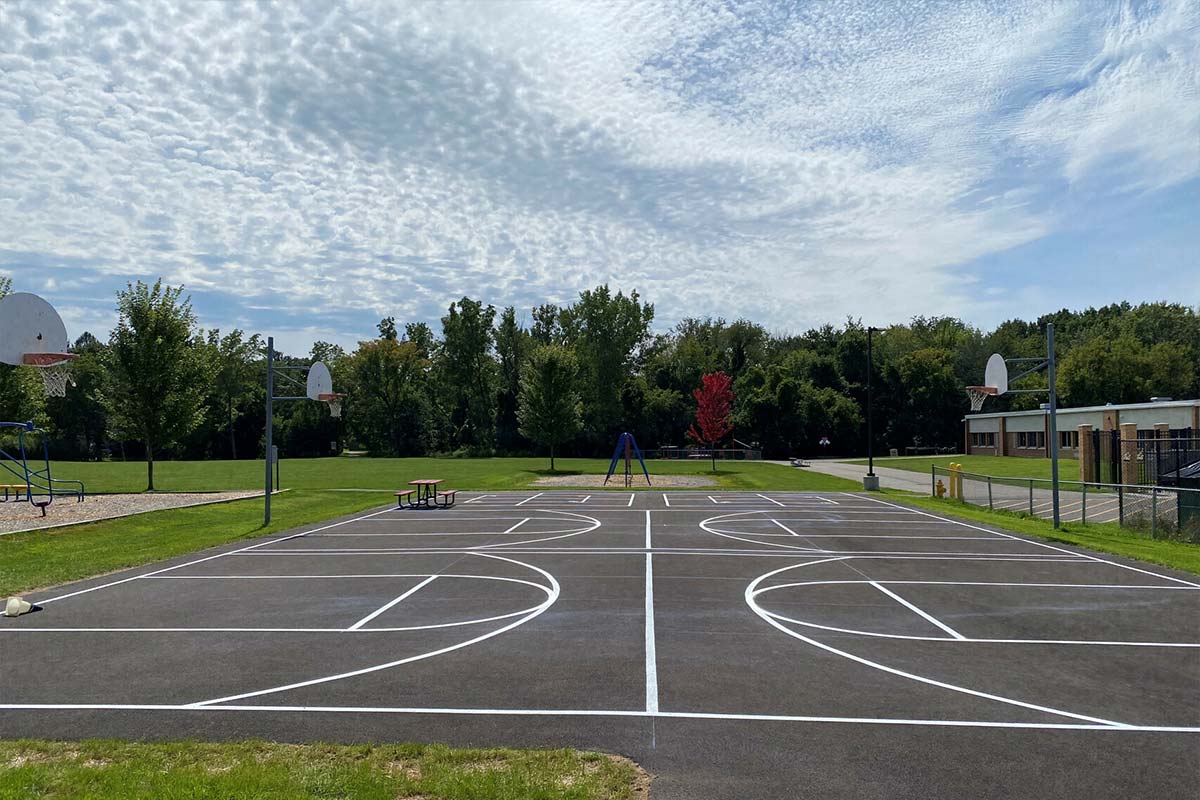
Court dimensions by sport
Court striping is unforgiving in a way parking lot striping is not. A line in the wrong place changes how the game is played, and players notice on the first point.
The two sports with a published number we can stand behind:
| Playing dimensions | Governing source | |
|---|---|---|
| Pickleball | 20 ft × 44 ft, singles and doubles alike; non-volley zone 7 ft from the net on each side | USA Pickleball Official Rulebook |
| Tennis | 78 ft long; 27 ft wide singles, 36 ft wide doubles, service boxes to the published diagram | USTA court layout diagram |
Pickleball surprises people converting from tennis, because the playing dimensions do not change between singles and doubles — only the strategy does. The rulebook also recommends a total playing surface larger than the court itself, so players have room behind the baseline and outside the sidelines. A court painted tight against a fence plays badly no matter how accurate its lines are, so where the site allows it we lay out to the recommended surface and where it does not we say what the trade-off is before painting.
Basketball gets no row in that table on purpose. It is the sport where a confident number is most likely to be wrong: high school, collegiate, and international bodies publish different court sizes and different three-point arcs, and a page that names one figure is guessing about most of its readers. Ask us to lay out a basketball court and the first question back will be which standard it is being built to. For a residential or association pad that answers to no sanctioned body, we simply fit the best-proportioned court the concrete will hold.
Most suburban courts end up doing more than one job anyway — a tennis court with pickleball overlaid, a school pad carrying basketball and four-square, a park surface with hopscotch in the corner. Overlaying works. Keeping it playable is a matter of color separation and line-weight discipline, so each game’s lines read as one set and not as noise. Push too many colors onto a single surface and every game on it gets harder to play. Playground layouts follow no rulebook at all, being fitted to the space and the age group, and on a school pad they are usually the markings that get the most use.
Resurfacing, color, and line durability
Court markings live or die on what is underneath them.
Surface first. Court lines belong on a sound, clean, properly cured surface. Painting crisp lines on a cracked or delaminating acrylic system buys you a season at best, because the line fails wherever the surface does. If the pad needs crack repair, patching, or a fresh acrylic resurfacing system, that comes first and the striping goes on last. We will say so if that is what your court needs rather than painting over a problem.
Court paint, not traffic paint. Sports courts take textured acrylic court coatings and acrylic line paint, not the traffic paint used on a parking lot. The materials are different for good reasons — grip underfoot, ball response, color retention under UV, and the ability to take repeated resurfacing.
Color. Color choice is aesthetic and functional at once. Contrast between the playing area, the surround, and the lines is what makes the boundary readable at speed; the familiar blue-and-green combination is popular because it reads well in bright sun. For overlaid multi-sport courts, choosing the color set is part of the layout, not an afterthought.
Illinois weather. Outdoor courts in the suburbs go through freeze-thaw cycling every winter, and water that gets into a crack and freezes is what turns a hairline into a structural one. Keeping the surface sealed and the cracks repaired is what protects the lines; the striping is the last layer on and the first to show that something underneath has moved.
We stripe courts for schools, park districts, churches, homeowner and condominium associations, apartment communities, athletic clubs, and private residences across the suburbs, including Naperville, Wheaton, Schaumburg, Aurora, St. Charles, Geneva, and Oswego.
For a full list of our pavement marking services, visit our parking lot striping in Chicago Suburbs page.
Businesses We Serve




How it Works

GET A FREE ESTIMATE
Contact us today and we’ll have a quote to you in 24 hours

SCHEDULE AN INSTALLATION
We’ll have your play space restriped in less than 7 days, without affecting your playtime

GET A PARKING LOT THAT POPS
For a budget-friendly price, you’ll get a parking lot that looks like new
We proudly work with:


We proudly work with:


Frequently Asked Questions About Sports Court Striping in Chicago Suburbs, IL
What are the official pickleball court dimensions?
20 feet by 44 feet for both singles and doubles, per the USA Pickleball Official Rulebook, with the non-volley zone extending 7 feet from the net on each side. The rulebook also recommends a larger total playing surface around the court so players have room behind the baseline and outside the sidelines.
Can you add pickleball lines to our existing tennis court?
Yes, and it is one of the most common requests we get. The tennis court stays playable and the pickleball layout is overlaid in a contrasting color. How many pickleball courts fit depends on the size of the surface and the surround; we measure and show you the options before painting.
What are tennis court dimensions?
A tennis court is 78 feet long, 27 feet wide for singles play and 36 feet wide for doubles, with the service boxes and the center service line laid out to the USTA court diagram. The extra nine feet of width for doubles is the two alleys, which is why a single surface serves both formats — the doubles sidelines simply sit outside the singles ones. Fitting a court also means allowing run-off space behind the baselines and outside the sidelines, so the pad has to be meaningfully larger than the court itself.
Do you resurface courts as well as stripe them?
Striping only works on a sound surface. Where the pad needs crack repair, patching, or a new acrylic coating system, that work has to come first, because lines painted over a failing surface fail along with it and you pay for the striping twice. When we look at a court we will tell you plainly which of the two it actually needs — a court that only needs its lines refreshed is a much smaller job than one whose surface has started to delaminate, and it does nobody any good to paint the second as though it were the first.
Do you paint playground games?
Yes. Hopscotch, four-square, running tracks, alphabet and number grids, compass roses, and map layouts are regular work for schools, park districts, churches, and daycare facilities across the suburbs. Unlike sanctioned courts, these are laid out to the space available and the age group using them rather than to a rulebook, so there is real design latitude — we will work from your ideas, or suggest a set of layouts that fit the pad you have.
When is the best time of year to stripe a court in Illinois?
Court coatings and line paint need dry conditions and surface temperatures above the product minimum, which in practice means late spring through early fall in Illinois. Booking before the summer fills up gives the most flexibility on dates, and that matters most for schools and park districts, whose courts have to be finished and cured around a program calendar rather than whenever the weather cooperates. If your court is tied to a season opening or a school year, tell us the date and we will work backward from it.