Temporary Parking Lot Striping
In Chicago Suburbs, IL
Event Markings and Temporary Striping Solutions
1-800-STRIPER® provides professional temporary parking lot striping in Chicago Suburbs, IL — short-duration event markings, construction-zone striping, and overflow parking layouts on grass, gravel, pavement, or any surface using removable water-based traffic paint.
1-800-STRIPER® of Chicago Suburbs Provides Temporary Parking Lot Striping Services NEAR YOU
Need Temporary Stripes?
Use temporary stripes to direct traffic and create parking areas at your special event or to keep construction sites safe without a long-term commitment. We paint on grass, gravel, pavement, or any other surface where temporary striping is needed.
Striping solutions for:
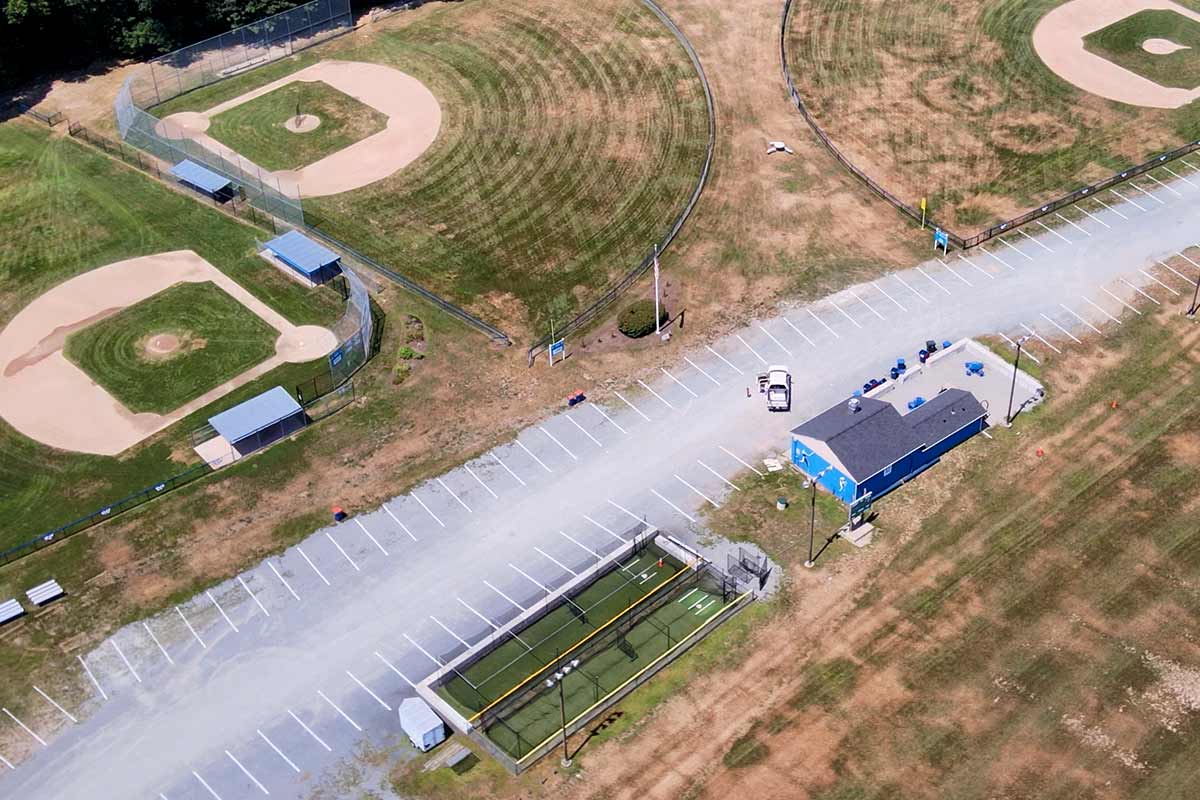
Temporary striping on grass, gravel, and unpaved surfaces
What makes striping temporary is how long the marking has to last, not what it sits on. The distinction matters because the surfaces involved are usually the ones a striping crew never touches on a normal week.
Take a field pressed into service as overflow parking for a festival, a graduation, a church event, or a county fair. It needs lanes and rows a driver can read from a moving vehicle, and turf marking paint is formulated for precisely that: it coats the blade instead of soaking into the soil, holds up for the length of the event, and grows out over the next few cuttings. Athletic fields get lined with the same class of product week after week.
Gravel behaves differently. Loose surfaces will not hold a painted line, because the line moves whenever the stone moves. So on aggregate the method changes to markers that do not depend on a continuous stripe: wheel stops, cones and delineators set out on a measured layout, staked edge markers, and painted aggregate at the decision points where a driver genuinely needs the information. What you end up with is a lot people can navigate, rather than a set of lines that disappear after the first hundred cars.
Pavement is the straightforward case. Asphalt and concrete take a removable water-based traffic paint instead of the longer-life products used for permanent markings — down fast, dry fast, legible, and liftable without the ghost line a permanent product leaves behind. Where a marking has to vanish cleanly on a known date, removable tape does the job instead.
Large sites are rarely one material, though, and that is where most of the planning goes. A single event lot can run from paved main aisle to compacted gravel to open field inside a few hundred feet. The site gets laid out as one circulation plan first; the marking method is then chosen surface by surface underneath it, so a driver experiences continuous guidance even while the method keeps changing under the tires.
Event, construction, and overflow layouts
The layout is the deliverable. Paint is only how it gets communicated.
A one-day or one-weekend lot has a specific problem to solve: absorb an arrival surge, hold vehicles efficiently, and empty again without gridlock. Entry has to be readable at approach speed. Rows want angling so drivers self-sort in the direction of travel. The exit path needs to be obvious from inside the lot, not just from the road. The markings that earn their place are the ones at decision points — where a driver picks a row, where staff will be directing traffic, where people cross on foot — and the interior stays simple enough to read in one pass.
Construction phasing asks something different again. While a property is being repaved, re-roofed, or expanded in sections, parking still has to work as the footprint shifts underneath it. Each phase gets its own set of markings and gives them up when it ends: a relocated entrance, a shifted fire lane, a contractor laydown area fenced out of the parking count, a rerouted pedestrian path from whichever door is currently the door.
Then there is capacity you need occasionally and not otherwise. Retail centers at the holidays, schools at graduation, churches at Easter and Christmas, venues with a seasonal peak — all of them need parking in November that would sit empty in February. Striping an overflow area for the peak and leaving it unmarked the rest of the year is a sensible use of a temporary marking, and it lets adjacent grass or gravel carry the load without anyone committing to paving it.
One thing that does not become temporary: accessible parking. A temporary lot is still parking serving the site, so if the layout displaces the existing accessible spaces, they move with it — required count, shortest accessible route to the entrance, access aisle and signage intact. That belongs in the plan at the start, not fitted in around the edges at the end.
The pieces that make up a typical event layout, in the order they get decided:
- Entry and queuing, worked out from the road inward
- Circulation direction and row angle
- Accessible spaces and their route to the entrance
- Capacity rows, filled in around the fixed elements
- Pedestrian crossings and staff positions
- Exit path and overflow release
Coverage runs across the western and northwestern suburbs, including Naperville, Aurora, Schaumburg, Wheaton, Joliet, Oswego, St. Charles, and Geneva.
For a full list of our pavement marking services, visit our parking lot striping in Chicago Suburbs page.
Businesses We Serve




How it Works

GET A FREE ESTIMATE
Contact us today and we’ll have a quote to you in 24 hours

SCHEDULE A STRIPING
We’ll have your space restriped in less than 7 days, without affecting your business hours

GET A PARKING LOT THAT POPS
For a budget-friendly price, you’ll get a parking lot that looks like new
We proudly work with:


We proudly work with:

Frequently Asked Questions About Temporary Parking Lot Striping in Chicago Suburbs, IL
How long does temporary striping last?
It depends on the surface and the product. On pavement, removable water-based traffic paint is meant to serve for the length of an event or a construction phase and then be removed. On turf, athletic-field style paint typically stays legible for the event and then grows out over the following mowings. On gravel, the marking method is physical rather than painted, so it lasts until it is picked up.
Can you stripe grass for event parking?
Yes. Turf marking paint is designed for it — the same class of product used to line athletic fields. It marks the blade rather than the soil, reads clearly from a vehicle, and disappears with normal mowing. It is the standard approach for festival, graduation, fair, and church overflow parking on open field.
Will temporary paint damage the pavement or leave a mark?
Removable water-based traffic paint is chosen specifically so it can be taken off without leaving the ghost line that a permanent marking leaves behind. Where a phase is short and a completely clean lift is the priority, removable tape is the better tool. We will tell you which one suits the surface and the timeline before the work is scheduled.
How is temporary striping different from regular parking lot striping?
Three things: the product, the surface, and the intent. Permanent striping uses long-life traffic paint on prepared pavement and is meant to last through seasons of traffic. Temporary striping uses removable or short-life products, is frequently applied to grass, gravel, or dirt as well as pavement, and is designed to be removed or to fade out when the event or phase is over.
Do you handle the layout, or do we need to plan it?
We handle it. Most clients come to us with a date, a headcount, and a piece of ground. We walk the site, work out circulation and capacity, and lay out entries, rows, aisles, accessible spaces, and pedestrian crossings as one plan. If you already have a site plan from an event company or a general contractor, we mark to it.
Do the MUTCD rules apply to a temporary lot?
Not as a legal requirement on private property. The Manual on Uniform Traffic Control Devices is the national standard for traffic control devices on streets, highways, bikeways, and private roads open to public travel, under 23 CFR 655.603(a) — a private commercial parking lot is not in that category. We follow MUTCD conventions on arrows, crosswalk patterns, and color anyway, because drivers already know how to read them, but we do not represent it as a rule that governs your lot.
Do you still need accessible spaces in a temporary lot?
Yes. A temporary parking area is still parking serving the site, so accessible spaces belong in it — at the required count, on the shortest accessible route to the entrance, with the access aisle marked and signage in place. If the temporary layout displaces the existing accessible spaces, they move with the layout.
How much notice do you need for an event?
The more the better, particularly in the spring and fall when the outdoor event calendar is full and the weather window is narrow. Painting needs a dry surface, so the practical constraint is usually forecast rather than schedule. Booking early gives us room to move the application day if the weather turns and still have the lot marked before your gates open.