Parking Lot Sign Installation
In Fairfield County, CT
ADA, Fire Lane, and Directional Signs
1-800-STRIPER provides professional parking lot sign installation in Fairfield County, CT — mounting accessible-space signs, fire lane and no-parking signs, and directional and reserved-parking posts to the above-grade sign requirements of Connecticut General Statutes Section 14-253a, for commercial properties across Fairfield, New Haven, and Litchfield counties.
1-800-STRIPER® of Fairfield County PROVIDes Parking Lot Sign Installation Services NEAR YOU
Are you communicating clearly?
We install new signs in adherence with local regulatory standards and can repair or replace damaged signs so you can clearly communicate your parking requirements.
Parking Lot Sign Installation in Fairfield County, CT
Paint on the pavement tells a driver where to park. Signs tell them the rules — who a space is reserved for, where they cannot stop, which way to drive, and where the fire lane starts. On most commercial lots the two work together, and a lot that has been restriped but never had its signs updated is only half done.
1-800-STRIPER of Fairfield County installs and replaces the full range of parking lot signs across southwestern Connecticut: accessible and van-accessible space signs, fire lane and no-parking signs, stop and yield signs, directional and one-way signs, and reserved or tenant-parking posts. New posts or existing ones, a single sign or a whole lot, it is the same job.
What Connecticut Law Requires on an Accessible Space Sign
This is the one property owners miss, and Connecticut is more specific than most states about it.
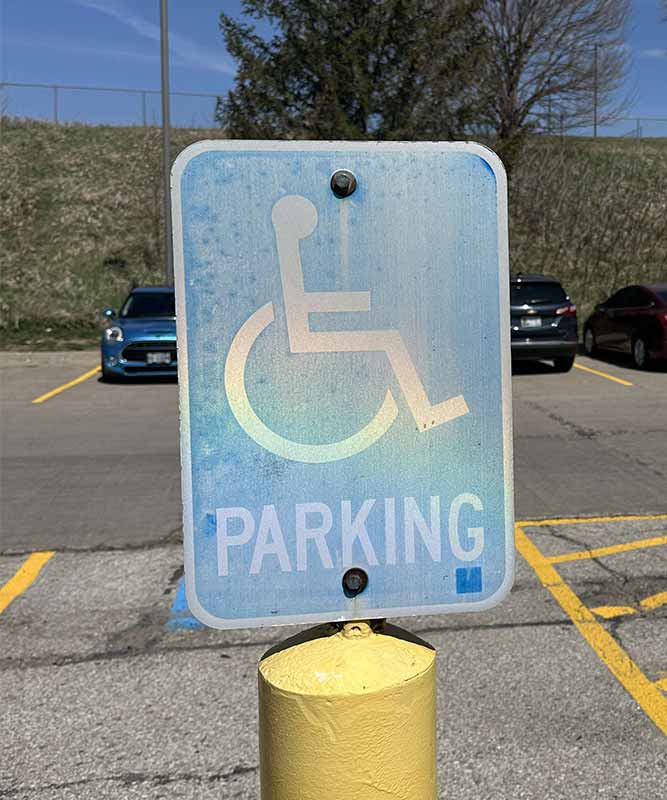
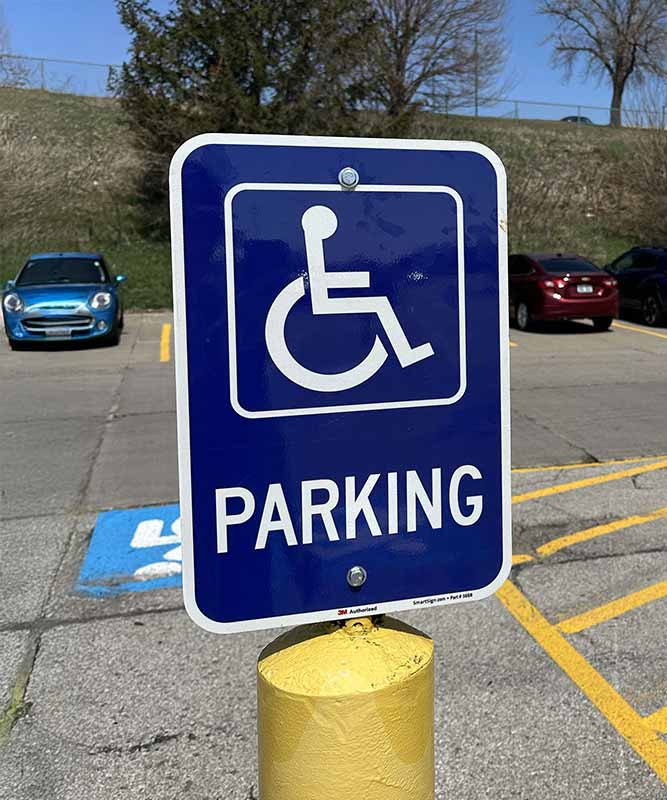
Under Connecticut General Statutes Section 14-253a, accessible spaces have to be designated by above grade signs with white lettering against a blue background, bearing the international symbol of access. Above grade is the operative phrase. A symbol painted on the pavement is not a substitute, for the simple reason that a parked car covers it — which is why the sign goes up on a post where it stays readable with a vehicle in the stall. The federal 2010 ADA Standards agree and put a number on it: the bottom of the sign sits at least 60 inches above the ground, and van spaces carry an additional “van accessible” designation.
There is a wrinkle in the Connecticut statute that catches people, and it is worth knowing before you order signs. Older signs read “handicapped parking permit required.” But the statute says that whenever such a sign is replaced, repaired or erected, it has to read “reserved parking permit required” instead, along with “violators will be fined,” the symbol of access, and an indication of the minimum fine — which may be a notice affixed to the sign. So a like-for-like replacement of a damaged sign is not actually like-for-like. If you are replacing signs on an older lot, the wording changes.
Section 14-253a also drives how many spaces you need. Private parking areas of 200 or more cars are subject to a schedule set out in the statute, beginning at one percent of spaces for lots of 201 to 1,000 and scaling from there, while lots of 200 or fewer are exempt under that subsection. The statute is explicit that this does not override a stricter rule: where the State Building Code or a municipal ordinance imposes more stringent requirements, those govern instead. Your town can ask for more, and several in the county do.
Fire Lane, Directional, and Reserved Parking Signs
Accessible signage is the regulated end of the work, but it is not the whole sign schedule.
- Fire lane and no-parking signs are approved by your local fire marshal, who is the authority having jurisdiction for your property. Connecticut runs one statewide fire safety code, but the marshal sets the sign size, wording, and spacing along the lane. We confirm those requirements rather than guessing at them.
- Stop, yield, and directional signs keep traffic moving predictably through the lot and follow the shapes and colors drivers already read on the street.
- Reserved and tenant parking signs handle the day-to-day friction — visitor spaces, tenant stalls, curbside pickup, and EV charging bays.
If you are not sure what your jurisdiction asks for, we would rather check it than guess, and we will tell you what we confirmed and what you should confirm with your fire marshal.
Our Sign Installation Process
- Confirm what the lot needs. Accessible counts, fire lanes, reserved spaces, and traffic flow drive the sign schedule. We match it to your layout and your town.
- Locate utilities before digging. Every post that goes in the ground gets a utility locate first.
- Set the posts. We core into concrete or set posts in the ground depending on the surface, plumb and aligned, at the mounting height the standards require.
- Mount and align the signs. Each sign faces the approach it is meant to be read from, square and at a consistent height across the lot.
- Walk it with you. We check every sign against the schedule so nothing is missing before we leave.
For a full list of our pavement marking services, visit our parking lot striping in Fairfield County page.
Businesses We Serve




How it Works

GET A FREE ESTIMATE
Contact us today and we’ll have a quote to you in 24 hours

SCHEDULE AN INSTALLATION
We’ll have your installation scheduled in less than 7 days, without affecting your business hours

GET A PARKING LOT THAT POPS
For a budget-friendly price, you’ll get a parking lot that looks like new
We proudly work with:


We proudly work with:


Frequently Asked Questions About Parking Lot Sign Installation in Fairfield County, CT
What does Connecticut require on an accessible parking sign?
Connecticut General Statutes Section 14-253a requires accessible spaces to be designated by above grade signs with white lettering against a blue background, bearing the international symbol of access. “Above grade” is the key phrase — a symbol painted on the pavement does not satisfy it, because a parked car covers it. The federal 2010 ADA Standards add the mounting height, putting the bottom of the sign at least 60 inches above the ground, and require a “van accessible” designation on van spaces.
My accessible signs say “handicapped parking permit required” — do I need to change them?
Not while they are intact, but the wording changes the moment you touch them. Connecticut General Statutes Section 14-253a says that whenever such a sign is replaced, repaired or erected, it has to read “reserved parking permit required” along with “violators will be fined,” bear the symbol of access, and indicate the minimum fine — which the statute allows to be a notice affixed to the sign. So a damaged sign is not a like-for-like swap. If you are replacing signs on an older lot, order the current wording.
How many accessible spaces does my lot need?
Connecticut General Statutes Section 14-253a sets a schedule for private parking areas of 200 or more cars, starting at one percent of spaces for lots of 201 to 1,000 and scaling up from there, with lots of 200 or fewer exempt under that subsection. But the statute is explicit that a stricter rule wins: where the State Building Code or a municipal ordinance imposes more stringent requirements, those govern. Your town can ask for more, so this is worth confirming for your specific property rather than assuming the state floor applies.
Is paint on the pavement enough, or do I need a sign?
You need the sign. That is the whole point of Connecticut’s “above grade” requirement in Section 14-253a — pavement markings disappear under the vehicle parked on them, so the designation has to stay visible at eye level with a car in the stall. In practice the two work together: the painted symbol and cross hatch mark the space and the aisle, and the post-mounted sign carries the designation. A freshly striped accessible space with no sign is not compliant.
Who decides what my fire lane signs have to say?
Your local fire marshal, as the authority having jurisdiction. Connecticut runs a single statewide fire safety code, but the marshal approves the sign size, wording, and spacing along the lane for your property. That is why we confirm the requirement with your jurisdiction before we install rather than running one generic spec across every town in the county.
Can you install signs on both concrete and asphalt?
Yes. On concrete we core and set the post; on asphalt or in a landscaped area we set the post in the ground. Either way the post goes in plumb, at the mounting height the standards require, and only after a utility locate. We can also mount to an existing wall or post where that is the better answer for the location.