Fire Lane Striping
In Nashville, TN
Code-Compliant Fire Lane Markings
1-800-STRIPER provides professional fire lane striping in Nashville, TN — marking compliant fire lanes, curbs, and no-parking zones per the International Fire Code (IFC §503) for commercial properties throughout Davidson, Williamson, and Rutherford counties.
1-800-STRIPER® of Nashville PROVIDes Fire Lane Striping Services NEAR YOU
Is your parking lot ready for first responders?
Our team is well-versed in local fire regulations and will parter with you to design a fire lane striping plan that creates unobstructed emergency access to protect your customers and property.
Core Services:
Tennessee Adoption of the International Fire Code and Who Enforces It
Tennessee adopts the International Fire Code (IFC), 2021 edition, by reference through the Tennessee State Fire Marshal (Tenn. Comp. R. & Regs. 0780-02-02-.01). The statewide adoption covers fire-lane marking, fire-apparatus access roads, hydrant access zones, and posted no-parking zones around fire department connections (FDCs).
Day-to-day enforcement runs through local fire departments. Across Middle Tennessee that includes Nashville Fire Department, Franklin Fire Department, Murfreesboro Fire Rescue, Brentwood Fire Department, La Vergne Fire Department, Mount Juliet Fire Department, Hendersonville Fire Department, Smyrna Fire Department, and the equivalent agencies in the smaller counties we serve. The Tennessee State Fire Marshal supervises statewide consistency and acts as the technical reference when local jurisdictions disagree.
Failed inspections begin with a written corrective notice and a deadline to bring markings into compliance. Repeat findings escalate to citations and, in commercial occupancies, can trigger occupancy permit issues. Most property managers we work with prefer to schedule fire-lane restripes ahead of the routine inspection cadence rather than reacting to a notice.
Stripe Width, Color, and Lettering Spec
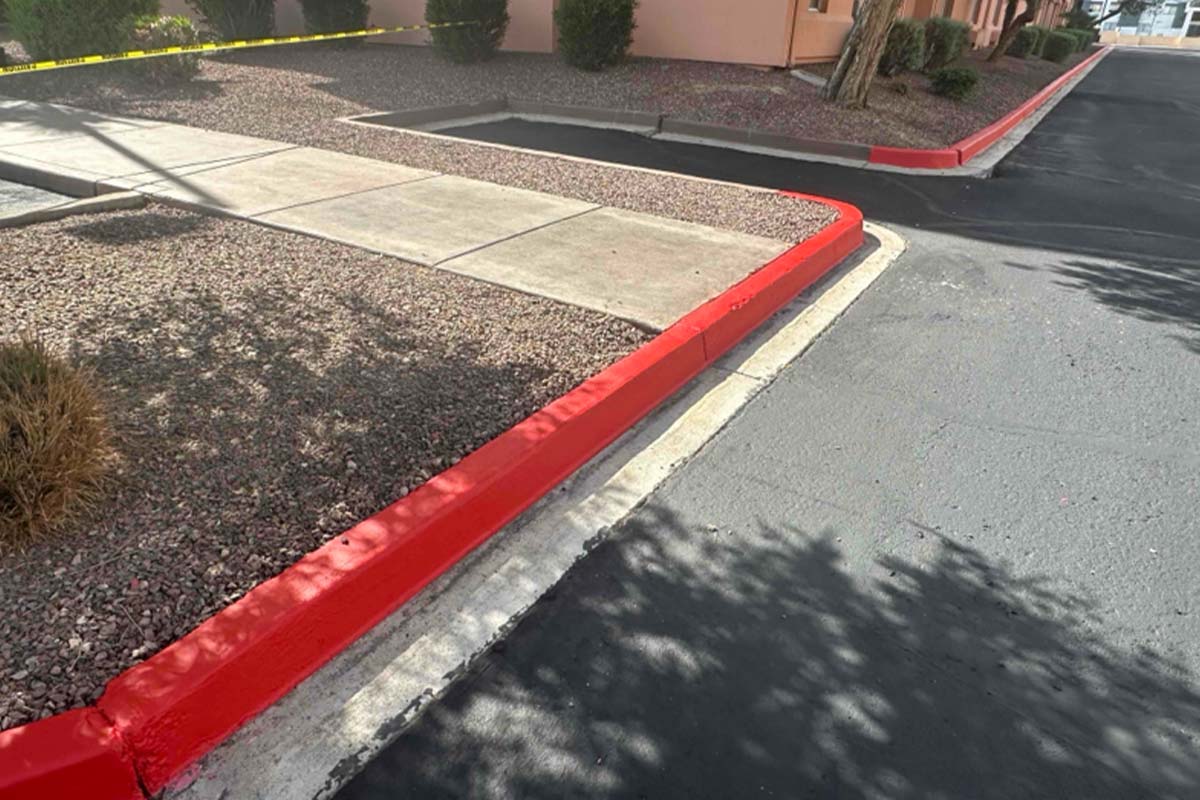
The IFC requires fire apparatus access roads to be marked where the fire code official requires it (IFC §503.3), clearly visible to approaching apparatus. Most Middle Tennessee jurisdictions enforce the following baseline:
| Element | Spec |
|---|---|
| Curb / no-parking zone color | Red (full curb face plus 4 inches of pavement, or full marked zone) |
| Pavement stripe color (when marked on pavement) | Red |
| Pavement stripe width | 4 inches minimum |
| Lettering — block | NO PARKING – FIRE LANE in white over red |
| Letter height | 12 inches minimum (some jurisdictions require 18 inches) |
| Letter spacing | Repeat every 50 feet maximum along the lane |
| Hatched no-parking zone | Diagonal red hatching, 4-inch stripe width, 4-foot spacing |
Local fire marshals in dense commercial districts (downtown Nashville, the Cool Springs Galleria area in Franklin, and the Murfreesboro retail corridor) sometimes require taller letters, narrower text-block intervals, or supplemental signage. We confirm the local spec with the authority having jurisdiction (AHJ) before mobilizing.
Fire Apparatus Access Roads (IFC §503)
IFC §503 sets the geometry for fire apparatus access roads on commercial property — the lanes a fire engine must use to reach a building or hydrant. The default specs:
– Unobstructed clear width: at least 20 feet, exclusive of shoulders (IFC §503.2.1); the fire code official can require a greater width where the standard width is inadequate for fire or rescue operations (IFC §503.2.2). – Vertical clearance: at least 13 feet 6 inches (IFC §503.2.1). – Turning radius: sufficient for the largest piece of apparatus in the responding department’s fleet (typically 25–35 feet inside, 45–55 feet outside). – Surface: capable of supporting the imposed load of fire apparatus (commonly 75,000 lb). – Slope: generally limited to 10% maximum.
Marking these access roads — the curb stripes for the no-parking zone, plus any pavement-applied lettering — is routine on our Nashville fire-lane projects. We coordinate with the AHJ during marking layout so the painted line matches the exact geometry a responding fire engine will use during a call.
Marking Hydrants, FDCs, and Standpipe Connections
Three additional zones require fire-marshal-compliant marking on most Middle Tennessee commercial properties:
– Fire hydrants — at least 15 feet of clear no-parking zone on each side. We mark the curb red and add hatched ground markings on the adjacent pavement. – Fire department connections (FDCs) — at least 7.5 feet on each side of the connection per local AHJ practice. We add a “FDC” pavement marking and hatched no-parking zone on the approaches. – Standpipe connections — same approach as FDCs, with markings sized to the apparatus that would respond.
These markings need to remain readable across the full inspection cycle. We restripe them on the same 12–24 month cadence as the main fire-lane stripe — sometimes more often when the property sees heavy delivery vehicle traffic that wears curb paint quickly.
Refresh Cycle: Why Fire Lanes Restripe Faster Than Regular Stalls
Fire-lane markings restripe every 12 to 24 months — on the shorter end of the cycle compared to ordinary parking stall lines. The reason is enforcement risk: fire-code inspections are reactive, and a faded curb or a missing NO PARKING – FIRE LANE text block during a routine commercial inspection results in a written citation regardless of how recent the broader lot restripe was.
Color science explains the wear pattern. Red traffic paint pigments fade faster under UV exposure than yellow or white. In Middle Tennessee’s humid-subtropical climate, summer UV between June and September accelerates that fade across all painted surfaces. Curb paint in particular wears at the cant where the curb meets the pavement because that joint accumulates heat, water, and road salt across the year.
We schedule fire-lane restripes for property managers in two patterns: (1) bundled with the lot-wide restripe every 18–24 months, or (2) a standalone fire-lane refresh at the 12-month mark for high-traffic properties whose curb paint visibly wears faster than the rest of the lot.
Coordinating With the Local Fire Department
Before mobilizing on a Nashville fire-lane project we typically:
- Pull the original marking plan — most commercial properties have a current marking layout from the original site-plan approval. The plan is the reference for stripe length, hydrant clearances, and lettering positions.
- Walk the property with the AHJ when needed — if the marking has drifted from the original layout (because of new construction, dumpster relocation, or a building expansion), we walk the site with the local fire department and confirm the current required layout.
- Get written confirmation of letter-height and interval requirements — Nashville Fire Department, Franklin Fire Department, and Murfreesboro Fire Rescue may require slightly different letter heights or text-block intervals; we capture the spec in writing before painting.
- Schedule paint cure around traffic — fire lanes are usually adjacent to the building’s main entry, so we paint during off-hours and protect the cure window with cones.
Property managers do not always realize that a re-marking project can be a chance to update the marking layout to current AHJ expectations rather than just refreshing the existing line. We surface that option during the initial walk and let the property decide.
Common Compliance Failures We See Across Nashville Properties
The five most common fire-lane compliance failures on Middle Tennessee commercial lots:
- Faded curb paint — most common, especially on the south-facing curbs that take direct UV.
- Missing or worn NO PARKING – FIRE LANE text — text fades faster than the curb stripe because text occupies the highest-wear pavement surface.
- Hydrant clearance zone too short — older lots installed before current hydrant-clearance rules were widely enforced often have 8–10 feet of clearance instead of the required 15 feet on each side.
- Hatched no-parking zone missing or non-compliant — diagonal hatching at FDCs and around hydrants is sometimes omitted entirely or reduced to a single boundary stripe.
- Yellow paint on a fire lane — non-compliant in every Middle Tennessee AHJ we’ve encountered. Yellow is reserved for caution markings; fire lanes must be red.
Each of these can be corrected during a routine restripe. We document the existing condition before painting so the property has a record of what changed.
Surface Prep, Paint Selection, and Cure Window
We use a high-build red traffic paint formulated for both asphalt and concrete substrates. The application sequence:
- Pressure-rinse curbs and pavement to remove road salt, dirt, and loose paint.
- Tape critical edges where the no-parking zone meets a stall or driveway.
- Apply primer where bare concrete is exposed.
- Lay the stripe at full 4-inch width using a Graco LineLazer or curb-targeted hand applicator.
- Stencil the NO PARKING – FIRE LANE text using purpose-cut letter stencils sized to the AHJ requirement (12 or 18 inches).
- Cure window: 30–60 minutes for traffic paint at 70°F surface temperature; longer in cooler weather.
Surface temperature must be at least 50°F per Sherwin-Williams traffic paint cure spec, and pavement must be dry. We don’t stripe fire lanes during active rain or on wet pavement — paint adhesion fails, and the AHJ will reject the marking.
Working With Property Managers Across Davidson, Williamson, Rutherford, and Surrounding Counties
We work with property management companies, HOA boards, REIT owners, and corporate real-estate teams across the full 10-county Nashville service area. Common project types:
– Multi-tenant retail centers — fire lanes around the perimeter and at hydrant locations; restripe with the lot-wide cycle. – Office parks — fire access road, FDC marking, and hydrant clearance zones. – Multi-family / HOA / condo communities — emergency access roads through the development; stricter scrutiny because of life-safety implications. – Warehouse and distribution facilities along the I-24, I-40, and I-65 corridors — large fire-lane and apparatus-access scope, often with additional IFC §503 clear-width requirements. – Schools, churches, and assembly occupancies — fire-lane marking at all fire department access points; cycle aligned with school holiday or off-hours work.
We carry general liability insurance and workers’ compensation coverage and can provide a current certificate of insurance to property managers and general contractors before mobilization. Call (615) 949-6700 for a fire-lane assessment and free estimate anywhere in Middle Tennessee.
For a full list of our pavement marking services, visit our parking lot striping in Nashville page.
Businesses We Serve




How it Works

GET A FREE ESTIMATE
Contact us today and we’ll have a quote to you in 24 hours

SCHEDULE AN INSTALLATION
We’ll have your installation scheduled in less than 7 days, without affecting your business hours

GET A PARKING LOT THAT POPS
For a budget-friendly price, you’ll get a parking lot that looks like new
We proudly work with:


We proudly work with:


Frequently Asked Questions About Fire Lane Striping in Nashville, TN
How wide does a fire lane stripe need to be in Tennessee?
The Tennessee State Fire Marshal adopts the International Fire Code (IFC), 2021 edition, by reference (Tenn. Comp. R. & Regs. 0780-02-02-.01). The IFC requires fire apparatus access roads to be marked where the fire code official requires it (IFC §503.3), with stripe width and lettering large enough to be visible to approaching apparatus. Most Middle Tennessee jurisdictions enforce 4-inch-wide red curb striping with NO PARKING – FIRE LANE text repeated at intervals not exceeding 50 feet. Local fire marshals may set stricter rules in dense commercial districts.
What color does a fire lane have to be?
Red — the standard across Middle Tennessee jurisdictions. Curbs, hatched no-parking zones, and adjacent designated areas all use red traffic paint. Yellow stripes on a fire lane are non-compliant in every Middle Tennessee jurisdiction we work in. The contrasting NO PARKING – FIRE LANE text is white over the red base. We use a high-build red traffic paint formulated for asphalt and concrete substrates.
How often should fire lanes be restriped in Nashville?
Restripe red fire-lane markings every 12–24 months, on the shorter end of the cycle vs. ordinary stall lines. The reason: fire-code inspection is reactive — if a fire marshal flags a fade or a missing NO PARKING text block during a routine commercial inspection, the property gets cited. We schedule fire-lane restripes ahead of the typical inspection cadence, especially around Davidson and Williamson county commercial districts.
Who enforces fire lane compliance in Middle Tennessee?
The Tennessee State Fire Marshal sets statewide enforcement. Day-to-day inspection is done by local fire departments — Nashville Fire Department, Franklin Fire Department, Murfreesboro Fire Rescue, Brentwood Fire Department, and the equivalent agencies in the other counties we serve. They check compliance during life-safety inspections at commercial properties. A failed inspection typically results in a written corrective notice, not an immediate ticket, but repeat findings escalate quickly.