Thermoplastic Striping
In Boise, ID
Thermoplastic Pavement Markings
1-800-STRIPER® provides professional thermoplastic striping in Boise, ID — heat-applied stop bars, crosswalks, directional arrows, stall markings, and legends in a thick, retroreflective material that bonds into the pavement instead of drying on top of it, for commercial properties across Ada and Canyon counties.
1-800-STRIPER® of Boise PROVIDes Thermoplastic Striping Services NEAR YOU
Want to reduce the maintenance requirements for your parking lot?
Thermoplastic pavement markings are a durable, weather and vehicle-resistant striping option for your parking lot or facility.
You can utilize them for stop bars, ADA stalls, no-parking zones, directional arrows, crosswalks, or your entire parking lot.
Benefits:
Thermoplastic Striping in Boise, ID
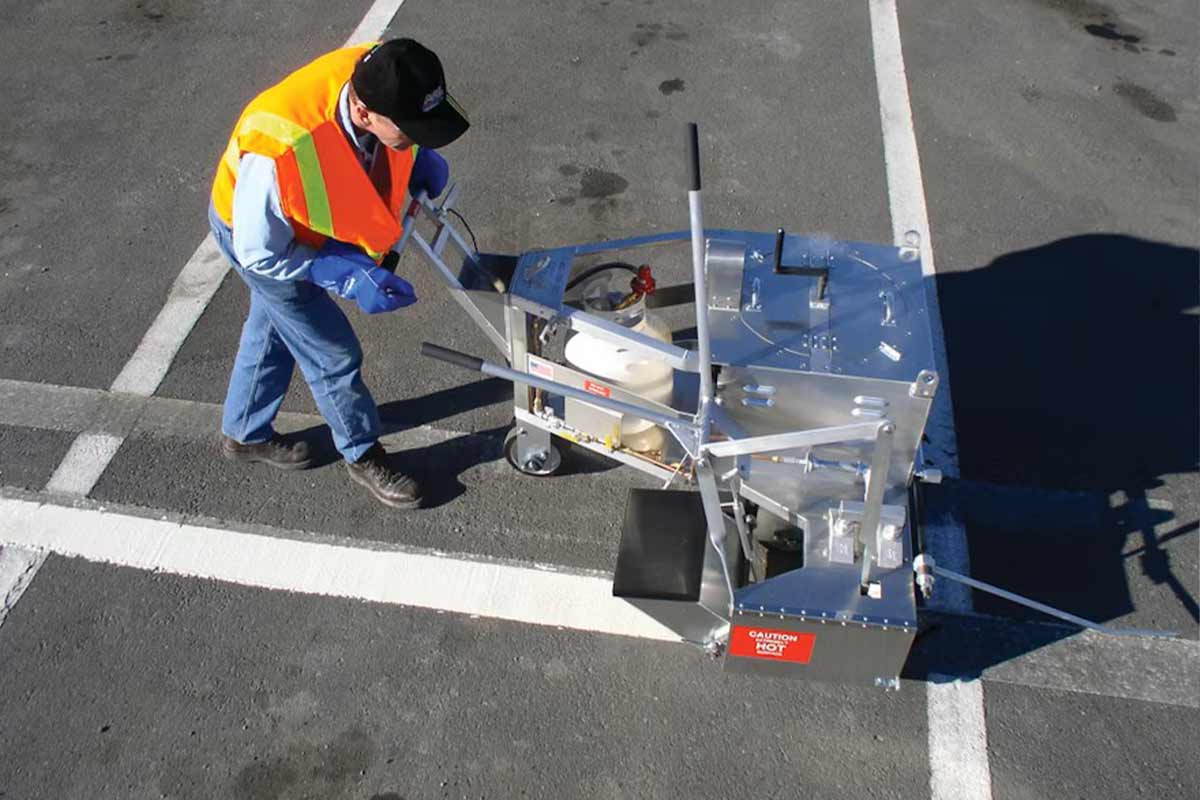
Thermoplastic is a different product from the traffic paint most lots are striped with. It arrives as a solid and goes down hot, so instead of drying on top of the surface it fuses to it and cools into a thick, hard band you can feel with your hand. That thickness is the whole point: a painted line is a thin film on the asphalt, while a thermoplastic line is a raised marking with glass beads locked into it for night visibility. We use it on Treasure Valley properties where a marking has to survive traffic that would wear paint off in a season — stop bars, crosswalks, and arrows that take a tire every few seconds.
The Spec Idaho Writes for Its Own Highways
Idaho publishes exactly what a thermoplastic marking has to be. The Idaho Transportation Department’s 2023 Standard Specifications for Highway Construction, Section 630, is the state’s pavement-marking specification, and Section 630.02 sets the material requirement in one line: “Provide preformed thermoplastic meeting AASHTO M 249.”
Section 630.03.B is where the numbers live. For preformed thermoplastic, ITD requires a minimum marking thickness of 125 mils, a minimum retroreflectivity of 325 millicandelas per square meter per lux for white and 200 for yellow (tested per ASTM E1710), and a minimum skid resistance of 45 British Pendulum Number (tested per ASTM E303). Application method is left to the manufacturer’s written installation instructions — ITD deliberately doesn’t dictate a temperature, because that belongs to the material you’re actually installing. Glass beads get their own requirement in Section 720.08: AASHTO M 247 Type I, with a moisture-resistant coating specifically for thermoplastic markings.
Two honest caveats about all of that. First, Section 630 governs ITD’s own highway construction contracts. It is not a code that binds your parking lot, and we won’t tell you otherwise. Second, those numbers describe what the state buys for highway work — a commercial parking lot is a different job, and the right thickness and material for your site is a conversation, not a spec you inherit from a highway contract. We cite ITD because it’s the clearest published answer in Idaho to “what is this material actually supposed to be,” and because you deserve a reference point that isn’t a contractor’s sales sheet. Ask us what we’re proposing to install on your lot and we’ll tell you plainly.
Thermoplastic vs. Traffic Paint
Thermoplastic is not a replacement for paint everywhere, and we won’t sell it as one. It costs more to install and it’s the right call in specific places, not across an entire lot by default.
Paint is the sensible choice for standard stall lines — long, straight runs that tires roll across but rarely turn on. It goes down fast, it’s economical over a big lot, and refreshing it on a maintenance cycle is straightforward. Thermoplastic earns its place where wear concentrates and a faded marking creates a real problem: stop bars, crosswalks, directional arrows, and the legends at entrances and drive aisles. Those take the most abuse and are the ones a driver most needs to see.
You’ll see “lasts six to eight times longer than paint” thrown around in marketing copy for this product. We’d rather be straight with you: thermoplastic is meaningfully more durable than paint in high-wear spots, but no one can hand you a multiplier that’s true for your lot. How long a marking lasts depends on traffic volume, the pavement underneath, sun exposure, and how often a plow blade crosses it. We’ll look at your lot and tell you which markings justify the material and which don’t.
Where Thermoplastic Makes Sense in the Treasure Valley
The Boise area is hard on pavement markings in a particular way. Summers put months of intense high-desert sun on the surface, winters run pavement through repeated freeze-thaw, and plowed storms drag a steel edge across every line in the lot. Together that’s why Treasure Valley lots often need refreshing on a shorter cycle than lots in milder climates.
That’s the case for using thermoplastic selectively rather than everywhere. On surfaces that get plowed, a raised marking takes the blade directly — so pavement condition and the plow pattern matter as much as the material choice, and we’ll walk the lot with you before recommending it. Where it consistently pays off is the high-turnover retail and industrial sites around Boise, Meridian, Nampa, and Caldwell: entrance arrows, stop bars at exits, and crosswalks between the lot and the door, where the marking is doing safety work every day.
We install thermoplastic for retail centers, office and medical parks, industrial and warehouse properties, HOAs and apartment communities, schools, and municipal sites — commercial work only. We can phase the work overnight or in sections so a busy lot never fully closes. Call (208) 480-1025 for a free estimate.
For a full list of our pavement marking services, visit our parking lot striping in Boise page.
Businesses We Serve




How it Works

GET A FREE ESTIMATE
Contact us today and we’ll have a quote to you in 24 hours

SCHEDULE AN INSTALLATION
We’ll have your installation scheduled restriped in less than 7 days, without affecting your business hours

GET A PARKING LOT THAT POPS
For a budget-friendly price, you’ll get a parking lot that looks like new
We proudly work with:


We proudly work with:

Frequently Asked Questions About Thermoplastic Striping in Boise, ID
What is thermoplastic striping, and how is it different from painted lines?
Thermoplastic arrives as a solid and is applied hot, so it fuses into the pavement and cools into a thick, raised band rather than drying as a thin film on top. Idaho’s own highway specification gives you a sense of the difference in scale: the Idaho Transportation Department’s Standard Specifications, Section 630.03.B, require preformed thermoplastic markings to be at least 125 mils thick. Paint sits on the surface; thermoplastic bonds into it.
What standard does thermoplastic have to meet in Idaho?
On state highway work, the Idaho Transportation Department’s Standard Specifications Section 630.02 require “preformed thermoplastic meeting AASHTO M 249,” and Section 630.03.B sets a minimum 125 mil thickness, minimum retroreflectivity of 325 millicandelas per square meter per lux for white markings and 200 for yellow (per ASTM E1710), and minimum 45 British Pendulum Number skid resistance (per ASTM E303). Worth being clear: that’s ITD’s specification for its own highway contracts, not a code binding your parking lot, and a commercial lot is a different job from a highway. We point to it because it’s the clearest published answer in Idaho to what this material is supposed to be. For what we’d install on your specific lot, ask us and we’ll tell you plainly.
How much longer does thermoplastic last than paint?
Longer in high-wear spots — but we won’t give you a multiplier. You’ll see “six to eight times longer than paint” in marketing copy for this product, including on some of our own network pages, and we’d rather be straight: how long any marking lasts on your lot depends on traffic volume, the pavement underneath, sun exposure, and how often a plow crosses it. We’ll look at your lot and tell you which markings justify the material.
Should I use thermoplastic for my whole parking lot?
Usually not, and we’ll say so. Standard stall lines are long straight runs that tires roll across but rarely turn on — paint is the sensible, economical choice there. Thermoplastic earns its cost where wear concentrates and a faded marking becomes a safety problem: stop bars, crosswalks, directional arrows, and entrance legends. Using it selectively is how you get durability where it matters without paying for it where it doesn’t.
Does thermoplastic hold up to snowplows in the Treasure Valley?
It’s a real consideration, and it cuts both ways. Thermoplastic resists the tire scuffing and turning wear that strips paint, but it’s also a raised marking, so a plow blade contacts it directly. How it fares depends on your pavement’s condition and how the lot gets plowed. We walk the lot before recommending it rather than applying a blanket rule — on some Boise-area sites it’s clearly the right material, and on others we’ll tell you paint on a shorter cycle is the better spend.
Can you apply thermoplastic over my existing painted lines?
The surface has to be right first. Thermoplastic bonds mechanically into the pavement’s texture, so it needs a clean, sound, dry surface to key into — loose material, heavy paint build-up, sealer, or crumbling asphalt all work against that bond. We assess the surface, prep it, and tell you honestly if the pavement needs attention before a long-life marking is worth installing. Putting a durable material over a failing surface just buys you a durable marking on top of a short-life lot. Call (208) 480-1025 for a free estimate.