
ADA Parking Lot Striping
In SE Boston, MA
ADA-Compliant Accessible Parking
1-800-STRIPER® provides ADA-compliant parking lot striping in SE Boston, MA — installing accessible spaces, van-accessible stalls, access aisles marked with diagonal stripes, ISA symbols, and required signage per the 2010 ADA Standards for Accessible Design and 521 CMR 23.00.
1-800-STRIPER® of SE Boston PROVIDes ADA Parking Lot Striping Services NEAR YOU
Need to make your property more accessible?
Upgrade your facility to become fully ADA compliant by partnering with us to create clear, accessible parking for all your visitors.
Our ADA Compliant line striping services include:
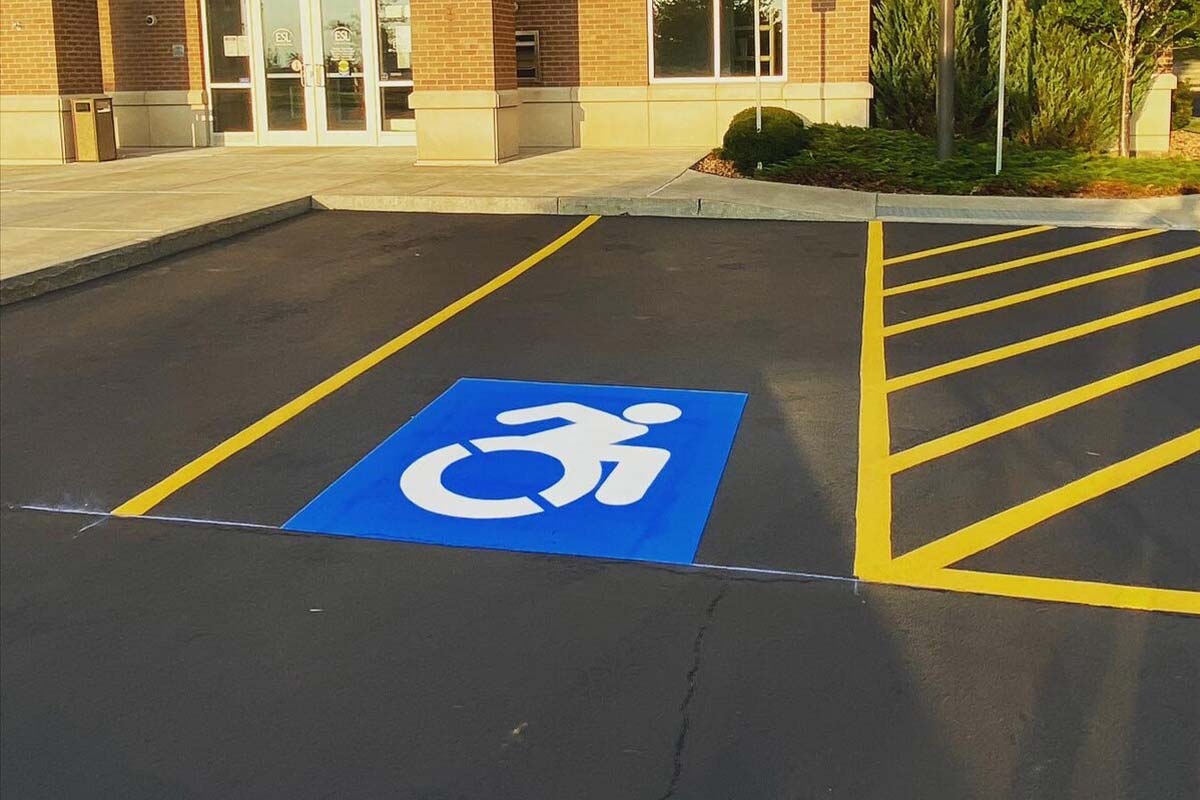
Need to make your property more accessible?
Preserved heading and the existing four-item service list beneath it. Body copy expanded below rather than replaced.
Accessible parking is the part of a lot that gets looked at hardest and repainted least. A stall that was compliant when the lot was first laid out can fall out of compliance simply by fading, because a marking nobody can see is not a marking. We install and refresh accessible spaces, van-accessible stalls, access aisles, International Symbol of Accessibility pavement symbols, and the signage that has to accompany them, on commercial and municipal properties across Brockton, Quincy, Braintree, Randolph, and the surrounding towns.
ADA Parking Requirements in SE Boston, MA
A Massachusetts lot answers to two documents at once, and they do not cover the same ground.
When they attach is worth settling first, because the answer differs for a new lot and an old one. The 2010 Standards govern what a compliant space looks like where a facility is newly built or altered. On an existing lot that is not being altered, a business serving the public instead carries a continuing obligation to remove barriers where that is readily achievable. Restriping is the point at which the question usually gets asked, and our restriping page covers what it brings into scope.
The 2010 ADA Standards for Accessible Design are federal and set the counts and the geometry. Section 208.2.4 requires at least one in every six accessible spaces to be van-accessible. Section 502.3.3 requires that access aisles be marked so as to discourage parking in them.
Then federal law stops short, deliberately. Advisory 502.3.3 states that the method and color of marking “are not specified by these requirements but may be addressed by State or local laws or regulations.” That is an explicit handoff, and most states never pick it up.
Massachusetts does. 521 CMR 23.00: Parking and Passenger Loading Zones, administered by the Massachusetts Architectural Access Board, answers the question the federal advisory leaves open. Section 23.4.6(e) requires that access aisles “shall be clearly marked by means of diagonal stripes.” Section 23.4.5 requires the space itself to be delineated in a color contrasting with the surface.
The dimensions come from the same chapter. Section 23.4.6(b) sets a five-foot access aisle for a car space and an eight-foot aisle for a van space. Section 23.4.7 carries a Massachusetts-only alternative that lets a lot build every accessible space eleven feet wide with a five-foot aisle instead of mixing car and van widths.
Placement is regulated too, and this is the requirement we most often find missed on an older lot. Section 23.3.3 requires accessible spaces to be located closest to the accessible entrance, and “in no case, more than three spaces from the accessible entrance.” Where no space can be placed within two hundred feet, a drop-off area within one hundred feet is required instead.
Our ADA Striping Process
- Measure what exists. Stall widths, aisle widths, the distance from each accessible space to the accessible entrance, and the slope. Numbers first, opinions after.
- Count against the total. The required number of accessible spaces is driven by the size of the parking facility, and the van share follows the federal one-in-six rule.
- Confirm placement. If accessible spaces sit further than three spaces from the accessible entrance, relocating them is part of the work, not an optional extra.
- Lay out aisles and stripe. Access aisles marked with diagonal stripes per 521 CMR 23.4.6(e), stall outlines in a contrasting color.
- Symbols and signage. Pavement symbols and the upright signage each space requires, positioned so a parked vehicle does not obscure them.
- Walk it with you. We hand over what was measured and what changed, so the next repaint starts from a record instead of a guess.
For a full list of our pavement marking services, visit our parking lot striping in SE Boston page.
Businesses We Serve




How it Works

GET A FREE ESTIMATE
Contact us today and we’ll have a quote to you in 24 hours

SCHEDULE AN INSTALLATION
We’ll have your installation scheduled in less than 7 days, without affecting your business hours

GET A PARKING LOT THAT POPS
For a budget-friendly price, you’ll get a parking lot that looks like new!
We proudly work with:


We proudly work with:


Frequently Asked Questions About ADA Parking Lot Striping in SE Boston, MA
How does Massachusetts want an access aisle marked?
With diagonal stripes. 521 CMR 23.4.6(e) states that access aisles “shall be clearly marked by means of diagonal stripes,” and 521 CMR 23.4.5 requires the accessible space itself to be delineated in a color that contrasts with the surface. This is one of the few places where a state answers a question federal law explicitly leaves to state and local regulation, so a lot marked to the federal minimum alone can still fall short here.
How many van-accessible spaces does our lot need?
Under section 208.2.4 of the 2010 ADA Standards, at least one in every six accessible spaces must be van-accessible, and every parking facility needs at least one. The total number of accessible spaces scales with the size of the facility. We count against your actual stall total rather than an assumed one, because lots are rarely the size the site plan says they are.
Where do accessible spaces have to be located?
As close to the accessible entrance as the layout allows. 521 CMR 23.3.3 requires them to be the closest spaces and, in its own words, “in no case, more than three spaces from the accessible entrance.” If no space can be placed within two hundred feet of the entrance, the regulation calls for a drop-off area within one hundred feet instead. On older lots this is the requirement we most often find unmet.
How wide does an access aisle need to be?
521 CMR 23.4.6(b) sets five feet for a car space and eight feet for a van space. Massachusetts also allows an alternative under 521 CMR 23.4.7: build every accessible space eleven feet wide with a five-foot access aisle, and the mixed car and van widths are not needed. Which approach suits a lot usually comes down to how much width the existing bays give you.
Our ADA stalls have just faded. Is that a compliance problem?
It is the most common compliance gap we find. The requirements describe markings that are present and legible — diagonal striping on the aisle, contrasting delineation on the space, a visible pavement symbol. A stall worn to a ghost outline satisfies none of that, no matter how correct the original layout was. On an existing lot the duty that reaches it is barrier removal, owed where it is readily achievable, so refreshing ADA parking lot striping in SE Boston, MA is usually the simplest way to close the gap.
Do we need signs as well as paint?
Yes. Pavement markings and upright signage work together, and paint alone does not carry an accessible space. Signage has to stay visible when the space is occupied, which is why mounting height and position matter as much as the sign itself. We install signage as part of the striping work rather than leaving it as a separate trade for you to chase.