Parking Lot Restriping
In Chicago Suburbs, IL
Restripe Existing Lines and Markings
1-800-STRIPER® provides professional parking lot restriping in Chicago Suburbs, IL — refreshing faded stalls, ADA spaces, fire lanes, and directional arrows worn down by Chicago-area freeze-thaw cycles, using fast-dry traffic paint for commercial properties across the suburbs.
1-800-STRIPER® of Chicago Suburbs Provides Parking Lot Restriping Services NEAR YOU
Need to brighten up your faded parking lot?
Keep your parking lot safe and attractive by restriping annually to freshen up lines and symbols that have faded from the sun, weather, and traffic. Nothing beats a fresh coat of paint!
Benefits:
When faded markings become a code problem
Most restriping is scheduled because the lot looks tired. That is a perfectly good reason. But on a commercial property in the suburbs there are markings whose legibility is not a matter of appearance, and knowing which ones they are changes how you prioritize the work.
Fire lanes carry a continuous duty. International Fire Code section 503.3 requires that the means by which fire lanes are designated be maintained in a clean and legible condition at all times, and be replaced or repaired when necessary to provide adequate visibility. That is not an installation requirement that was satisfied once. It is a standing obligation, and it is the clearest example of a marking whose fading is a compliance question rather than a cosmetic one. Section 503.4 reinforces it: access roads may not be obstructed in any manner, including the parking of vehicles, and the minimum widths and clearances established in sections 503.2.1 and 503.2.2 must be maintained at all times. A lane nobody can see is a lane nobody can be told they are blocking.
Which edition of the IFC applies is a municipal question in Illinois — the state has no statewide adopted fire code for apparatus access, and each village or city adopts an edition by ordinance with its fire department as the authority having jurisdiction. The maintenance language in 503.3 has been stable across recent editions, so the duty holds regardless of which year your town is on.
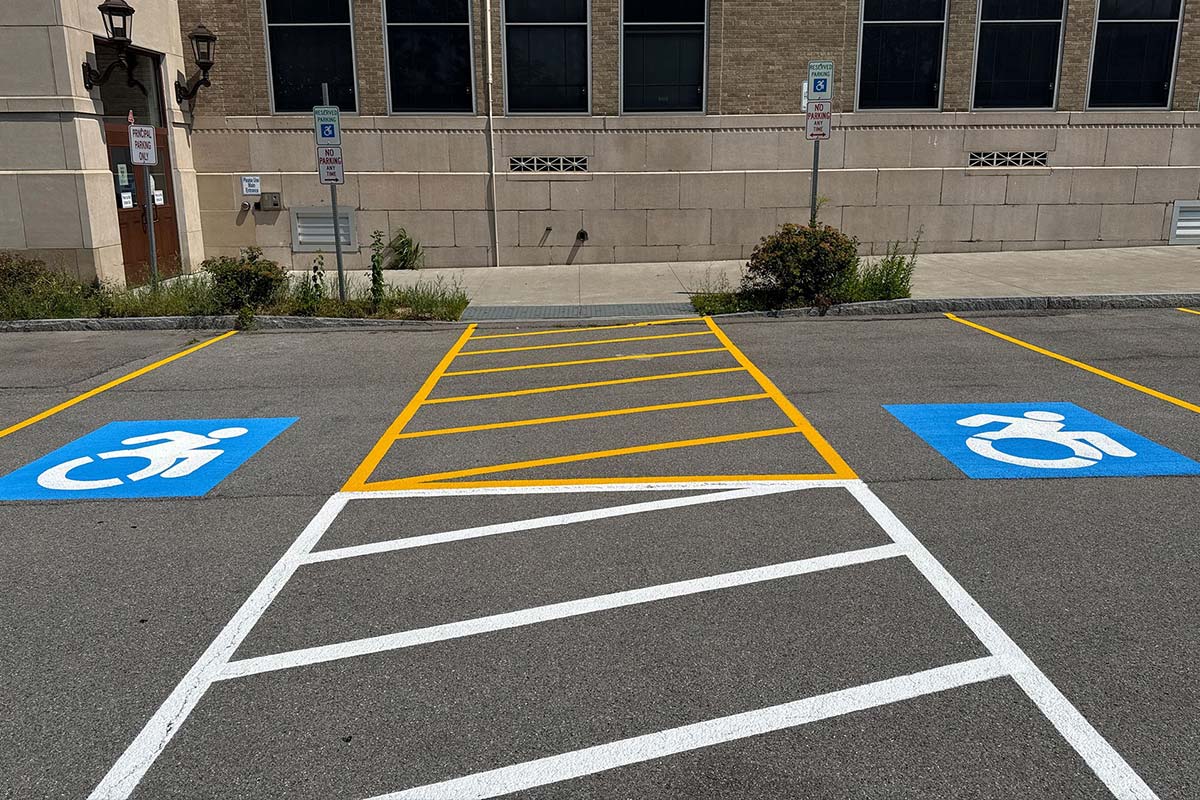
Accessible parking stops working when the geometry stops being legible. The 2010 ADA Standards define an accessible space by dimensions that are expressed in paint: section 502.2 sets the minimum widths, and section 502.3 requires the access aisle to be at least 60 inches wide, to run the full length of the space, and to be marked so as to discourage parking in it. When the hatching in an access aisle wears away, drivers park in it, and the space stops delivering what the standard requires. The same applies to the boundary lines that define the space width — an accessible space is 96 inches wide because it is marked at 96 inches, and an unmarked edge is not a dimension.
The Department of Justice has published informal guidance addressed to this exact job, and its position is that “because restriping is relatively inexpensive, it is readily achievable in most cases” — that is, a restripe is the natural moment to bring an accessible space up to the current standard rather than to reproduce an old one. That guidance is informal: DOJ states plainly that its guidance documents have no legally binding effect and no force or effect of law. The duties themselves come from 28 CFR 36.304(a), which requires a public accommodation to remove barriers in an existing facility where that is readily achievable, and 28 CFR 36.402, which requires an alteration to be made accessible to the maximum extent feasible. What the guidance tells you is how the enforcing agency thinks about the work, which is worth knowing before you decide whether a restripe reproduces the old layout or corrects it.
Everything else is about how the lot works. Directional arrows, stop bars, crosswalks, do-not-block hatching at loading doors, and no-parking zones at hydrants and dumpster enclosures are what keep a busy lot orderly. They fade at different rates because they take different traffic — an arrow at a lot entrance sees every vehicle that comes in and goes first, while a stall line in an under-used corner may look new for years.
A practical order of priority. When a budget will not cover the whole lot in one season, we sequence it: fire lanes and accessible parking first because they carry duties, then the circulation markings that prevent conflicts, then the general stall lines. That is the sequence we recommend, and we will say so even when it means a smaller job this year.
A note on what does not govern your lot. The Manual on Uniform Traffic Control Devices is the national standard for traffic control devices on streets, highways, bikeways, and private roads open to public travel, under 23 CFR 655.603(a). A private commercial parking lot is not in that category, and Illinois adopts the National MUTCD with a state supplement published by IDOT for the roadway network. We follow MUTCD conventions on arrow shapes, crosswalk patterns, and color because drivers already know how to read them, and consistency is worth having — but we do not tell property owners that the MUTCD requires anything of their lot, because it does not.
Chicago-area freeze-thaw and marking life
Markings in the Chicago suburbs do not wear the way markings in a mild climate wear, and the reason is winter.
The mechanism. Pavement markings fail from a combination of abrasion, chemical attack, and the movement of the surface underneath them. Illinois winters supply all three. Temperatures cross the freezing point repeatedly through the season, so water in the pavement and in every crack freezes and expands and thaws again on a cycle rather than staying frozen; that movement works on the bond between the marking and the surface. Snowplow blades scrape across the lot at the height of the marking, which is exactly the wrong height. De-icing salt and brine sit on the surface in solution and get carried across it by tires. And traffic continues through all of it.
The result is that the lot you restriped in September can look distinctly worse in April, and the wear is not uniform: entrances, drive aisles, and turning areas go first, plow paths lose whole runs of line, and stalls in the far corners of the lot look almost untouched. That unevenness is the diagnostic. A lot that has faded evenly is at the natural end of a paint cycle; a lot with bare drive aisles and crisp perimeter stalls has been plowed hard.
What that means for scheduling. The practical striping season in Illinois runs from spring through fall, because traffic paint needs dry pavement and surface temperatures above the product minimum. That gives a real choice about when in the season to book. Spring restriping restores a lot after the winter and looks its best through the busy months, which is why most retail, medical, and association properties choose it. Fall restriping goes into winter fresh and takes the first season’s punishment immediately. Neither is wrong, and if a property has an event, an inspection, a lease-up, or a sale on the calendar, that date should drive the decision rather than a rule of thumb.
What extends marking life. The largest factor is the surface itself. Paint applied to a clean, sound, dry surface bonds properly; paint applied over dirt, oil, loose sealer, or a marking that is already failing does not, and it comes off with the thing it was painted onto. We clean and prepare before painting rather than painting over the problem. Where a lot is due for sealcoating or an asphalt overlay, that work belongs first and the striping goes on last — restriping a lot that is about to be sealed is money spent twice.
We are not going to give you a number of years. Marking life on a suburban commercial lot depends on traffic volume, plow contractor, salt regime, surface condition, and the product used, and any single figure would be a guess dressed as a fact. What we will do is look at your lot, tell you which markings are near the end and which have life left, and give you an honest sequence.
We restripe lots across DuPage, Cook, Kane, Will, and Kendall counties, including Naperville, Aurora, Schaumburg, Joliet, Bolingbrook, Wheaton, Elmhurst, Carol Stream, West Chicago, Lombard, and Glendale Heights.
Layout changes at restriping time
A restripe follows the layout that is already there. That is what makes it fast and inexpensive — and it is also why a restripe is the moment to ask whether the existing layout is still the right one, because the cost of changing it is never lower than when the lot is already being marked.
When the answer is yes, keep it. A layout that works, in a lot whose use has not changed, should be refreshed as-is. Most restriping is exactly this.
When it is worth revisiting. Several things should trigger the question:
- The accessible parking count no longer matches the lot. If spaces have been added or removed since the last layout, the required accessible count from section 208.2 of the 2010 ADA Standards may have moved with it, and the van-accessible ratio under 208.2.4 applies on top of the count. Restriping to the old count locks in a shortfall for another cycle.
- Accessible spaces are in the wrong place. Section 208.3.1 puts accessible parking on the shortest accessible route to an accessible entrance. If the entrance moved, or a tenant fit-out changed which door people use, the accessible spaces should move with it.
- The tenant mix changed. A retail center that gained a restaurant or a medical suite has a different demand curve and different turnover than it had before, and the stall angle and circulation that served the old mix may not serve the new one.
- Traffic conflicts keep happening in the same place. If there is one corner where near-misses cluster, that is a layout problem and repainting the same lines will not fix it.
- You need more capacity. Changing stall angle, converting a two-way aisle to one-way, and reclaiming dead corners can add spaces without touching the pavement. Whether the trade in circulation quality is worth it is your call, and we will show you both counts.
- Fire access has changed. New construction, an addition, a fence, or a dumpster enclosure can compromise an apparatus access route that used to be clear. That belongs in front of the fire prevention bureau, not in a paint decision.
Adding markings while the crew is on site. Restriping is also the natural time to add what the lot is missing: EV charging stall markings, expectant-mother or curbside-pickup spaces, numbered stalls for a condominium or association property, loading zones, speed humps, and directional arrows at a confusing entrance. Adding them during a scheduled restripe avoids a second mobilization.
Association and condominium properties. Association lots have a particular pattern — resident stalls that need to stay numbered and assigned, visitor parking that has to remain findable, and a board that needs the work scheduled around residents rather than around a retail closing time. We plan the sequence in sections so residents always have somewhere to park, and we confirm the numbering scheme against the association’s own records before we paint it rather than reading it off faded pavement.
Removal. Where a layout genuinely changes, the old lines have to come off rather than simply be painted around, or the lot ends up with two contradictory sets of markings and drivers follow whichever they see first. Marking removal is part of the scope on any real re-layout, and it should be quoted as such rather than discovered afterward.
For a full list of our pavement marking services, visit our parking lot striping in Chicago Suburbs page.
Businesses We Serve




How it Works

GET A FREE ESTIMATE
Contact us today and we’ll have a quote to you in 24 hours

SCHEDULE AN INSTALLATION
We’ll have your installation scheduled in less than 7 days, without affecting your business hours

GET A PARKING LOT THAT POPS
For a budget-friendly price, you’ll get a parking lot that looks like new
We proudly work with:


We proudly work with:

Frequently Asked Questions About Parking Lot Restriping in Chicago Suburbs, IL
How often should a parking lot be restriped?
There is no fixed interval, and anyone quoting one across all lots is guessing. Marking life depends on traffic volume, how the lot is plowed and salted, the surface condition, and the product used. What is fixed is the condition standard for certain markings: fire lane designations must be kept clean and legible at all times under International Fire Code section 503.3, and accessible spaces stop meeting the 2010 ADA Standards once the lines and access-aisle hatching that define them are no longer legible. We walk the lot and tell you what is near the end.
What is the difference between striping and restriping?
Striping lays out and paints markings on a surface that has none or that is getting a new layout — new pavement, an expansion, a redesign. Restriping refreshes the markings already there, following the existing layout. Restriping needs less layout work, which is why established properties are usually on a restriping cycle.
When is the best time of year to restripe in the Chicago suburbs?
The practical season runs spring through fall, because traffic paint needs dry pavement and surface temperatures above the product minimum. Spring restores the lot after winter and carries it through the busy months; fall goes into winter fresh. If you have an inspection, an event, a lease-up, or a sale on the calendar, let that date drive the choice.
Do you have to close the whole lot?
No. We work in sections so the property keeps functioning, closing one area at a time and reopening it once the paint has dried enough to take traffic. On retail and medical properties that usually means working early, late, or on a weekend; on association properties it means sequencing so residents always have somewhere to park.
Can you restripe over the existing lines?
Where the existing marking is sound and the layout is not changing, yes — that is what restriping is. Where the old paint is failing, or where the layout is actually changing, the old lines have to be removed first. A new line painted onto a failing one fails with it, and a new layout painted around an old one leaves drivers two sets of instructions.
Should we sealcoat before restriping?
If the lot is due for sealcoating or an asphalt overlay, that work comes first and the striping goes on last. Sealcoat covers markings completely, so restriping a lot that is about to be sealed is money spent twice — and it is a surprisingly common sequence error when the two jobs are booked with different contractors who are not talking to each other. If no surface work is planned, restriping stands on its own. If you are unsure whether your lot needs sealcoating, that is worth settling before the striping is scheduled rather than after.
Can you change our layout while you restripe?
Yes, and a restripe is the cheapest moment to do it. Common changes are adding accessible spaces to meet the count required by section 208.2 of the 2010 ADA Standards, relocating accessible spaces onto the shortest accessible route to the entrance under section 208.3.1, changing stall angle to add capacity, adding EV or curbside-pickup stalls, and renumbering association parking. We measure the lot, show you the plan, and paint once you approve it.
Do you work with condominium and homeowner associations?
Yes. Association and condominium properties are a regular part of our work across the western and northwestern suburbs. The differences that matter are practical ones — assigned and numbered resident stalls, visitor parking that has to stay findable, and scheduling that works around residents rather than around business hours. We confirm the numbering against the association’s records before painting rather than reading it off faded pavement, and we sequence the lot in sections so nobody is left without a space.