Fire Lane Striping
In Chicago Suburbs, IL
Fire Lane and Fire Curb Striping Services
1-800-STRIPER® provides professional fire lane striping in Chicago Suburbs, IL — marking fire apparatus access roads, red curbs, and no-parking fire lane zones to the International Fire Code edition your municipality has adopted, kept clean and legible as § 503.3 requires.
1-800-STRIPER® of Chicago Suburbs Provides Fire Lane Striping Services NEAR YOU
Is your parking lot ready for first responders?
Our team is well-versed in local fire regulations and will partner with you to design a fire lane striping plan that creates unobstructed emergency access to protect your customers and property.
Core Services:
Which fire code governs your suburb
There is no single Illinois fire code for parking lot fire lanes, and this is the single most useful thing to know before anyone paints anything.
Illinois has no statewide adopted fire code covering fire apparatus access. The Office of the Illinois State Fire Marshal adopts the NFPA 101 Life Safety Code at the state level, but apparatus-access roads and their marking are governed locally: each municipality across Cook, DuPage, Kane, Will, and Kendall counties adopts an edition of the International Fire Code by its own ordinance, and its fire department or fire protection district enforces it as the authority having jurisdiction.
That means the edition in force is a property-by-property question. To show that this is a real difference and not a hedge, here is one verified example from a town we serve:
> City of Naperville — the Naperville Fire Department publishes its adopted codes directly, and the list names the International Fire Code, 2018 edition, alongside the Naperville Municipal Code as amended, the National Fire Codes, and NFPA 101 (2006 edition). Read first-party from the city’s own fire alarm requirements page, 2026-08-04.
Neighboring towns are on their own ordinances and their own adoption cycles, and several have moved to later editions. We do not publish an edition for a village we have not read, because a confidently wrong code year is worse than no code year. What we do instead is check the adopting ordinance for the municipality your property sits in, and confirm the local requirements with the fire prevention bureau before laying out the lane — the AHJ is the one who signs off, and their local amendments are the part no model code will tell you.
For a property owner the consequence is simple. If a contractor tells you what your fire lane must look like without first asking which town you are in, they are quoting a template rather than your code.
Fire lane dimensions, marking, and signage
Two different authorities are at work here: the International Fire Code sets the road, and your AHJ sets the paint.
Start with the road. Under IFC section 503.1.1, an approved fire apparatus access road must extend to within 150 feet of all portions of the facility and of the exterior walls of the first story, measured by an approved route around the building. Section 503.2.1 requires that road to have an unobstructed width of not less than 20 feet and an unobstructed vertical clearance of not less than 13 feet 6 inches. Section 503.2.3 requires the surface to support the imposed loads of fire apparatus and to be surfaced for all-weather driving. Dead-end access roads longer than 150 feet need an approved turnaround under section 503.2.5, and the required turning radius is set by the fire code official rather than by a fixed number in the code.
Dimensions like these are why fire lane striping is a layout job before it is a painting job. The lane has to be wide enough after the striping, not before it — a 20-foot requirement met only when no one is parked along the edge is not met.
Now the marking. Section 503.3 is short and worth quoting properly, because it is routinely paraphrased into something stronger or vaguer than it says:
> Where required by the fire code official, approved signs or other approved notices or markings that include the words NO PARKING—FIRE LANE shall be provided for fire apparatus access roads to identify such roads or prohibit the obstruction thereof. The means by which fire lanes are designated shall be maintained in a clean and legible condition at all times and be replaced or repaired when necessary to provide adequate visibility.
Three things follow from the actual text. First, designation is triggered where required by the fire code official — the AHJ decides which access roads get designated. Second, the required wording is NO PARKING—FIRE LANE. Third, and most often missed, the maintenance duty is continuous: markings must be kept clean and legible at all times, and replaced or repaired when necessary for adequate visibility. That is a standing obligation on the property, not a one-time installation.
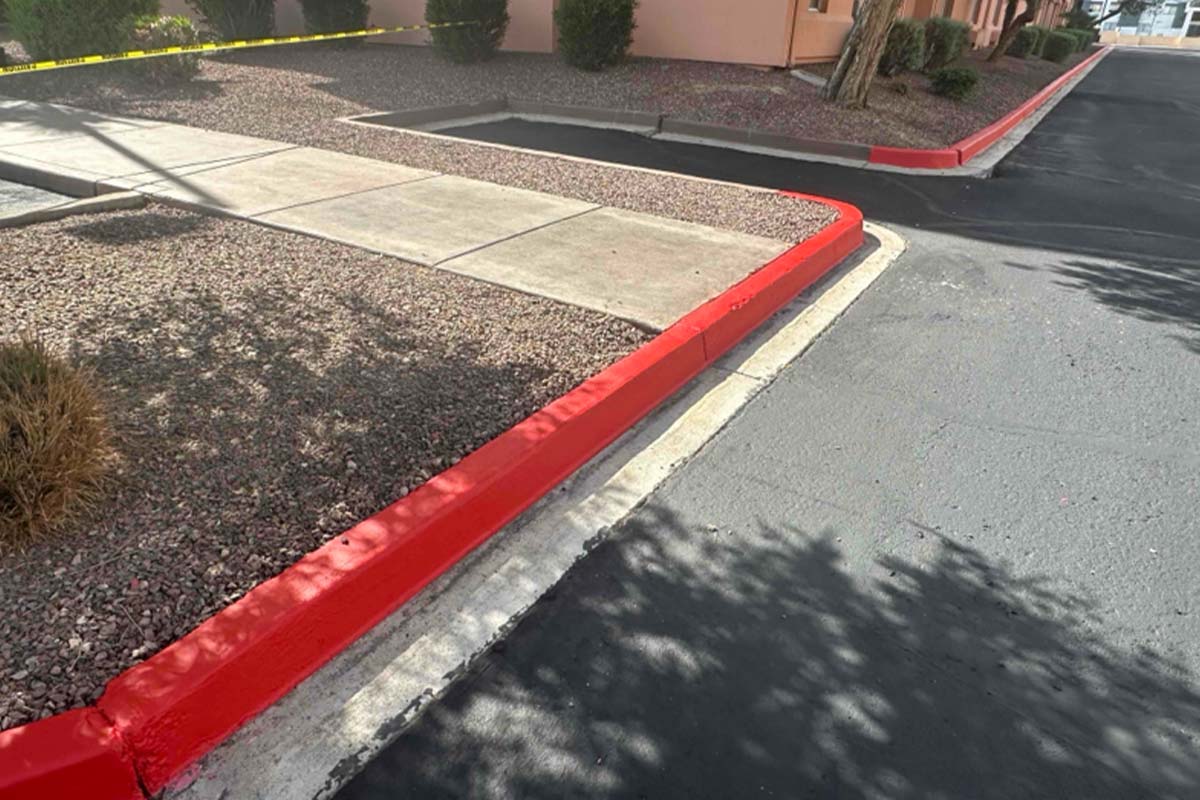
What the code does not specify. IFC 503.3 does not give a color, a stripe width, a letter height, or a spacing interval for signs. Those come from the local AHJ, and they vary between towns. Red curbs and red lane borders with white lettering are near-universal practice in the suburbs, and we paint them that way as the default — but we confirm the local specification rather than presenting a convention as the code.
Obstruction. Section 503.4 prohibits obstruction of fire apparatus access roads in any manner, including the parking of vehicles, and requires the minimum widths and clearances established in sections 503.2.1 and 503.2.2 to be maintained at all times. This is the section that makes the marking worth having: a lane that is not legible is a lane nobody can be told they are blocking.
Towing. Enforcement on private commercial property in Illinois brings in a separate instrument. Before a vehicle can be towed from private commercial property without the owner’s consent, 625 ILCS 5/4-203(f) requires a conspicuous notice sign posted at each entrance — or, where there are no curbs or access barriers, not less than one sign per 100 feet of frontage. That is an alternative, not both. The sign must carry letters at least two inches high, light-reflective on a contrasting background, state that unauthorized vehicles will be towed at the owner’s expense, and give the towing service’s name and current phone number; the bottom of the sign must be at least four feet above the ground and it must have been posted continuously for at least 24 hours before any tow.
We serve commercial, industrial, retail, medical, institutional, and association properties across the western and northwestern suburbs, including Naperville, Aurora, Schaumburg, Joliet, Bolingbrook, Wheaton, Elmhurst, Glendale Heights, and Elgin.
For a full list of our pavement marking services, visit our parking lot striping in Chicago Suburbs page.
Businesses We Serve




How it Works

GET A FREE ESTIMATE
Contact us today and we’ll have a quote to you in 24 hours

SCHEDULE AN INSTALLATION
We’ll have your installation scheduled in less than 7 days, without affecting your business hours

GET A PARKING LOT THAT POPS
For a budget-friendly price, you’ll get a parking lot that looks like new
We proudly work with:


We proudly work with:


Frequently Asked Questions About Fire Lane Striping in Chicago Suburbs, IL
Does Illinois have a statewide fire code for fire lanes?
No. Illinois has not adopted a statewide fire code governing fire apparatus access. The Office of the Illinois State Fire Marshal adopts NFPA 101, the Life Safety Code, at the state level, but fire lane access and marking are adopted and enforced locally — each municipality adopts an edition of the International Fire Code by ordinance and its fire department or fire protection district enforces it.
Which edition of the International Fire Code applies to my property?
Whichever edition your municipality has adopted, which differs between towns and changes as councils update their ordinances. As one verified example, the City of Naperville publishes the 2018 International Fire Code among its adopted codes. We check the adopting ordinance for your town and confirm with the fire prevention bureau rather than assuming a single edition across the suburbs.
How wide does a fire lane have to be?
Under IFC section 503.2.1 a fire apparatus access road must have an unobstructed width of not less than 20 feet and an unobstructed vertical clearance of not less than 13 feet 6 inches. The word doing the work is unobstructed — the clear width has to survive the parking, landscaping, and snow storage around it, which is a layout question as much as a paint question.
What does the code say the fire lane has to say?
Section 503.3 requires approved signs, notices, or markings including the words NO PARKING—FIRE LANE, where the fire code official requires them, to identify the access road or prohibit its obstruction. The code specifies the wording, not the color, letter height, or spacing — those are set by your local authority having jurisdiction.
Do fire lanes have to be red?
The International Fire Code does not say so. Red curbs and red lane markings with white lettering are the prevailing convention across the suburbs and the default we paint unless told otherwise, but the specification that binds you is your AHJ’s, and we confirm it before painting rather than quoting a color as if it came from the code.
How often do fire lanes need to be repainted?
The code sets a condition, not an interval. Section 503.3 requires the means of designating fire lanes to be maintained in a clean and legible condition at all times and replaced or repaired when necessary to provide adequate visibility. In practice, suburban lots that are plowed and salted through the winter lose legibility faster than the same markings would elsewhere, so the honest answer is that the repainting cycle is set by how your lane actually looks, not by a number.
Can we have cars towed from our fire lane?
Towing from private commercial property in Illinois has its own signage prerequisite under 625 ILCS 5/4-203(f), separate from the fire code marking. A conspicuous notice must be posted at each entrance — or, where there are no curbs or access barriers, at not less than one sign per 100 feet of frontage. That is an either-or, not both. The notice needs light-reflective letters at least two inches high on a contrasting background, the towing service’s name and current phone number, and continuous posting for at least 24 hours before any tow.
Can you handle the signs as well as the pavement markings?
Yes. Signage and pavement marking are usually specified together by the authority having jurisdiction, and it is better to install them as one package so that the wording, the placement along the lane, and the mounting height all match what the fire prevention bureau expects to see at inspection. Splitting the two across separate contractors is how properties end up with compliant curbs and non-compliant signs, or with signs whose wording does not match the marking they are supposed to explain. We handle both together and confirm the specification with the bureau before installing either.