Warehouse Line Painting
In Cincinnati, OH
OSHA-Compliant Safety Markings
1-800-STRIPER provides professional warehouse line painting in Cincinnati, OH — OSHA-compliant aisle lines, pedestrian walkways, and safety zone markings per OSHA 1910.22 requirements using durable epoxy and traffic paint for industrial facilities.
1-800-STRIPER® of Cincinnati PROVIDes Warehouse Floor Markings Services NEAR YOU
Want your indoor space to operate more efficiently?
Warehouse and interior markings ensure clear traffic lanes, organized storage zones, and designated spaces designed to help your business operate safely and efficiently.
Benefits:
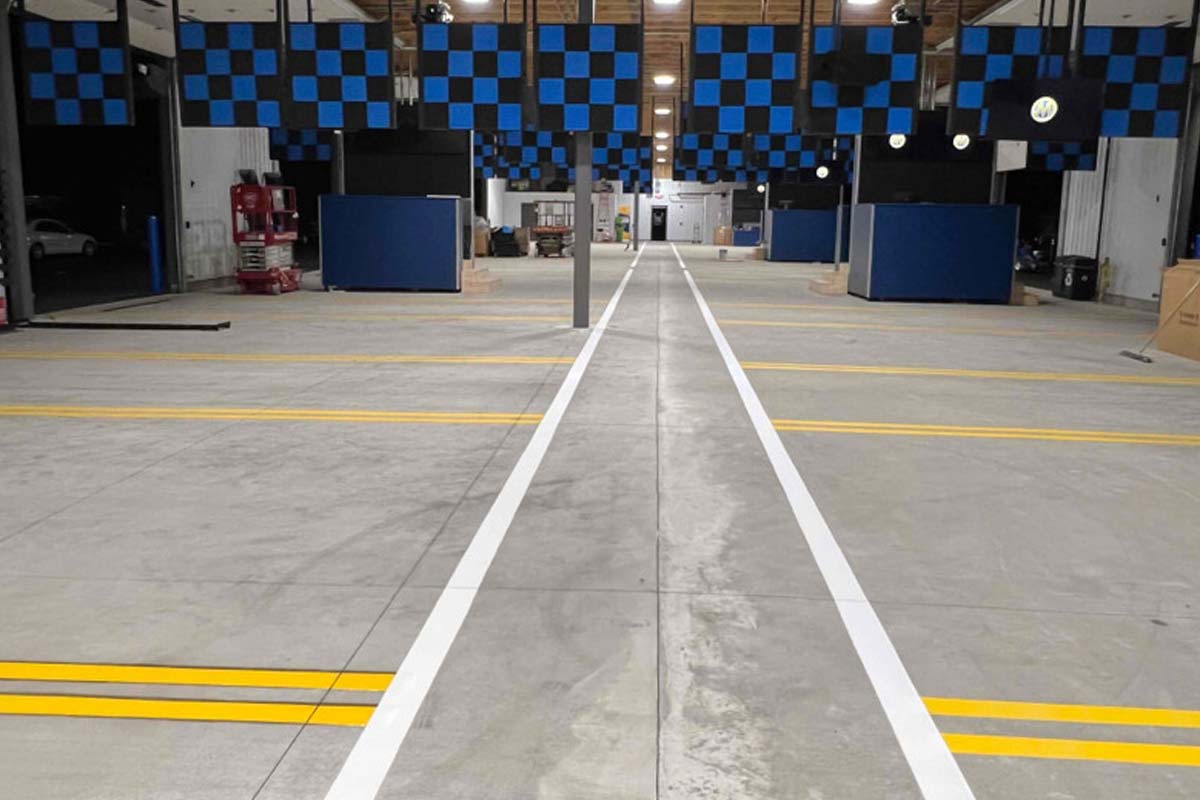
Warehouse Line Painting in Cincinnati, OH
Warehouse line painting marks the floor of an industrial facility for safety and organization — the aisles, pedestrian walkways, forklift travel paths, safety zones, and storage boundaries that keep people and equipment separated and moving. We paint and refresh warehouse floor markings for distribution centers, manufacturing plants, and industrial facilities across Greater Cincinnati.
Good floor markings are a safety system, not just paint. They keep forklifts and foot traffic apart, mark the clearances OSHA requires around equipment and exits, and organize storage so aisles stay clear. In a busy warehouse, faded or missing lines are a hazard and a compliance problem at the same time. We lay out and paint durable markings that hold up to forklift traffic and stay legible on a working floor.
OSHA Aisle-Marking Requirements
Warehouse floor marking is driven by federal safety regulation. OSHA 1910.22, the Walking-Working Surfaces standard, requires that aisles and passageways be kept clear and in good repair, with no obstruction that could create a hazard. OSHA 1910.176(a) adds that where mechanical handling equipment like forklifts is used, sufficient safe clearances have to be allowed for aisles, and permanent aisles and passageways have to be appropriately marked.
OSHA sets the requirement to mark aisles but does not dictate an exact line width, which gives facilities flexibility to size markings to their operation — 2-to-4-inch lines are common, and aisle widths are set to the equipment that uses them. What matters for compliance is that the aisles are clearly and permanently marked, kept clear, and wide enough for safe forklift and pedestrian movement. We lay the markings out to your facility’s traffic pattern and equipment so they meet the standard and actually work on the floor.
Markings We Apply — Aisles, Walkways, Safety Zones, and Labels
A warehouse floor-marking system has several elements, and we apply all of them:
- Aisle lines — the main traffic aisles for forklifts and material movement, marked to your facility’s layout.
- Pedestrian walkways — separated, clearly marked paths that keep people out of forklift traffic.
- Safety and hazard zones — clearances around equipment, electrical panels, eyewash stations, and exits.
- Storage boundaries — floor outlines that keep staged material and racking inside their footprints and out of the aisles.
- Labels and directional markings — bay numbers, directional arrows, stop points, and dock markings.
The layout is the important part — markings only improve safety if they route traffic sensibly and keep clearances where OSHA requires them. We plan the system around how your floor actually operates before we paint.
Color Coding and ANSI Z535.1 Safety Colors
Color is how a floor-marking system communicates at a glance, and the conventions come from two sources. OSHA 1910.144 sets the baseline — red for fire-protection equipment and danger, yellow for caution and marking physical hazards like aisles and traffic paths. The ANSI Z535.1 Safety Color Code expands that into the full palette most warehouses use:
| Color | Common warehouse use |
|---|---|
| Yellow | Aisleways, traffic lanes, general caution |
| Red | Fire equipment, emergency stops, danger |
| Orange | Warning of hazards, energized equipment |
| Green | Safety equipment, first aid, PPE stations |
| Blue | Informational, materials awaiting inspection |
| Black/White | Housekeeping and general marking |
Consistent color coding is what makes a marked floor readable — a worker or a visiting driver can interpret the aisles, hazards, and safety stations without a legend. We apply the color system consistently across the facility so the markings mean the same thing everywhere on the floor.
Our Warehouse Marking Process
Warehouse work is planned around keeping the facility operational.
- Walkthrough. We map the floor with you — traffic patterns, equipment clearances, pedestrian routes, and OSHA-required markings.
- Layout plan. We plan the aisle lines, walkways, safety zones, and color coding to OSHA 1910.22 and ANSI Z535.1.
- Surface prep. We clean the concrete so the paint bonds — critical on a floor that takes forklift traffic.
- Paint. We apply durable floor markings in the coded colors, using epoxy or high-durability traffic paint sized to the wear the area takes.
- Scheduling. We work around your operation — off-shift, weekend, or sectioned — so the floor stays productive during the job.
Paint That Holds Up to Forklift Traffic
Warehouse floors take punishment that parking lots do not — constant forklift wheel loads, pallet-jack traffic, and turning-point abrasion that wears ordinary paint off in months. The paint selection is what determines whether the markings last.
For high-wear areas — main forklift aisles, turning points, dock approaches — durable epoxy floor coatings hold up best, bonding hard to the concrete and resisting the abrasion of wheel traffic. For lower-wear areas and faster turnarounds, high-durability traffic paint is often the practical choice. We match the product to how much traffic each area takes, so the main aisles get the most durable markings and the whole system stays legible on a working floor for as long as possible before it needs a refresh.
For a full list of our pavement marking services, visit our parking lot striping in Cincinnati page.
Businesses We Serve




How it Works

GET A FREE ESTIMATE
Contact us today and we’ll have a quote to you in 24 hours

SCHEDULE A STRIPING
We’ll have your space restriped in less than 7 days, without affecting your business hours

GET A PARKING LOT THAT POPS
For a budget-friendly price, you’ll get a parking lot that looks like new
We proudly work with:


We proudly work with:

Frequently Asked Questions About Warehouse Line Painting in Cincinnati, OH
What does OSHA require for warehouse aisle markings?
OSHA 1910.22 requires that aisles and passageways be kept clear and in good repair, and OSHA 1910.176(a) requires that where forklifts and other mechanical handling equipment are used, permanent aisles and passageways be appropriately marked with sufficient safe clearances. OSHA does not mandate an exact line width, so facilities size the markings to their operation — but the aisles must be clearly and permanently marked and kept clear.
What do warehouse floor-marking colors mean?
The conventions come from OSHA 1910.144 and the ANSI Z535.1 Safety Color Code. Yellow marks aisles, traffic lanes, and general caution; red marks fire equipment, emergency stops, and danger; orange warns of hazards; green marks safety and first-aid stations; blue is informational; and black-and-white is used for housekeeping and general marking. Consistent color coding lets anyone on the floor read the aisles and hazards without a legend.
How wide should aisle lines be?
OSHA does not set a specific line width, which leaves it to the facility — 2-to-4-inch lines are common. What matters more is the aisle width itself, which should be sized to the equipment that uses it so forklifts and pedestrians have safe clearance. We set both the line width and the aisle layout to your equipment and traffic pattern.
What paint holds up to forklift traffic?
For high-wear areas like main forklift aisles, turning points, and dock approaches, durable epoxy floor coatings hold up best — they bond hard to the concrete and resist wheel abrasion. For lower-wear areas and faster turnarounds, high-durability traffic paint is often the practical choice. We match the product to the traffic each area takes so the heaviest-used markings get the most durable paint.
Can you mark walkways and safety zones?
Yes — pedestrian walkways and safety zones are core to a warehouse marking system. We mark separated walkways that keep people out of forklift traffic and paint the clearance zones OSHA requires around equipment, electrical panels, eyewash stations, and exits, all in the ANSI Z535.1 color code so they read consistently across the floor.
Can you work around our operating schedule?
Yes. Warehouse work is planned around keeping you operational — off-shift starts, weekend work, and sectioning the floor so we mark one area while the rest keeps running. We coordinate the schedule so the paint has time to cure in each area before traffic returns to it.