Parking Lot Restriping
In Maple Grove, MN
Restripe Existing Lines and Markings
1-800-STRIPER® provides professional parking lot restriping in Maple Grove, MN — repainting faded stalls, directional arrows, crosswalks, curb paint, accessible stalls, and fire lane markings with durable traffic paint for commercial properties across the northwest Twin Cities metro.
1-800-STRIPER of Maple Grove PROVIDes Restriping Services NEAR YOU
Need to brighten up your faded parking lot?
Keep your parking lot safe and attractive by restriping annually to freshen up lines and symbols that have faded from the sun, weather, and traffic. Nothing beats a fresh coat of paint!
Benefits:
Parking Lot Restriping in Maple Grove, MN
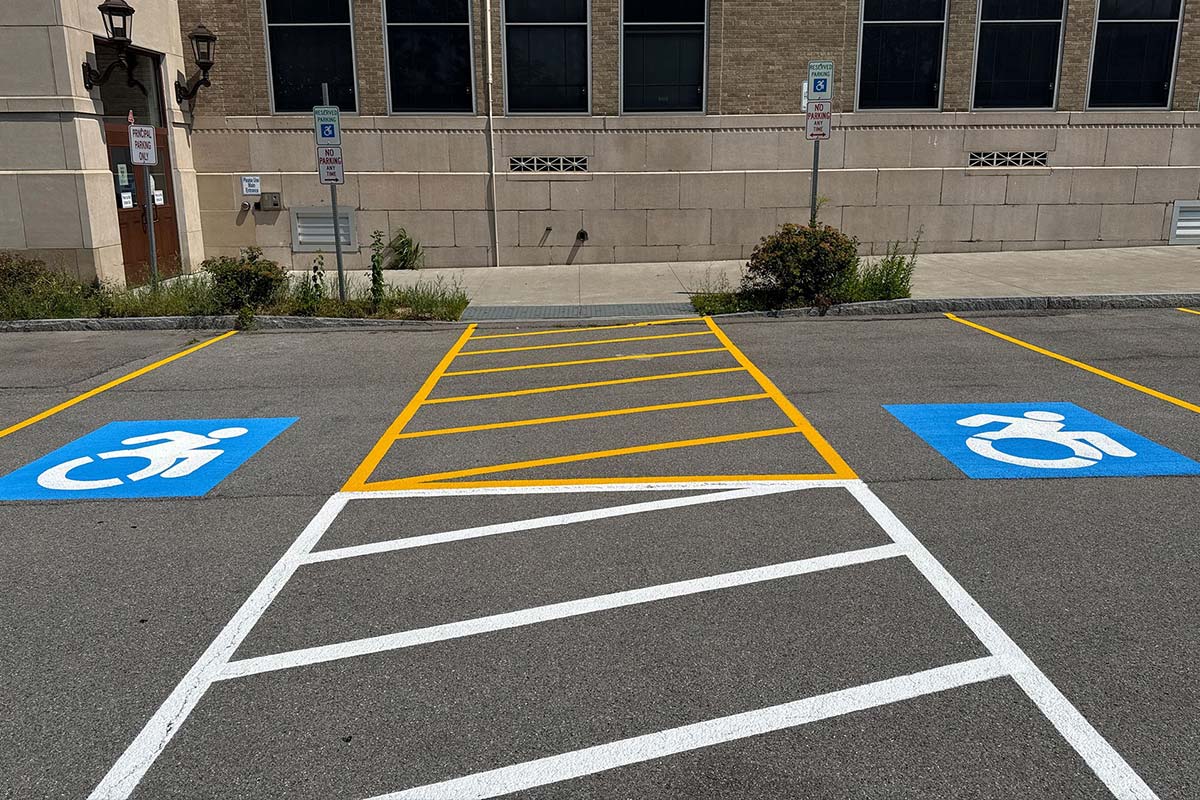
Restriping is repainting the lines you already have. The layout stays; the markings come back to full contrast. Stall lines, directional arrows, stop bars, crosswalks, curb paint, accessible stalls and their access aisles, fire lane markings and no-parking hatching all get refreshed over the existing pattern.
In Minnesota it is closer to scheduled maintenance than to a one-off project. A lot that gets plowed all winter and salted repeatedly will fade faster than the same lot in a milder climate, and faded markings cost you more than curb appeal — they are what keeps a fire lane readable and an accessible stall identifiable.
We restripe retail centers, medical buildings, warehouses, churches, schools, apartment communities and municipal lots from Maple Grove and Rogers through Monticello and Big Lake up to St. Cloud, Sartell and Sauk Rapids.
What Minnesota Winters Do to Parking Lot Paint
Four things wear parking lot markings here, and three of them are seasonal.
Plow blades. A steel edge dragged across painted asphalt removes paint mechanically. Lines that run across the plow’s path — stall lines, crosswalks, hatching — take the worst of it, and the wear is concentrated wherever the operator drops the blade.
Deicing salt and sand. Salt brine sits on the surface through freeze and thaw cycles, and traction sand scours it. The combination abrades paint faster than traffic alone.
Freeze and thaw. Water works into the pavement, freezes, expands, and lifts the surface slightly. Repeat that through a Minnesota winter and the pavement texture that paint bonds to changes. This is not a marginal effect in this state: MnDOT publishes Spring Load Restrictions every year precisely because thawing subgrade loses strength, and in the Metro zone those restrictions have run from early March into late April.
Ultraviolet light and traffic. The year-round background wear that every lot gets, concentrated in drive aisles and at entrances.
The practical result is that lines in traffic lanes and along plow paths fade years before lines in a low-traffic corner of the same lot. That is why a walk of the property matters more than the date of the last restripe.
What Gets Repainted in a Restripe
A full restripe covers everything the lot already carries:
- Standard stall lines, including double lines where the layout uses them
- Accessible stalls, access aisles and the no-parking designation inside the aisle
- Accessible stall symbols
- Directional arrows and lane lines
- Stop bars and crosswalks
- Fire lane markings, curbs and lettering
- No-parking hatching and keep-clear zones
- Loading zones and delivery areas
- Curb paint, including safety-yellow curbs
- Speed bump and speed hump markings
- Numbered or reserved stall lettering
A partial restripe covers only the areas that have worn — usually the drive aisles and the entrance — and leaves the rest for the next cycle. That is a reasonable choice when the fade is genuinely uneven, and a false economy when it is not, because a half-refreshed lot reads as neglected from the street.
When to Restripe in the Twin Cities Striping Season
The trigger is condition, not the calendar: if a driver approaching at low speed cannot pick out the stall lines, the lot is due. Accessible stalls and fire lanes are the exception — those should never be allowed to reach the point of being hard to read, because their markings carry a compliance function, not just a wayfinding one.
Seasonally, pavement marking in Minnesota is warm-season work that starts once the frost is out and the surface is reliably dry. MnDOT’s own Spring Load Restriction dates are a decent proxy for when the ground has finished thawing in each part of the state: in the Metro zone they have run from early March to late April, and in the North zone into mid-May. Lots along the Interstate 94 corridor toward St. Cloud sit in the Central zone, which thaws between the two.
Booking early in the season buys you date flexibility. Waiting until late summer means competing with everyone who waited.
One thing worth being clear about: the Manual on Uniform Traffic Control Devices is the national standard for roads open to public travel, and the parking area itself is not one of them. Under 23 CFR 655.603(a), parking areas and the driving aisles within parking areas are excluded from that definition. Read the same subsection carefully, though, because it cuts both ways: roads within shopping centers and similar privately owned facilities, where the public drives without access restrictions, are expressly included. So a retail center’s ring road can sit inside the MUTCD’s scope while the parking bays it feeds sit outside it. For the stall lines, arrows and crosswalks inside the parking area, MnDOT pavement markings practice is a useful convention that we follow where it helps drivers, not a legal requirement. The standards that do bind the parking area are the accessibility code and, for fire lanes, the fire code as your fire code official applies it.
Restriping vs. a Full Re-Layout
| Restripe | Re-layout | |
|---|---|---|
| Layout | Unchanged | Redesigned |
| Old lines | Painted over on the same pattern | Removed or offset |
| Stall count | Same | May change |
| Best when | Lines have faded, the layout still works | Tenant change, accessibility upgrade, bigger delivery vehicles, or a fresh resurface |
| Downtime | Section by section, lot stays open | Longer, more sequencing |
If your accessible stalls do not meet the current Minnesota dimensions, a restripe will faithfully reproduce a non-compliant lot. That is the one case where refreshing the existing pattern is the wrong answer, and we will say so before painting rather than after.
For a full list of our pavement marking services, visit our parking lot striping in Maple Grove page.
Businesses We Serve




How it Works

GET A FREE ESTIMATE
Contact us today and we’ll have a quote to you in 24 hours

SCHEDULE AN INSTALLATION
We’ll have your installation scheduled in less than 7 days, without affecting your business hours

GET A PARKING LOT THAT POPS
For a budget-friendly price, you’ll get a parking lot that looks like new
We proudly work with:


We proudly work with:


Frequently Asked Questions About Parking Lot Restriping in Maple Grove, MN
How often should a Minnesota parking lot be restriped?
Condition sets the interval, not the calendar, and in this climate the interval is shorter than in milder states. Plow blades, deicing salt and traction sand all remove paint mechanically through the winter, so drive aisles and plow paths fade well before low-traffic corners of the same lot. The practical test is simple: if a driver approaching at low speed cannot pick out the stall lines, the lot is due.
What is the difference between restriping and a full re-layout?
A restripe repaints the lines you already have on the same pattern, so the layout and stall count stay the same. A re-layout redesigns the lot, which usually means removing or offsetting the old lines so drivers do not follow a ghost pattern. Restripe when the layout still works and the paint has simply faded. Re-layout after a tenant change, an accessibility upgrade, larger delivery vehicles, or a resurface.
When can you restripe in Minnesota — is it seasonal?
Yes, it is warm-season work that begins once the frost is out and the surface is reliably dry. MnDOT’s Spring Load Restriction dates are a reasonable proxy for when the ground has finished thawing: in the Metro zone those restrictions have run from early March to late April, and later in the northern zones. Booking early in the season gives you the most flexibility on scheduling dates.
Do you have to remove the old lines first?
Usually not. A restripe repaints over the existing pattern, so the new line covers the old one and no removal is needed. Removal matters when the layout changes and the new lines would sit close to the old ones, because old markings stay faintly visible on asphalt and drivers follow whichever line they can see. In that case removing the old pattern is the honest fix.
Can you restripe while our business stays open?
Yes, and that is how most of these jobs run. The lot gets sequenced in sections so customers and deliveries always have a way in and out while a finished section dries. We plan the sequence around your entrances, loading areas and busiest hours before the crew arrives. Larger properties are commonly split across more than one visit for the same reason.
Does the MUTCD apply to my parking lot markings?
Not to the parking area itself. Under 23 CFR 655.603(a), parking areas and the driving aisles within them are excluded from the definition of a road open to public travel, so the Manual on Uniform Traffic Control Devices does not set the legal standard for your stall lines. The same subsection does include roads through a shopping center that the public drives without restriction, so a retail center’s ring road can be in scope even when its parking bays are not. For the parking area, the accessibility code and the fire code are what bind.