
Warehouse Line Painting
In NW Detroit, MI
OSHA-Compliant Safety Markings
1-800-STRIPER provides professional warehouse line painting in NW Detroit, MI — marking permanent aisles, pedestrian walkways, storage and staging zones, and equipment clearances per the federal OSHA aisle-marking rule for general industry at facilities across Oakland, Wayne, and Macomb counties.
1-800-STRIPER® of NW Detroit PROVIDes Warehouse Line Painting Services NEAR YOU
Want your indoor space to operate more efficiently?
Warehouse and interior markings ensure clear traffic lanes, organized storage zones, and designated spaces designed to help your business operate safely and efficiently.
Benefits:
What Warehouse Line Painting Covers in NW Detroit, MI
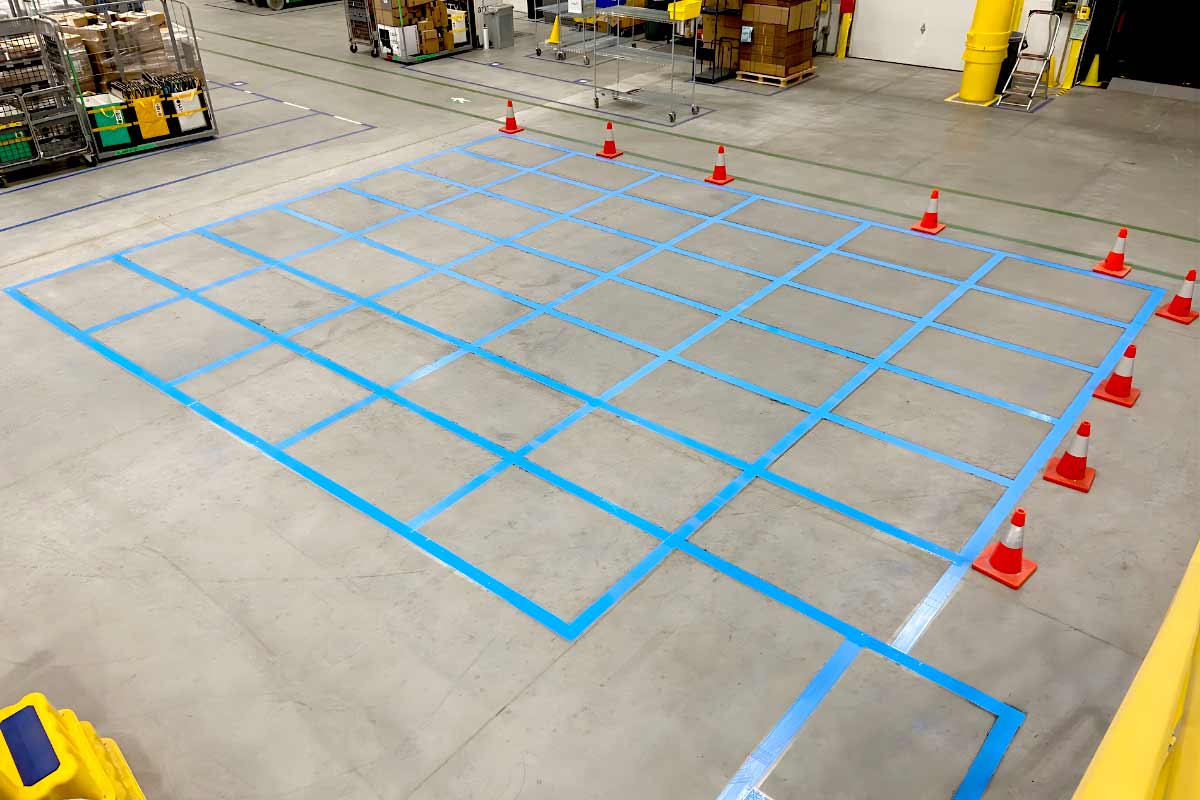
Warehouse line painting is interior floor marking — the lines, legends and symbols that tell people and equipment where to go inside a building. On a distribution or manufacturing floor in this area that usually means aisle boundaries, pedestrian walkways, racking and storage footprints, staging and stretch-wrap areas, dock approach zones, equipment clearance around panels and eyewash stations, and the legends that name each area.
It is closer to layout work than to decoration. A floor marking plan encodes how the building is supposed to operate: where a forklift may travel, where a person on foot is protected, what may be set down and what must stay clear. When the plan is good, a new hire understands the traffic pattern on their first shift. When it is bad or worn out, people improvise, and improvisation around powered industrial trucks is the problem the markings exist to prevent.
What OSHA Actually Requires — and What It Does Not
This is the section most competitor pages get wrong, and the correction is genuinely useful to a facility manager.
The federal rule that requires aisle marking is 29 CFR 1910.176(a), in the materials handling and storage standard. Its operative sentence is short: permanent aisles and passageways shall be appropriately marked. The same paragraph requires sufficient safe clearances for aisles at loading docks, through doorways and wherever turns or passage must be made, and requires aisles to be kept in good repair with no obstruction that could create a hazard.
That is the whole of it. The rule sets no line width, no line color and no aisle width. It says permanent aisles must be marked, and that clearances must be sufficient — a performance requirement, judged against how your building actually operates.
So when a striping company tells you OSHA requires 2-inch yellow lines, or a 4-foot pedestrian walkway, they are quoting an industry convention as though it were a regulation. The conventions are good practice and we mark to them by default, because consistency across facilities is worth something. But knowing which parts are law and which parts are convention is what lets you make sensible decisions about your own floor rather than paying for someone else’s default.
One Michigan-specific note, since people ask: MIOSHA runs a state occupational safety plan, and its general industry standards adopt the federal standards, which are then enforced with the same force as a state rule. The operative text for aisle marking in a Michigan warehouse is the federal text above. There is no separate Michigan aisle-marking dimension to comply with.
Aisle and Walkway Markings
Aisle marking is the core of the job and the part with the compliance obligation attached. The rule covers permanent aisles — the routes that are part of how the building works, not a temporary gap between two pallets that will be gone next week. Deciding which is which is a real conversation, and it is worth having before painting rather than after.
Pedestrian walkways are the other half. Separating people from powered industrial trucks is the single highest-value thing floor marking does, and the way it is done matters: a walkway that runs where people actually want to walk gets used, and one that adds thirty seconds to every trip gets ignored. Before we mark walkways we look at where the worn paths already are, because the floor tells you what the traffic pattern really is.
Practical points that come up on most jobs here: crossings where a walkway meets a forklift aisle need to be obvious from both directions; corners and blind intersections deserve more marking than straight runs; and dock areas need the approach and the standing area distinguished, because that is where pedestrians and trucks meet most often.
Color Conventions and Where They Come From
Since the aisle rule sets no color, the colors you see on warehouse floors come from convention and from adjacent standards rather than from the marking rule itself.
The regulation people are usually reaching for is 29 CFR 1910.144, which sets color identification for physical hazards — red for fire protection equipment and danger, yellow for caution and for marking physical hazards such as striking against, stumbling, falling, tripping and caught-in-between. That is a hazard-color rule, not an aisle-color rule, and it is the honest source of the yellow that dominates warehouse floors.
The other reference is ANSI Z535.1, the safety color code, which is a consensus standard rather than a regulation. Facilities that operate to a corporate standard usually have their own palette derived from it.
What this means in practice: your color scheme is a decision, and a defensible one is any scheme that is consistent, that reserves the strongest colors for the highest hazards, and that everybody in the building has been told about. What is not defensible is a floor where three previous contractors each used a different palette and nobody knows which is current.
Storage, Staging, and Equipment Zones
Beyond aisles, most of the value of a floor marking plan is in defining what may occupy a piece of floor.
Racking and storage footprints keep pallets inside the space they were planned for and stop the slow creep that narrows an aisle a few inches per month. Staging and outbound areas give receiving and shipping somewhere defined to put things down, which is what prevents work in progress from ending up in a walkway. Stretch-wrap and consolidation zones need enough marked room for the equipment plus a person moving around it.
Equipment clearance is the category that gets missed. Electrical panels need clear working space in front of them, and the fastest way to keep that space clear is to mark it and label it. The same logic applies to eyewash stations, safety showers, fire extinguishers, fire department connections and emergency exits. On a busy floor an unmarked clearance zone becomes a storage location within a month.
Safety and Hazard Markings
Hazard markings are the smaller-area, higher-consequence part of the plan: overhead door swing paths, low clearances, changes in floor level, edges of docks and pits, battery charging areas, and the approach to any machine with a working envelope that extends into a walkway.
These are also the markings most worth reviewing when a facility changes what it does. A line that was correct for the old process is misleading rather than merely worn once a machine is moved or a rack run is extended, and a misleading floor marking is worse than none. When we quote a facility that has been reconfigured, the first question is what changed, not what faded.
Coating Choices for Warehouse Floors
Interior floor coatings are chosen against three things: the substrate, the traffic, and how long the floor can be out of service.
Sealed and unsealed concrete behave differently, and a coating that bonds well to bare concrete may not bond at all to a floor with a previous sealer on it. Traffic type matters more than traffic volume — hard polyurethane forklift wheels abrade markings far faster than foot traffic or cart traffic. And cure time is often the binding constraint in a facility that runs multiple shifts, because the floor cannot carry traffic until the coating is hard.
There is also a straightforward tradeoff between durability and changeability. A hard-wearing marking is the right answer for an aisle layout that is stable for years, and the wrong answer for a staging area that gets reconfigured every quarter, where a marking that can be removed cleanly is worth more than one that lasts a decade. A good plan uses both in the same building.
Scheduling Around an Operating Facility
Almost no warehouse in this market can hand over an empty floor, so the schedule is part of the design.
The usual approach is zoning: the floor is divided into areas that can be cleared in sequence, and each is marked and allowed to cure while the operation runs elsewhere. Weekend and shutdown windows are the other common pattern, particularly for facilities that can consolidate inventory for a day or two. Racking that has to move is the long pole — the marking itself is fast, and it is emptying and repositioning the racks that takes the time.
Surface preparation deserves planning too. Concrete carries dust, rubber, oil and old coating residue, and none of it is visible as a problem until a marking lifts. Cleaning the marking lines properly is the difference between a floor plan that lasts and one that needs redoing in a season.
How Warehouse Line Painting Works
- Walk the floor and understand the operation. Traffic flow, shift pattern, powered equipment, pinch points, and where the worn paths already run.
- Draft the marking plan. Aisles, walkways, crossings, storage and staging footprints, equipment clearances, and hazard markings, with the color scheme agreed rather than assumed.
- Agree the scope and the schedule. Which zones, in what sequence, in which windows, with what cure time between.
- Prepare the surface. Clean the marking lines back to sound substrate — the step that determines how long the work lasts.
- Mark and legend. Lines, symbols and text, laid out from the agreed plan.
- Cure and hand back zone by zone. Each area returns to service only once the coating will take traffic.
- Walk the finished floor with your team. The plan only works if the people using the building know what it means.
Estimating a Floor Marking Project
A facility with a stable layout and a weekend shutdown window is a very different project from the same square footage marked around a running operation, and the gap between the two is mostly schedule rather than paint. Linear feet of marking and the number of legends set the baseline. Concrete condition sets the preparation.
Zoning the work across shifts multiplies the mobilizations, and racking that has to be emptied and moved is usually the longest item on the plan. Tell us the shift pattern when you call and we can shape the estimate around it. 1-800-STRIPER of NW Detroit, (947) 295-8012, no charge for the estimate.
For a full list of our pavement marking services, visit our parking lot striping in NW Detroit page.
Businesses We Serve




How it Works

GET A FREE ESTIMATE
Contact us today and we’ll have a quote to you in 24 hours

SCHEDULE A STRIPING
We’ll have your space restriped in less than 7 days, without affecting your business hours

GET A PARKING LOT THAT POPS
For a budget-friendly price, you’ll get a parking lot that looks like new
We proudly work with:


We proudly work with:

Frequently Asked Questions About Warehouse Line Painting in NW Detroit, MI
Does OSHA require yellow lines in a warehouse?
No. The aisle-marking rule, 29 CFR 1910.176(a), says only that permanent aisles and passageways shall be appropriately marked and that clearances must be sufficient. It sets no color and no width. Yellow is a convention drawn from the hazard-color rule at 29 CFR 1910.144 and from ANSI Z535.1, which is a consensus standard rather than a regulation.
How wide do warehouse aisles have to be?
The federal rule does not give a number. It requires sufficient safe clearances where mechanical handling equipment is used, judged against your operation — the equipment you run, the loads it carries and the turns it has to make. Equipment manufacturers publish turning and clearance data, and that is the practical basis for sizing an aisle rather than a regulatory figure.
Are Michigan warehouse marking rules different from federal ones?
Not for aisle marking. MIOSHA operates a state plan whose general industry standards adopt the federal standards, which then carry the same force as state rules. The operative aisle-marking text in a Michigan warehouse is the federal text, so there is no separate Michigan dimension or color to comply with.
Can you do warehouse line painting while we keep operating?
Usually yes. Most facilities are marked in zones, with each area cleared, marked and left to cure while the operation continues elsewhere. Weekend and shutdown windows are the alternative where an operation cannot be split. The constraint is normally cure time and any racking that has to move, not the marking itself.
How long do warehouse floor markings last?
It depends far more on traffic type than on traffic volume. Hard forklift wheels abrade markings much faster than foot or cart traffic, and a poorly prepared surface will fail long before a well-prepared one regardless of coating. A clean substrate and a coating matched to the traffic are what determine the interval, which is why surface preparation is not a place to economize.
What drives the cost of a warehouse line painting project?
Linear feet of marking, the number of legends and symbols, the coating chosen, how much surface preparation the concrete needs, how many zones the job splits into, whether the work runs on a shutdown or around shifts, and whether racking has to be moved. Warehouse line painting is priced against the floor in front of us, so call for a free estimate rather than working from an average.