
Fire Lane Striping
In NW Detroit, MI
Code-Compliant Fire Lane Markings
1-800-STRIPER provides professional fire lane striping in NW Detroit, MI — marking fire lanes, red curbs, no-parking zones, and access-road boundaries to the specifications set by your city’s adopted fire code and fire code official for commercial properties across Oakland, Wayne, and Macomb counties.
1-800-STRIPER® of NW Detroit PROVIDes Fire Lane Striping Services NEAR YOU
Is your parking lot ready for first responders?
Our team is well-versed in local fire regulations and will parter with you to design a fire lane striping plan that creates unobstructed emergency access to protect your customers and property.
Core Services:
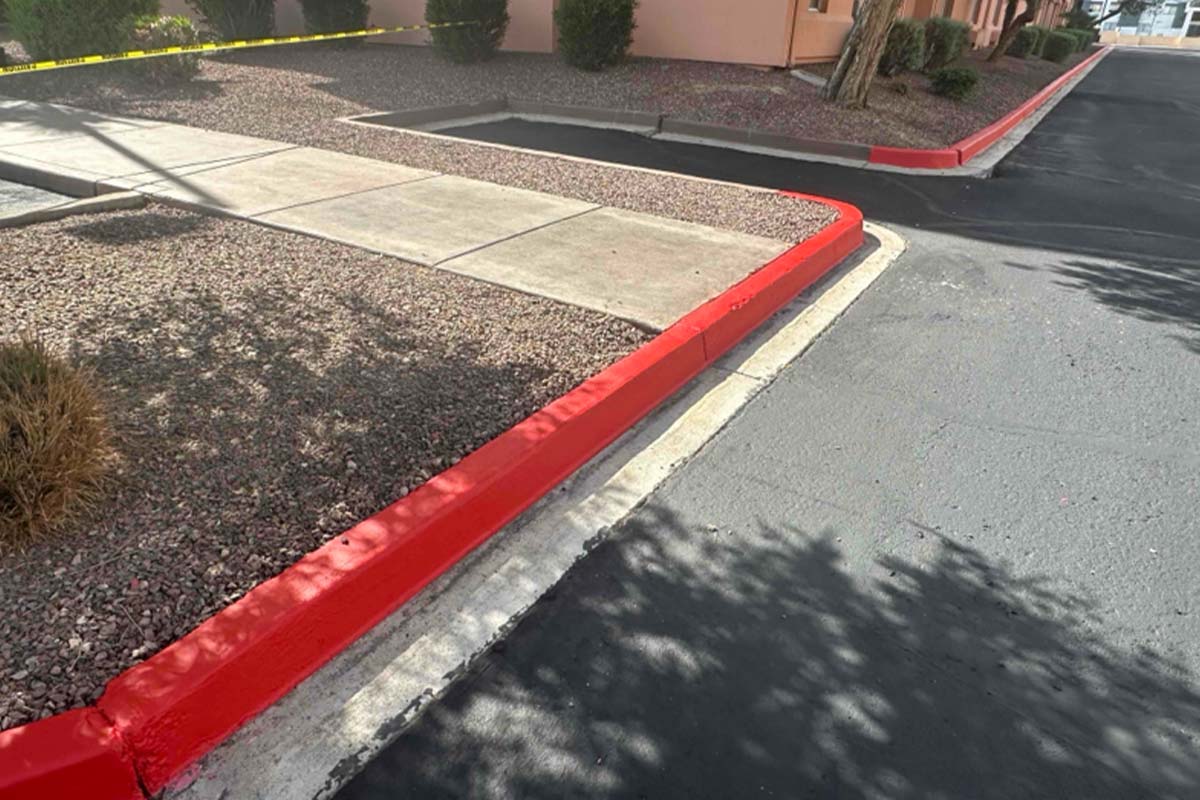
What Fire Lane Striping Involves in NW Detroit, MI
Fire lane striping marks the parts of a property that have to stay clear so fire apparatus can reach a building and crews can work. On a typical commercial lot that means a painted boundary along the access route, red curb treatment where the code official calls for it, lettering that identifies the lane, no-parking markings at the points where drivers are most tempted to stop, and the posts and signs that make the restriction enforceable when a vehicle is already sitting in the lane.
The work is unusual among parking lot services in that the specification is not ours to choose. Stall widths are a design decision. Fire lane markings are a compliance decision, and the person who makes it is your fire code official. That is why the first step on a fire lane job is finding out what your city requires, not quoting a standard layout.
What we mark on a commercial property here, in the usual order of importance: the fire apparatus access road boundary, the area in front of a fire department connection or hydrant, red curbs along the lane, NO PARKING FIRE LANE lettering at the intervals your city specifies, and the sign posts. Where a lot has been resurfaced and the old markings are gone entirely, we work from the approved site plan and the fire marshal’s direction rather than from whatever the pavement remembers.
Who Sets Fire Lane Rules in Michigan — Your City, Not the State
This is the part most striping websites get wrong, and it is worth being precise about because getting it wrong costs a property owner real money.
In Michigan the fire code that applies to your parking lot is the one your city has adopted by ordinance, and the official who enforces it is your local fire code official. Cities adopt different editions and then amend them. That means there is no single sentence that describes fire lane requirements for the whole NW Detroit service area, and any contractor who quotes you one standard for Livonia, Southfield, Troy, Canton and Sterling Heights alike is guessing.
Take one city in this territory as a worked example. Sterling Heights adopts the International Fire Code, 2024 edition, as the fire code of the city under Section 20-22 of its Code of Ordinances, and adopts the code’s appendices along with it. That detail matters more than it looks.
The appendix covering fire apparatus access roads is optional almost everywhere — municipalities routinely take the body of the code and leave the appendices out, which is why a requirement that binds in one city simply does not exist in the next one over. Sterling Heights keeps it. The city’s own building code listing names the 2024 International Fire Code with its amendments, references and appendices, and the fire department’s plan submittal guidelines tell designers that fire apparatus access roads have to comply with Chapter 5 and Appendix D of that code. It is in force there in practice, not just on paper.
The city then amends what it adopted. Section 20-23 carries Sterling Heights’ local amendments to the fire code, and one of them is a modifications provision: it gives the fire code official express authority to require or permit changes to the fire apparatus access requirements — the width of an access road, the geometry of a dead-end turnaround, the parking restrictions attached to a fire lane — where the published requirements do not fit what fire or rescue operations actually need at a site. That is the mechanism worth understanding, and it holds across Michigan cities whatever edition they adopted. Even a city that takes the appendix in full still leaves the last call with an official who is allowed to vary it for your property.
Livonia, where our shop is based, runs the same pattern through a different chapter — Chapter 15.16 of the Livonia Code of Ordinances is the city’s Fire Prevention Code, and Section 15.16.030 is the section that adopts a document by reference. Which document, and which amendments, is a question for Livonia’s fire marshal, and it is the right first phone call on any Livonia fire lane job.
The practical upshot for a property owner with sites in more than one city: do not assume the markings that passed inspection at one location will pass at another. Confirm with the fire code official who covers the address.
Fire Lane Sign and Marking Specifications
Because the specification is local, the useful thing we can show you is what a real, adopted, in-territory specification actually looks like — so you know the level of detail to ask your own fire marshal about.
Sterling Heights amends Appendix D Section D103.6, and the shape of that amendment tells you what a city can pin down. It requires permanent NO PARKING – FIRE LANE signs on fire apparatus access roads where the fire code official calls for them. It sets a minimum sign size rather than leaving the dimensions to whoever orders the signs.
It fixes a letter and background color scheme and requires the background to be reflective, rather than accepting any legible sign. And through the amended Section D103.6.1 it treats a narrower access road as its own case, with the fire code official deciding whether that road is posted on one side or on both. The figures themselves sit in Section 20-23, which is linked from this page — read them there, and have your fire marshal confirm which of them apply to your address before anything is ordered or installed.
Notice what is in that specification and what is not. There is a sign size, a color scheme and a reflectivity requirement, and there is a rule about which side of the road gets posted. There is no sentence saying every fire lane in the city must be painted red, and no universal stripe width. The judgment calls sit with the fire code official, which is exactly why the answer to “what does my fire lane have to look like” is a phone call rather than a web page.
Questions worth putting to your fire marshal before a job is scheduled, because they are the ones that change the work: does this lane need curb paint, lettering, signs, or all three; what interval do you want lettering repeated at; what sign size and mounting height do you require; do you want the lane posted on one side or both; and does the access road width on this site trigger anything specific.
Fire Apparatus Access Roads and What They Mean for Your Lot
A fire apparatus access road is not the same thing as a fire lane stripe, and confusing the two is how properties end up marking the wrong strip of asphalt.
The access road is the route a fire engine takes to get within working distance of the building. Its width, its vertical clearance, its turning geometry and its ability to carry the weight of apparatus are design and engineering questions settled when the site is built or altered, and they appear in the fire code and its appendices. The striping is what keeps that route usable day to day by stopping people parking on it.
On an existing commercial property the practical consequence is that you cannot decide where the fire lane goes. It follows the access road that was approved for the site. When a lot gets resurfaced and the markings vanish, the correct source for where the lane belongs is the approved site plan and the fire code official — not a photograph of the lot from before the resurfacing, which may itself have been wrong.
The other consequence is about obstruction. A fire lane that is marked correctly but blocked by a dumpster enclosure, a seasonal display, a delivery vehicle or drifted snow is not doing its job. Winter is the version of this that matters here: plowed snow has to go somewhere, and if it goes into the fire lane the lane is closed. Where snow storage is a live problem on a site, it is worth raising with the fire marshal when the lane is marked rather than in February.
Keeping Fire Lane Markings Legible
Fire lane markings are the markings on a commercial property most likely to draw a formal comment, and it is almost always because they have faded rather than because they were laid out wrong.
The reason is physical. Fire lanes run along curb lines and building frontages, which is where plows work hardest, where salt concentrates, and where water sits. Red curb paint on a concrete curb takes a beating from a plow blade in a way that a stall line in the middle of a bay does not. So the fire lane on a Michigan lot generally needs attention before the rest of the markings do, and treating the whole lot as one restriping interval tends to leave the fire lane looking worse than everything around it.
A workable rhythm on commercial properties in this area: inspect after the plowing season ends, treat curb paint and lettering as the first thing to refresh, and coordinate anything that changes the extent of the lane with the fire code official rather than deciding it on site. If your fire marshal has already asked once about legibility, that is the signal to schedule rather than to add it to a list.
How Fire Lane Striping Works
- Confirm the requirement with the authority having jurisdiction. We establish which fire code your city has adopted, which amendments apply, and what the fire code official wants for this address — sign size and mounting, lettering interval, curb treatment, and which sides get posted.
- Establish where the lane actually runs. From the approved site plan and the fire official’s direction, not from the remains of old paint.
- Agree the scope in writing. Extent of lane, linear feet of curb, number and position of signs, lettering count, and anything that has to change from what is on the ground today.
- Prepare the surface. Curbs and pavement are cleaned of grit, salt residue and loose material. Curb paint fails early far more often from a dirty substrate than from the wrong product.
- Mark and install. Lane boundary, curb, lettering and no-parking markings, then sign posts where they are part of the scope.
- Protect during cure, then walk it with you. Coned or taped until the coating is hard, then a final check against the agreed scope.
The work is normally done outside business hours so the property never has to close, and it can be run in sections on sites where the whole lane cannot be taken out of service at once.
What a Fire Lane Quote Depends On
Unusually for parking lot work, a large part of a fire lane quote is set by somebody outside the transaction. Your fire code official decides how many NO PARKING FIRE LANE legends the lane carries and at what interval, how many signs go up and on which sides, and whether curb painting is part of the requirement or only pavement marking. Those decisions land before we price anything.
What remains on our side is the linear footage of lane and curb, the condition of that curb, how many posts need footings cut into pavement rather than reusing what is there, and whether the job runs overnight or in stages. Call (947) 295-8012 and we will price it against your site and your city.
For a full list of our pavement marking services, visit our parking lot striping in NW Detroit page.
Businesses We Serve




How it Works

GET A FREE ESTIMATE
Contact us today and we’ll have a quote to you in 24 hours

SCHEDULE AN INSTALLATION
We’ll have your installation scheduled in less than 7 days, without affecting your business hours

GET A PARKING LOT THAT POPS
For a budget-friendly price, you’ll get a parking lot that looks like new
We proudly work with:


We proudly work with:


Frequently Asked Questions About Fire Lane Striping in NW Detroit, MI
Who decides what my fire lane has to look like in NW Detroit?
Your local fire code official. In Michigan the applicable fire code is adopted by your city, and cities adopt different editions and then amend them. Sterling Heights, for example, adopts the International Fire Code, 2024 edition, including its appendices, under Section 20-22 of its code. Requirements differ by city, so confirm with the fire marshal covering your address.
Does a fire lane have to be painted red?
Not necessarily, and that is a common assumption. What a lane requires depends on the code your city adopted and what your fire code official directs — some sites need curb paint, lettering and signs, others need only some of those. Red curb with lettering is a widespread convention rather than a universal rule, so ask before assuming.
What size do fire lane signs need to be?
It depends on the city, which is why no web page can answer it for your address. Sterling Heights, for example, amends Appendix D Section D103.6 so that its fire code official can require permanent NO PARKING – FIRE LANE signs, and that amendment sets a minimum sign size and a reflective color scheme rather than leaving either open. Other cities in this territory set their own, and some set none at all. Ask the fire marshal covering your property before you order signs.
How do I know where the fire lane goes on my property?
It follows the fire apparatus access road approved for the site, not a line somebody chose. The reliable sources are the approved site plan and your fire code official. This matters most after a lot is resurfaced and every marking disappears — recreating the lane from an old photograph can reproduce a layout that was never right in the first place.
Can snow storage block a fire lane?
Yes, and it is one of the most common ways a correctly marked lane stops working through a Michigan winter. A lane that is full of plowed snow is not available for apparatus. If snow storage on your site has nowhere to go except the fire lane, raise it with your fire marshal when the lane is being marked rather than during a storm.
How often does fire lane striping need to be redone?
More often than the rest of the lot, usually. Fire lanes sit along curbs and building frontages where plow blades, salt and standing water do the most damage, so curb paint and lettering degrade faster than stall lines in the middle of a bay. Inspect after plowing season ends, and treat a fire marshal’s comment about legibility as the trigger to schedule.