Warehouse Line Painting
In Annapolis, MD
OSHA-Compliant Safety Markings
1-800-STRIPER provides warehouse line painting in Annapolis, MD — striping OSHA-compliant aisles, pedestrian walkways, forklift lanes, and safety zones per 29 CFR 1910.176(a) using durable floor-marking paint for warehouses and industrial facilities.
1-800-STRIPER® of Annapolis PROVIDes Warehouse Floor Markings Services NEAR YOU
Want your indoor space to operate more efficiently?
Warehouse and interior markings ensure clear traffic lanes, organized storage zones, and designated spaces designed to help your business operate safely and efficiently.
Benefits:
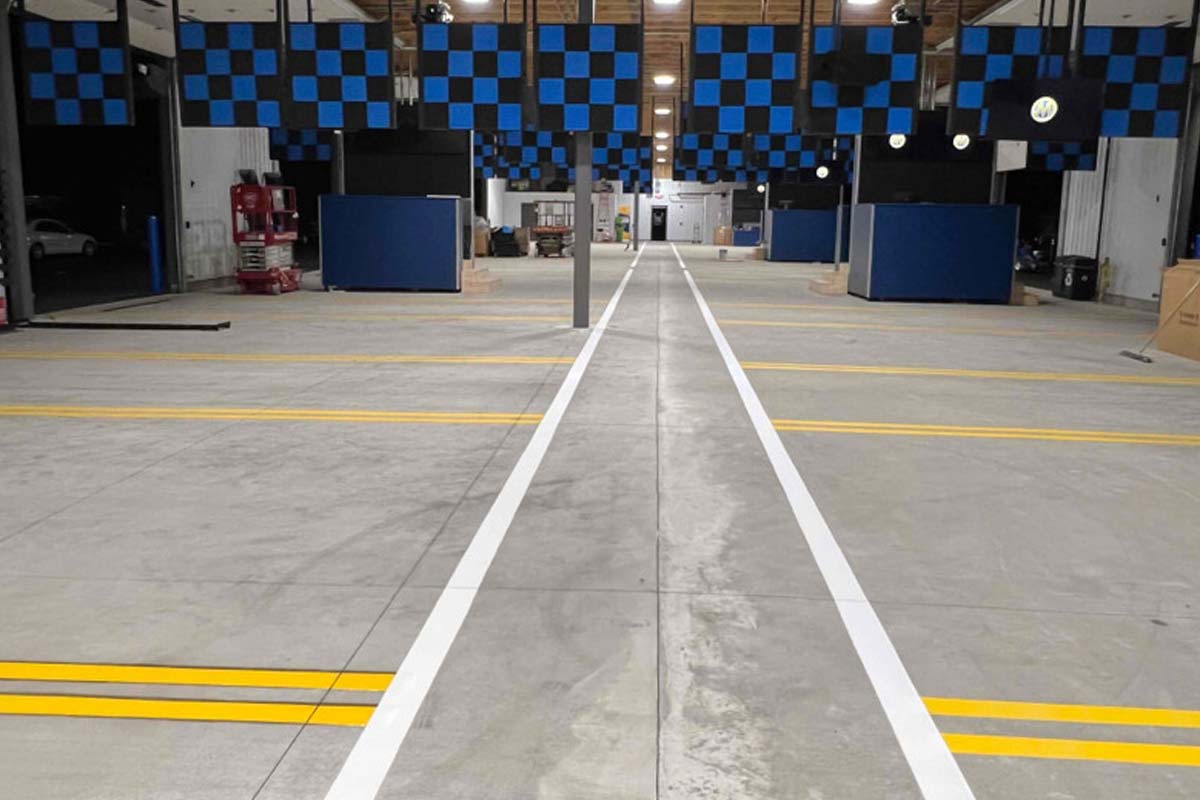
Warehouse Line Painting in Annapolis, MD
Warehouse floor marking organizes movement and keeps people and forklifts apart. Aisles, walkways, staging areas, hazard zones, and equipment locations all read from the paint on the floor, and in a facility where lift trucks and pedestrians share the space, those lines are a safety system, not decoration. We paint durable floor markings for warehouses and industrial facilities across the Annapolis area, laid out around how your operation actually moves — and we work to what OSHA actually requires, which is more specific in some places and far less specific in others than most people assume.
OSHA Aisle-Marking Duty
OSHA does require aisles to be marked. Under 29 CFR 1910.176(a), where mechanical handling equipment such as forklifts is used, “permanent aisles and passageways shall be appropriately marked.” That is the governing federal duty for warehouse aisle marking, and you can read it directly on OSHA’s site. If your facility runs lift trucks, marked permanent aisles are not optional.
We lay out and paint those aisles and passageways so they satisfy the marking duty and, just as importantly, so they make the floor work — clear travel lanes, defined pedestrian routes, and marked staging that keeps the operation moving.
Colors and Widths: What’s Required vs. Convention
Here is what surprises most facility managers: OSHA §1910.176(a) requires that aisles be “appropriately marked” but specifies no color and no line width. There is no federal number for how wide an aisle stripe must be and no mandated color for it. The yellow you see in most warehouses comes from ANSI Z535.2, a voluntary safety-color standard, not from OSHA — and it is a convention worth following, not a legal requirement.
That distinction matters because it is where bad advice lives. Common practice, which we follow, uses:
- Yellow for aisles and traffic lanes.
- White for equipment, workstations, and general layout.
- Red or red/orange for defect or hold areas.
- Black-and-yellow or red-and-white hatching for hazard and keep-clear zones.
We mark to this convention because it is what your people already read, and we will happily match an existing facility color scheme. What we will not do is tell you OSHA mandates a specific width or color — it does not, and anyone who says otherwise is quoting convention as if it were code.
Marking Around Operations
A working warehouse rarely empties out for the paint crew, so we plan around your operation. We mark in zones, coordinate around shifts and receiving schedules, and prep and paint sections so the rest of the floor keeps running. Floor-marking paint needs a clean, dry, degreased surface to bond, so surface prep — sweeping, and cutting oil and residue on an industrial floor — is part of the job, not an afterthought. We schedule the closure of each zone with you and keep each freshly painted lane out of service until it has cured enough to take forklift traffic.
Areas We Serve
We paint warehouse and industrial floor markings across Anne Arundel, Howard, and Baltimore counties — including the distribution and industrial corridors around Glen Burnie, Hanover, Jessup, Elkridge, Odenton, and Columbia. If your facility is near the edge of that area, call and we will confirm coverage: (410) 991-0032.
For a full list of our pavement marking services, visit our parking lot striping in Annapolis page.
Businesses We Serve




How it Works

GET A FREE ESTIMATE
Contact us today and we’ll have a quote to you in 24 hours

SCHEDULE A STRIPING
We’ll have your space restriped in less than 7 days, without affecting your business hours

GET A PARKING LOT THAT POPS
For a budget-friendly price, you’ll get a parking lot that looks like new
We proudly work with:


We proudly work with:

Frequently Asked Questions About Warehouse Line Painting in Annapolis, MD
Does OSHA require warehouse aisles to be marked?
Yes, where powered industrial trucks are in use. 29 CFR 1910.176(a) states that “permanent aisles and passageways shall be appropriately marked” in facilities that use mechanical handling equipment such as forklifts. So if your operation runs lift trucks, marked permanent aisles are a federal requirement, not a preference. We lay out and paint those aisles to meet the marking duty and to keep the floor working — clear travel lanes and defined pedestrian routes.
Does OSHA specify a color or a width for aisle markings?
No. This is the part most people get wrong. Section 1910.176(a) requires aisles to be “appropriately marked” but sets no color and no line width — there is no federal number for either. The familiar yellow lines come from ANSI Z535.2, a voluntary safety-color standard, not from OSHA. Following it is good practice and we recommend it, but it is a convention, not a code mandate. We will match a color scheme and a stripe width to your facility and never claim OSHA forces a specific figure.
What do the different marking colors mean?
The common convention — again from ANSI Z535.2, not OSHA — uses yellow for aisles and traffic lanes, white for equipment and workstations, red for defect or hold areas, and black-and-yellow or red-and-white hatching for hazard and keep-clear zones. The value of the scheme is consistency: once your team learns it, the floor reads instantly. We can apply the standard convention or match whatever your facility already uses, so a new area is consistent with the rest of the plant.
How do you prep the floor, and how durable are the markings?
Durability starts with prep. Floor-marking paint bonds only to a clean, dry, degreased surface, so we sweep and cut the oil and residue that build up on an industrial floor before any paint goes down — skipping that step is why cheap markings peel. On a properly prepped floor, durable floor-marking paint stands up to forklift traffic for a long service life. High-traffic lanes and turning points wear faster than open areas, so those are the spots to plan on refreshing first.
Can you mark the floor while we are still operating?
Usually, yes. We mark in zones and coordinate around your shifts and receiving schedule so the rest of the floor keeps running while we work one section. Each freshly painted lane stays out of service only until it has cured enough for forklift traffic. Tell us your busiest hours and any areas that cannot close when you call, and we will sequence the work around them rather than shut the operation down.
Can you mark forklift and pedestrian separation?
Yes — separating powered-truck routes from pedestrian paths is one of the main reasons to mark a warehouse floor, and it is where good marking earns its keep. We lay out distinct forklift lanes and pedestrian walkways, mark crossings where they meet, and define keep-clear zones around doors, racking, and equipment. The goal is a floor where a person on foot and a lift truck each have an obvious, separate path, which is exactly the safety outcome the aisle-marking duty exists to serve.