ADA Parking Lot Striping
In Annapolis, MD
ADA-Compliant Accessible Parking
1-800-STRIPER provides ADA parking lot striping in Annapolis, MD — laying out accessible stalls, van-accessible spaces, access aisles, and required signage per the 2010 ADA Standards for Accessible Design and the Maryland Accessibility Code.
1-800-STRIPER® of Annapolis PROVIDes ADA Compliance Services NEAR YOU
Need to make your property more accessible?
Upgrade your facility to become fully ADA compliant by partnering with us to create clear, accessible parking for all your visitors.
Our ADA Compliant line striping services include:
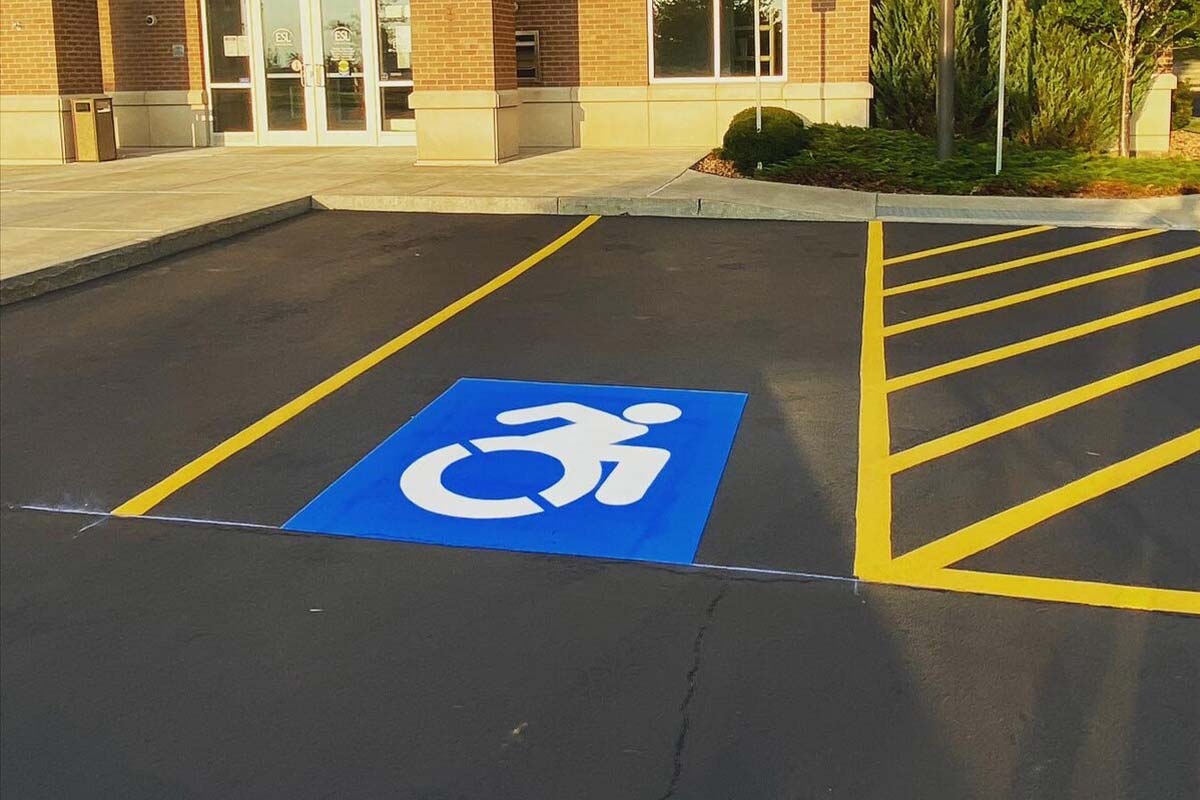
ADA Parking Lot Striping in Annapolis, MD
ADA parking is where a striping job stops being cosmetic and becomes a compliance question. The number of accessible spaces, their width, the access aisle beside them, the slope of the surface, and the sign at the head of the stall are all governed — by the federal 2010 ADA Standards and, in Maryland, by the state’s own accessibility code layered on top. Get one of them wrong and the lot can pass a glance and fail an audit. We lay out and stripe accessible parking for commercial properties across the Annapolis area to both the federal standard and the Maryland code, and we will tell you where an existing lot falls short before we touch it.
Accessible Space and Aisle Requirements
The 2010 ADA Standards, §502, govern the accessible space itself. A standard accessible car space is at least 96 inches (8 feet) wide. A van-accessible space is either 132 inches (11 feet) wide, or 96 inches wide paired with a wider access aisle. Every accessible space, car or van, must have an adjoining access aisle — the striped, no-parking zone a wheelchair or lift needs to deploy.
Access-aisle width is where the state layer matters. Under the federal standard the aisle must be at least 60 inches wide; the Maryland Accessibility Code (COMAR 09.12.53) likewise sets a 60-inch access aisle and, in places, references ICC A117.1 for technical detail. Two accessible spaces can share one aisle between them. The aisle has to be marked so it reads clearly as off-limits to parking, and the surface under both the space and the aisle has to be close to level — steep slopes are one of the most common quiet failures we find.
How Many Accessible Spaces You Need
Under §208.2.4 of the 2010 ADA Standards, the number of accessible spaces scales with the size of the lot. The ratio starts at one accessible space for every 25 total spaces and steps down as the lot grows — a small retail lot might need one, a large shopping center a dozen or more. Separately, at least one in every six accessible spaces (and always at least one) has to be van-accessible.
We compute the required count from your total space count, not from a rule of thumb, and build the accessible spaces into the layout from the start. Undercounting is a compliance exposure; overcounting quietly costs you general parking. Getting the number right is the first thing we settle.
Signage Requirements
Every accessible space needs a vertical sign bearing the International Symbol of Accessibility, mounted so it is visible when a vehicle is parked in the space — a painted symbol on the ground alone does not satisfy the standard. Under §502.6, van-accessible spaces carry an additional “van accessible” designation on the sign. The Maryland Accessibility Code adds the state’s own signage particulars on top of the federal requirement.
We mark the on-ground symbol where the layout calls for it and flag the vertical signs the lot needs, since the sign is a mounted-post item that often has to be coordinated with the property owner. What we will not do is imply a painted symbol is enough on its own — under the 2010 Standards, it is not.
Restriping and ADA Compliance
Restriping an existing lot is a trigger, not a free pass. The Department of Justice’s guidance, “ADA Guidance: Restriping Parking Lots,” is explicit that when you re-stripe a parking lot you have the opportunity — and the obligation — to bring the accessible spaces up to the current 2010 Standards. A lot laid out to an older standard, or never compliant to begin with, does not get grandfathered simply because it already has lines.
That is why we audit the accessible parking on any restriping job before we start: count, width, aisle, slope, and signage against the current standard. If the existing accessible spaces are non-compliant, restriping is the natural moment to fix them, and we will show you exactly what is short so the decision is yours with the facts in hand.
How We Stripe ADA-Compliant Parking
Getting an accessible lot right is a sequence, not a single pass. We work it in the same order every time so nothing compliant gets painted over and nothing required gets missed.
- Audit the existing lot. Measure the total space count and check any current accessible spaces against the 2010 Standards — count, width, access aisle, surface slope, and signage — so we know what is already compliant and what is not.
- Calculate the required count. Derive the number of accessible and van-accessible spaces from the lot total under §208.2.4, rather than working from a rule of thumb.
- Position the accessible spaces first. Place them on the shortest accessible route to the entrance and run the access aisles to the building before the general parking falls into place.
- Stripe the spaces, aisles, and symbols. Mark the accessible spaces, the on-ground symbols, and each access aisle as a no-parking zone.
- Flag the vertical signage. Identify the mounted signs the lot needs and confirm placement with the property owner, since the post-mounted sign is the governing requirement, not the painted symbol on its own.
Areas We Serve
We handle accessible-parking work throughout Anne Arundel, Howard, and Baltimore counties. Annapolis, Glen Burnie, Severna Park, Pasadena, Crofton, Odenton, Columbia, and Ellicott City are all inside the area, along with the towns around them. Properties out near the boundary are worth a quick call to check — (410) 991-0032.
For a full list of our pavement marking services, visit our parking lot striping in Annapolis page.
Businesses We Serve




How it Works

GET A FREE ESTIMATE
Contact us today and we’ll have a quote to you in 24 hours

SCHEDULE AN INSTALLATION
We’ll have your installation scheduled in less than 7 days, without affecting your business hours

GET A PARKING LOT THAT POPS
For a budget-friendly price, you’ll get a parking lot that looks like new!
We proudly work with:


We proudly work with:


Frequently Asked Questions About ADA Parking Lot Striping in Annapolis, MD
How many accessible parking spaces does my lot need?
The 2010 ADA Standards, §208.2.4, tie the count to the total number of spaces: one accessible space per 25 for the first 100, then a declining ratio as the lot grows, so a 40-space lot needs two and a 500-space lot needs far fewer than 20 per hundred. On top of that, at least one in six accessible spaces must be van-accessible, and there is always at least one van space. We calculate the exact requirement from your total rather than estimate it, and we can walk you through the 2010 ADA Standards table that produces the number.
What is a van-accessible space, and how many do I need?
A van-accessible space gives extra width so a side-mounted wheelchair lift can deploy. Under §502.2 and §502.3 it is either an 11-foot-wide space with a 5-foot aisle, or an 8-foot space paired with an 8-foot aisle. You need at least one van-accessible space for every six accessible spaces in the lot, and never fewer than one. Van spaces also carry a “van accessible” line on their sign. We size and place them as part of the layout, not as an afterthought.
How wide does the access aisle have to be?
At least 60 inches. That is the minimum under the federal 2010 ADA Standards and it is echoed by the Maryland Accessibility Code (COMAR 09.12.53), which sets the same 60-inch access aisle for the state. Two adjacent accessible spaces can share a single aisle between them. The aisle has to be striped so it clearly reads as no-parking, and its surface must be close to level — a compliant width over a too-steep slope still fails.
Does the accessible space need a sign, or is the painted symbol enough?
It needs a sign. The 2010 Standards, §502.6, require a vertical sign bearing the International Symbol of Accessibility, mounted high enough to stay visible when a vehicle occupies the space; van spaces need the added “van accessible” wording. The symbol painted on the pavement is common and useful, but on its own it does not meet the standard — the mounted sign is the governing requirement, with the Maryland Accessibility Code adding the state’s signage particulars.
Is blue paint required for accessible parking?
No — not by federal law. The 2010 ADA Standards require the accessible space to be marked and signed, but they do not mandate that it be painted blue. Blue striping and the blue-background symbol are a widespread convention, and some state or local jurisdictions do require them, but the federal ADA requirement is the marking, the access aisle, and the vertical sign — not a color. We stripe to whatever your local jurisdiction requires and default to the conventional blue where nothing more specific applies, but we will not tell you a color is a federal mandate when it is not.
Does restriping my lot mean I have to bring it up to ADA standards?
Effectively, yes, for the accessible parking. The Department of Justice’s “ADA Guidance: Restriping Parking Lots” treats a restripe as the point at which accessible spaces must meet the current 2010 Standards — an older or never-compliant layout is not grandfathered just because it already had lines. In practice that makes restriping the right moment to fix accessible parking, and we audit count, width, aisle, slope, and signage before we start so nothing non-compliant gets painted back in.
What are the penalties for non-compliant accessible parking?
Non-compliant accessible parking is an ADA violation, and it exposes a property to complaints, DOJ enforcement, and private legal action — the accessible spaces are among the most frequently cited items in parking-lot access complaints. We do not quote fine figures, because the exposure depends on the situation and is a question for your counsel, not your striping contractor. What we can do is remove the exposure at its source by bringing the count, dimensions, aisles, and signage into line with the current standard.