
Bollard Installation
In Orlando South, FL
Safety and Security Bollards
1-800-STRIPER® provides professional bollard installation in Orlando South, FL — fixed, removable, and collapsible bollards for storefronts, gas meters, loading docks, and drive-thrus, placed to keep fire access and accessible routes clear for commercial properties across Central Florida.
1-800-STRIPER® of Orlando South PROVIDes Bollard Installation Services NEAR YOU
Want to prevent accidents and protect your property?
Bollards provide physical protection for your customers and your property.
Safety and security:
Bollards create a physical barrier between vehicles and pedestrians, protecting people in walking areas from accidental or intentional vehicle intrusions.
Bollards act as a protective barrier around storefronts, gas stations, and other vulnerable areas, minimizing the risk of costly damage from vehicle impacts.
Strategic Placement Locations:
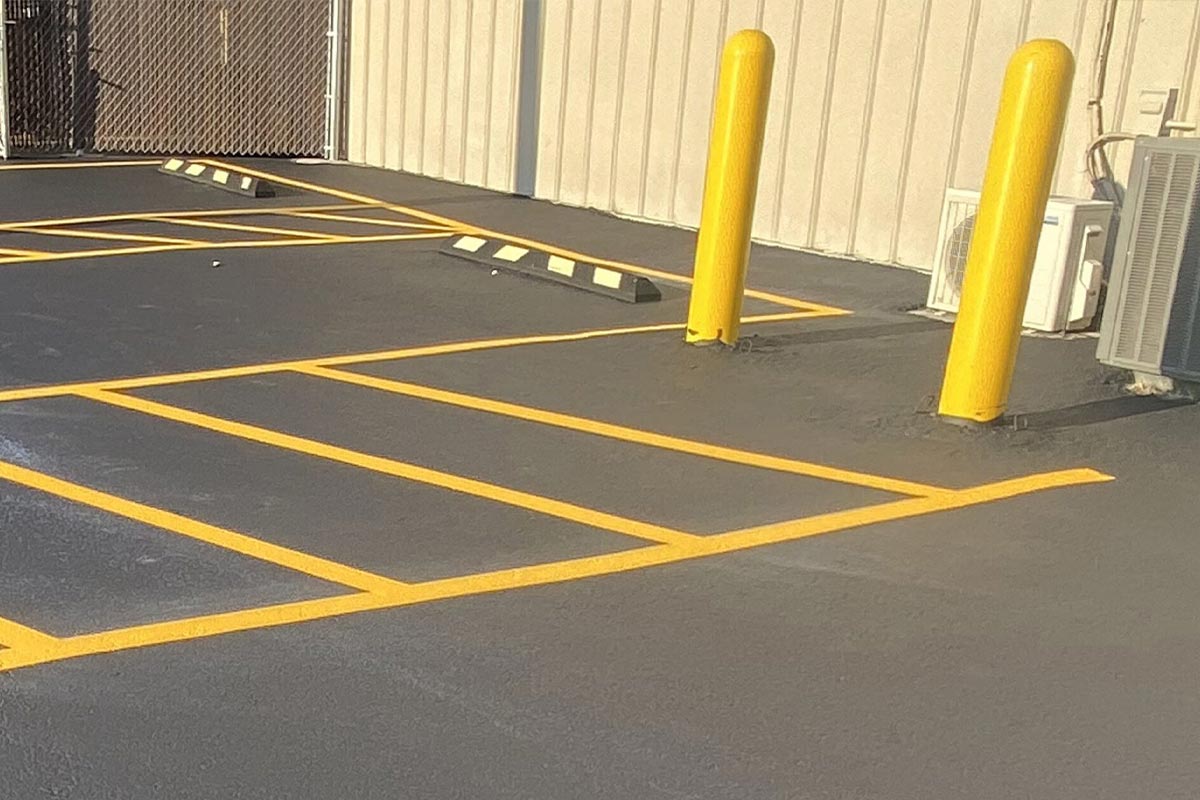
Bollard Installation in Orlando South, FL: What Bollards Protect
Bollards are short, sturdy posts set in or on the pavement to stop vehicles from reaching something that should not be hit. On commercial properties in Orlando South they guard storefronts, utility equipment, loading areas, and the edges of walkways, and they steer traffic around a site.
Property managers usually call for one of four reasons.
A vehicle has already driven into a building or a gas meter. An insurance carrier or lender has flagged an exposure. A new tenant has a drive-thru or walk-up window beside a lane of traffic. Or a loading dock needs a hard edge so trucks stop where they should.
Central Florida has plenty of storefront plazas where parking stalls sit directly against a glass front. When a car can roll forward off a stall and into the building, a row of bollards is one of the few fixes that works without redesigning the lot. If the stall layout itself is the problem, the layout and striping can be reworked alongside the bollards.
ASTM F3016 and ASTM F2656: Which Standard Applies to Your Lot
Two standards come up most, ASTM F3016 and ASTM F2656, and they measure different things. Mixing them up is a common reason a spec sheet does not match the job.
- ASTM F3016 is a test method for vehicle impact protective devices at low speeds. It is the reference for the kind of impact a parking lot or storefront actually sees: a driver who hits the gas instead of the brake, or a delivery vehicle that misjudges a turn. Results are reported as speed ratings and penetration ratings.
- ASTM F2656 covers crash testing of vehicle security barriers. It was written for defined-threat perimeter protection, such as government buildings, airports, and other high-security sites, and the test vehicles and speeds reflect that.
| ASTM F3016 | ASTM F2656 | |
|---|---|---|
| What it tests | Low-speed vehicle impact | Crash testing of security barriers |
| Typical setting | Storefronts, parking lots, loading areas | Defined-threat perimeters |
| Who usually specifies it | Property managers, insurers, architects | Security consultants, government owners |
Strip centers, medical offices, and retail pads usually fit the low-speed standard. If your insurer, architect, or security consultant names a specific rating, ask the bollard supplier for the test documentation behind it. Both standards are revised from time to time, so confirm the current edition when the order is placed.
Fixed, Removable, and Collapsible Bollards
The three general options differ in how they handle access.
Fixed bollards are set in the ground and stay put. They suit places where a vehicle should never pass, such as the front of a storefront or the side of a gas meter. Most are anchored in a concrete footing, with a core drilled through asphalt or concrete paving where the surface is already in place.
Removable bollards lift out of a socket so a vehicle, delivery truck, or event can pass when needed. Once the post is out, the socket is capped flush to the pavement.
Collapsible or fold-down bollards lower or hinge to the ground and lock upright again. They fit places where access is needed regularly and a removable post would be a nuisance to store.
Who needs to pass, and how often, decides the type. A drive lane serving scheduled delivery trucks is a different case from a planter-lined front sidewalk. Any fire access requirement also weighs on the choice, and it is covered below.
Bollard Placement at Storefronts, Gas Meters, Loading Docks, and Drive-Thrus
Each location has a different job, and placement follows from it.
- Storefronts. Bollards go between the parking stall and the building, spaced so a car cannot slip between posts. Spacing and clear width at entrances also have to leave room for people, including those using a mobility device.
- Gas meters and utility equipment. Bollards are set around meters, transformers, and other equipment at a distance that leaves the utility room to service the equipment. Check utility company requirements before placing posts.
- Loading docks. Posts protect door frames, walls, and dock equipment from trucks and forklifts. Placement has to allow trucks to maneuver.
- Drive-thrus. Bollards guard the pickup window, the menu board, and the edge of the lane. They also keep traffic in the lane and away from pedestrians.
Placement is always a site decision. A bollard that protects one thing can block another, so the whole circulation pattern gets reviewed.
Keeping Fire Access and Accessible Routes Clear
Bollards must not block fire department access roads or accessible routes, and approval for where they go sits with the authority having jurisdiction, usually your local fire marshal or fire code official.
The Florida Fire Prevention Code governs fire access, and local governments can add amendments. The Florida State Fire Marshal keeps an index of local amendments with filings for the City of Orlando, Orange County, Kissimmee, Ocoee, and Winter Garden. Other towns in the territory have none on file, which does not mean they have no fire-lane rules. Before you place posts along a drive aisle, confirm with the fire official covering your address.
Accessible routes work the same way. The 2010 ADA Standards for Accessible Design require accessible routes to remain usable, so a bollard should never narrow a path to an accessible entrance or sit inside an access aisle. Removable or collapsible bollards often solve the conflict where a fire lane or service drive crosses a protected area, since the post can be released when emergency crews need to pass. Where that applies, confirm the release method with the fire marshal so crews are never delayed.
Site Walk to Finished Posts, Step by Step
A bollard job follows a sequence, and skipping a step is the usual cause of rework.
- Walk the site. Note what is being protected, the vehicle paths, fire access, and accessible routes.
- Confirm approvals. Check HOA, landlord, and fire official requirements before ordering.
- Locate utilities. A utility locate request is made before any digging, since footings go into the ground.
- Mark the layout. Post positions are painted on the pavement and reviewed on site.
- Set the posts. Fixed bollards go into footings; removable and collapsible types go into their sockets or mounts.
- Finish the surface. The pavement around each post is patched and, where it makes sense, striped or marked.
If a paving or sealcoating contractor is scheduled, coordinate so footings are not cut through freshly coated asphalt. Many properties also pair bollards with wheel stops, signs, or restriping, so it helps to plan them together.
What Affects the Scope of a Bollard Installation
Post count is only part of the picture. Scope depends on the bollard type, the paving surface, the depth of the footing, any utilities nearby, and whether the area needs repair before work starts.
Removable and collapsible units involve more hardware than fixed posts. Spots beside a building or a drive-thru lane often call for phasing, so part of the area stays open to traffic while the posts go in. Surface repair, such as filling a pothole or patching a cracked slab near a footing, belongs to your paving contractor, and the schedule should reflect that.
Call 1-800-STRIPER of Orlando South at (321) 234-3110 for a free estimate, and describe what you want protected.
For a full list of our pavement marking services, visit our parking lot striping in Orlando South page.















How it Works

GET A FREE ESTIMATE
Contact us today and we’ll have a quote to you in 24 hours

SCHEDULE AN INSTALLATION
We’ll have your installation scheduled in less than 7 days, without affecting your business hours

GET A PARKING LOT THAT POPS
For a budget-friendly price, you’ll get a parking lot that looks like new
We proudly work with:


We proudly work with:


Frequently Asked Questions About Bollard Installation in Orlando South, FL
What is the difference between ASTM F3016 and ASTM F2656 bollards?
ASTM F3016 is a test method for vehicle impact protective devices at low speeds, which fits storefronts and parking lots. ASTM F2656 covers crash testing of vehicle security barriers for defined-threat perimeters, such as government and high-security sites. Most commercial plazas look to the low-speed standard. Whatever rating you are quoted, ask the supplier for the test documentation behind it.
How do I protect a storefront from cars driving into it?
A row of bollards between the parking stalls and the building is the usual answer. Posts are spaced so a vehicle cannot slip between them, yet people, including those using mobility devices, still have room to pass. Where stalls face the glass directly, the stall layout may deserve a second look as well. A site walk shows which approach fits, and the estimate is free.
Can bollards block a fire lane or an accessible route?
They must not. Bollards cannot block fire department access roads or accessible routes, and the authority having jurisdiction, usually your local fire marshal or fire code official, approves where they go. Where a protected area crosses a fire lane, removable or collapsible bollards are a common option. Confirm the release method with the fire official so emergency crews are never delayed.
What is the difference between fixed, removable, and collapsible bollards?
Fixed bollards are anchored in the ground and stay put, which suits storefronts and gas meters. Removable bollards lift out of a socket when vehicles need to pass. Collapsible ones lower or hinge to the ground and lock back upright. Which type fits depends on who needs access, how often, and whether a fire access requirement applies to the location.
Which commercial locations most often need bollards?
Storefront plazas, gas meters and utility equipment, loading docks, and drive-thru lanes come up most. Each has a different job, from guarding a glass front to keeping trucks off a dock door. Placement is decided on site, because a post that protects one item can block another. Call (321) 234-3110 and describe what you want protected.