
Wheel Stop Installation
In North Miami, FL
Concrete and Rubber Parking Stops
1-800-STRIPER® provides professional wheel stop installation in North Miami, FL — anchoring concrete, recycled-rubber, and plastic-composite wheel stops at stall heads to protect sidewalks, storefronts, and ADA accessible routes per the 2010 ADA Standards for commercial properties throughout Miami-Dade County.
1-800-STRIPER® of North Miami PROVIDes Wheel Stops Services NEAR YOU
Need to protect vehicles or walls from accidental damage?
Wheel stops (also called parking blocks) protect your property, enhance safety, and improve parking lot organization.
Benefits:
Wheel stops prevent vehicles from parking too far into a space or overextending into other spots, pedestrian walkways, and other areas, while also helping with vehicle alignment. They can prevent damage to buildings, curbs, or landscaping. Wheel stops also serve as clear visual cues for proper parking and are sometimes used on slopes to prevent cars from rolling.
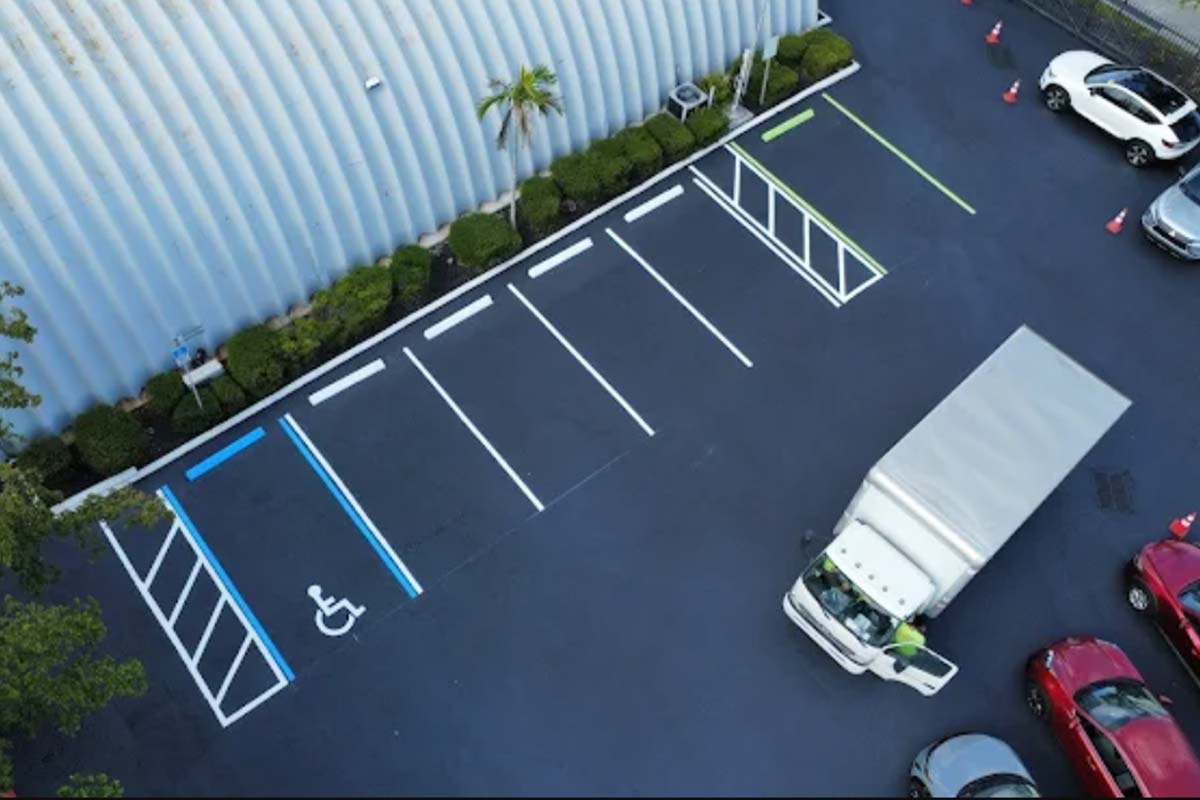
Wheel Stop Materials: Concrete, Rubber & Plastic
A wheel stop — also called a parking stop, parking bumper, or curb stop — is the low barrier at the head of a stall that keeps a vehicle from rolling too far forward. Standard wheel stops run about 6 feet long and 4 to 6 inches tall, long enough to catch both tires of a passenger vehicle without spanning the full stall width, which leaves a clear gap for pedestrians to step between parked cars. The right material depends on your traffic, your climate, and how often you expect to reset or replace them. The three common options compare like this:
| Material | Strengths | Trade-offs |
|---|---|---|
| Concrete | Heavy, rigid, long service life; holds position under heavy vehicles | Can crack or chip on hard impact; heaviest to handle and reset |
| Recycled rubber | Lighter than concrete, won’t rust or crack, often made from recycled tires | Less mass than concrete in high-impact lots |
| Plastic composite | Lightweight, durable, quick to install and replace | Lower mass; relies on solid anchoring to stay put |
For most North Miami lots, the choice comes down to durability versus ease of handling. Concrete is the traditional heavy-duty pick, while recycled rubber and plastic composite resist the cracking and rust that the area’s heat, sun, and salt air can drive — and both are quicker to swap out when one gets damaged.
How Wheel Stops Are Installed
Proper anchoring is what separates a wheel stop that stays put from one that shifts every time a tire taps it:
- Position at the stall head. We set each wheel stop at the head of the stall, square to the stall lines and set back from the curb or walkway so it stops the tire, not the bumper.
- Drill the anchor holes. We drill through the pre-formed channels in the stop and into the pavement below.
- Anchor to the surface. In asphalt we drive steel spikes or rebar pins through the stop into the base; in concrete we use anchor bolts sized to hold against repeated impact.
- Verify alignment. We check that every stop in a row lines up and sits at a consistent set-back, so the finished lot parks evenly and reads clean.
Wheel Stops & ADA Accessible Routes
Wheel stops have to respect the accessible route, not block it. Under the 2010 ADA Standards for Accessible Design, §403 requires accessible routes to keep a clear, unobstructed walking surface, and §502.7 addresses how a parked vehicle overhangs the space in front of it. When a car pulls into a stall and its front end hangs over a curb or walkway, that overhang can eat into the path of travel a wheelchair needs.
A correctly placed wheel stop solves this by stopping the vehicle short, so the front overhang stays out of the accessible route and the adjacent sidewalk keeps its full clear width. The set-back distance is what matters — place the stop too close to the walk and the bumper still intrudes; place it correctly and the route stays clear. This is most critical along accessible stalls and the access aisles beside them, where any encroachment on the route can put the whole space out of compliance. Getting that set-back right once, at install, is far cheaper than discovering at an inspection that the parked cars are eating into the path of travel, which is why we set wheel stops with that clearance in mind on every lot we stripe.
For a full list of our pavement marking services, visit our parking lot striping in North Miami page.
Businesses We Serve




How it Works

GET A FREE ESTIMATE
Contact us today and we’ll have a quote to you in 24 hours

SCHEDULE AN INSTALLATION
We’ll have your installation scheduled restriped in less than 7 days, without affecting your business hours

GET A PARKING LOT THAT POPS
For a budget-friendly price, you’ll get a parking lot that looks like new
We proudly work with:


We proudly work with:


Frequently Asked Questions About Wheel Stop Installation in North Miami, FL
What is a wheel stop?
A wheel stop — also called a parking stop, parking bumper, or curb stop — is a low barrier set at the head of a parking space to stop a vehicle’s front tires at the right point. It keeps cars from rolling over sidewalks, into storefronts, or past the stall boundary, and it helps protect pedestrians, building façades, and landscaping. Wheel stops also play a role in ADA accessible routes by keeping vehicle overhang out of the required walking path. We supply and anchor them to the surface.
What materials do wheel stops come in?
The three common materials are concrete, recycled rubber, and plastic composite. Concrete is heavy, rigid, and long-lasting but can crack over time. Recycled rubber and plastic-composite stops are lighter, won’t rust or crack, resist chipping, and are easier to handle and replace — and they’re often made from recycled material. Each anchors securely to asphalt or concrete. The best choice depends on your traffic, budget, and appearance preferences. We’ll walk through the trade-offs and install the type that fits your lot.
How are wheel stops anchored?
Wheel stops are fastened to the pavement so they stay put under repeated tire contact. On asphalt we typically use long steel spikes or rebar pins driven through the stop into the base; on concrete we use anchor bolts set into drilled holes. Proper anchoring is what keeps a stop from shifting or being pushed out of place over time. We set each stop at the correct position in the stall and anchor it to the surface it’s installed on.
Where should wheel stops be placed?
A wheel stop is positioned near the head of the stall so a vehicle’s front tires contact it at the right depth — usually set back a couple of feet from the curb or sidewalk so the front overhang doesn’t reach the walkway. Correct placement is especially important along ADA accessible routes, where the 2010 ADA Standards require the walking surface to stay clear of vehicle encroachment. We lay out wheel-stop positions so they protect the walkway and keep stalls usable.
Are wheel stops required for ADA accessible routes?
Wheel stops aren’t universally mandated, but they’re a common and effective way to keep parked vehicles from overhanging an accessible route. The 2010 ADA Standards (§403 route clearance and §502.7 regarding overhang) require that accessible routes and access aisles stay clear of obstruction — including a car’s front overhang. Placing wheel stops to hold vehicles back is a practical method of meeting that requirement. We position them to protect the accessible route where it runs along parking.
How much does wheel stop installation cost?
Wheel stop installation is quoted by the number of stops, the material (concrete, rubber, or plastic composite), and the anchoring surface (asphalt or concrete). Installing wheel stops alongside a striping or layout project is usually the most efficient approach. Replacing broken concrete stops with longer-lasting rubber or composite is a common upgrade. Call (954) 932-0437 for a free wheel stop installation estimate in North Miami.