Wheel Stop Installation
In Fort Myers, FL
Concrete and Rubber Parking Stops
1-800-STRIPER provides professional wheel stop installation in Fort Myers, FL — anchoring concrete, recycled-rubber, and plastic-composite wheel stops at stall heads to protect sidewalks, storefronts, and ADA accessible routes for commercial properties throughout Lee, Charlotte, and Hendry counties.
1-800-STRIPER® of Fort Myers PROVIDes Wheel Stops Services NEAR YOU
Need to protect vehicles or walls from accidental damage?
Wheel stops (also called parking blocks) protect your property, enhance safety, and improve parking lot organization.
Benefits:
Wheel stops prevent vehicles from parking too far into a space or overextending into other spots, pedestrian walkways, and other areas, while also helping with vehicle alignment. They can prevent damage to buildings, curbs, or landscaping. Wheel stops also serve as clear visual cues for proper parking and are sometimes used on slopes to prevent cars from rolling.
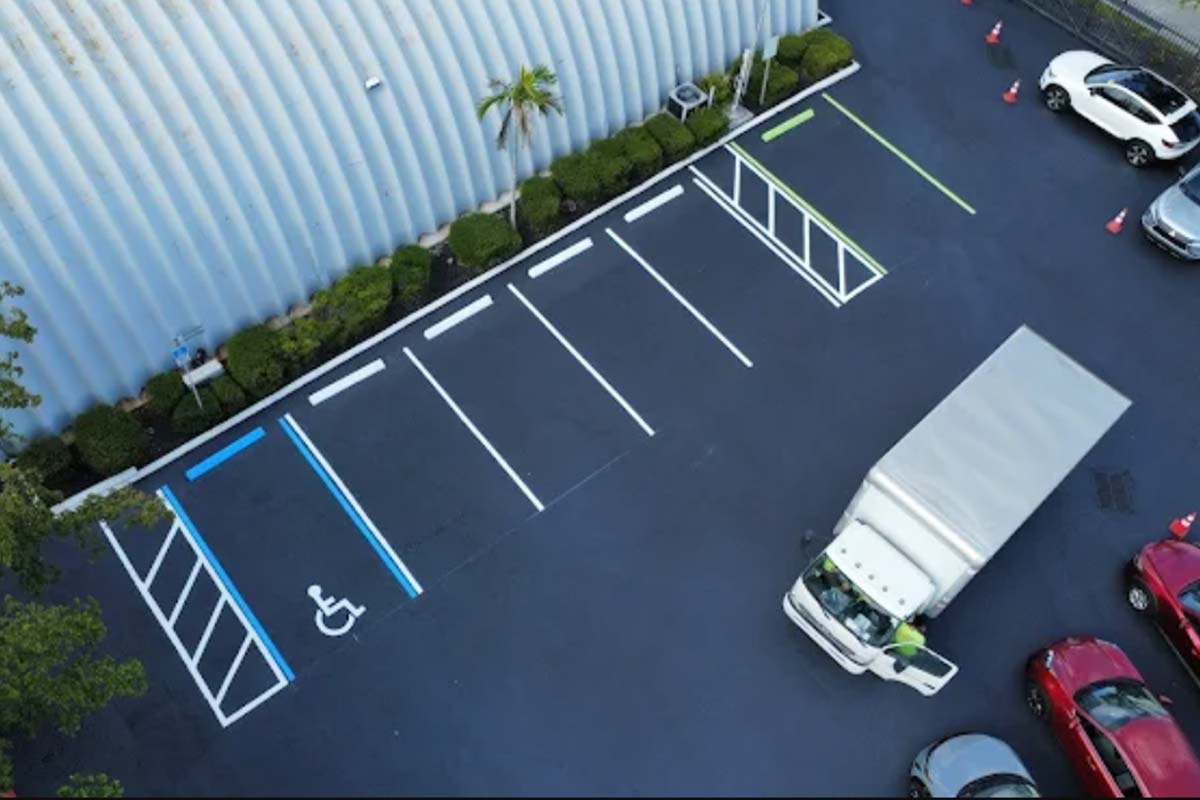
Wheel Stop Materials — Concrete vs Recycled-Rubber vs Plastic Composite
Three material families dominate the wheel-stop market.
Concrete stops are typically 6 feet long, 6 inches tall, and 6 inches wide at the base. They’re the heaviest, most durable, and most cost-effective per linear foot — but they crack under hard impact and chip at the corners over time.
Recycled-rubber stops weigh about a quarter of concrete. They install with steel pins driven through pre-drilled holes, absorb impact instead of transferring it to the vehicle, and don’t crack or chip. They cost more, though, and can shift under repeated curb-jumping in high-traffic stalls.
Plastic-composite stops sit between the two on both cost and durability. They’re light enough for one-person installation and hold up well in Florida UV when the polymer is UV-stabilized.
Where Wheel Stops Belong — Stall Heads, ADA Routes, Storefront Protection
Wheel stops belong at the head of any parking stall where vehicle overhang would interfere with pedestrian or accessibility traffic — the most common locations are stalls facing a sidewalk less than 6 feet wide, stalls facing a storefront where overhang could damage glass or signage, and accessible stalls where overhang could reduce the unobstructed accessible-route width below the ADA-required clearance. Curb-only protection (no wheel stop) leaves a typical sedan’s bumper roughly 24–30 inches over the curb — enough to obstruct a 5-foot sidewalk down to the 36-inch minimum or push the accessible route below 36-inch clear width.
ADA Accessible Route Protection — Clearance Rules
The 2010 ADA Standards for Accessible Design require accessible routes to maintain a minimum 36 inches of clear width along their length. Where a parking stall faces an accessible route — sidewalk, ramp, building approach — vehicle overhang can drop the effective accessible width below 36 inches. Wheel stops set 24 inches from the curb (the standard offset, allowing 6 feet of stall depth in a typical 9-by-18-foot stall) reduce overhang from ~30 inches to ~6 inches, preserving the 36-inch clear path. This is the most common reason wheel stops appear on a Phase 9 deployment plan in Fort Myers.
Anchoring Method — Rebar Pins vs Adhesive, Asphalt vs Concrete Substrate
On asphalt substrate, we anchor concrete and rubber wheel stops with two 12-inch rebar pins driven through the pre-cast holes in the stop. The pins drive easily through Fort Myers asphalt and bite into the underlying base course, holding the stop against bumper-tap impact. On concrete substrate, we either drill matching holes in the concrete and pin through, or — for stops that need to be removable for future re-layout — set the stop with construction adhesive only. Adhesive-only anchoring is appropriate for plastic-composite stops in light-duty stalls; high-traffic stalls always get pinned through to the substrate.
Replacement & Repair — Damage Thresholds & Matched-Color Refresh
Concrete wheel stops crack and chip under sustained impact. We replace a stop when it has cracked across its width (a transverse crack), when more than 25% of its volume has chipped away at the corners, or when it has shifted out of position to the point that its 24-inch offset from the curb is no longer reliable. Rubber stops are more forgiving — they tolerate corner deformation and surface gouging without losing function, and we typically replace them only on full breakage or when the rubber has degraded to the point of brittleness. Painted wheel-stop tops (yellow for high-visibility, blue for ADA-stall ID) get refreshed when faded; we coordinate this with restripe jobs in the same visit.
Our Process — Layout, Anchor, Finish
Wheel-stop installation runs in three steps: (1) layout — we measure each stall, mark the wheel-stop offset (typically 24 inches from the curb for a 9×18 stall, adjustable per the lot’s existing geometry), and chalk the centerline; (2) anchor — we drill or drive pins through the pre-cast holes into the substrate, verify the stop is set parallel to the curb, and trim or seat as needed; and (3) finish — we paint the top of the stop for high-visibility (yellow standard; blue on accessible stalls), apply the ISA symbol where the stop sits at an ADA stall, and clean the surrounding pavement.
Service Area — Lee, Charlotte, & Hendry Counties
Wheel-stop installations across Fort Myers, Cape Coral, Bonita Springs, Estero, Lehigh Acres, Sanibel, Punta Gorda, Port Charlotte, and LaBelle. Installations coordinated with restripe and ADA-signage work for a single mobilization where possible.
For a full list of our pavement marking services, visit our parking lot striping in Fort Myers page.
Businesses We Serve




How it Works

GET A FREE ESTIMATE
Contact us today and we’ll have a quote to you in 24 hours

SCHEDULE AN INSTALLATION
We’ll have your installation scheduled restriped in less than 7 days, without affecting your business hours

GET A PARKING LOT THAT POPS
For a budget-friendly price, you’ll get a parking lot that looks like new
We proudly work with:


We proudly work with: