Bollard Installation
In Fort Myers, FL
Safety and Security Bollards
1-800-STRIPER provides professional bollard installation in Fort Myers, FL — installing steel, concrete-filled, and bolt-down safety bollards to protect storefronts, fuel pumps, drive-thrus, and pedestrian zones per ASTM F3016 impact-rated standards for commercial properties throughout Lee, Charlotte, and Hendry counties.
1-800-STRIPER® of Fort Myers PROVIDes Bollard Installation Services NEAR YOU
Want to prevent accidents and protect your property?
Bollards provide physical protection for your customers and your property.
Safety and security:
Bollards create a physical barrier between vehicles and pedestrians, protecting people in walking areas from accidental or intentional vehicle intrusions.
Bollards act as a protective barrier around storefronts, gas stations, and other vulnerable areas, minimizing the risk of costly damage from vehicle impacts.
Strategic Placement Locations:
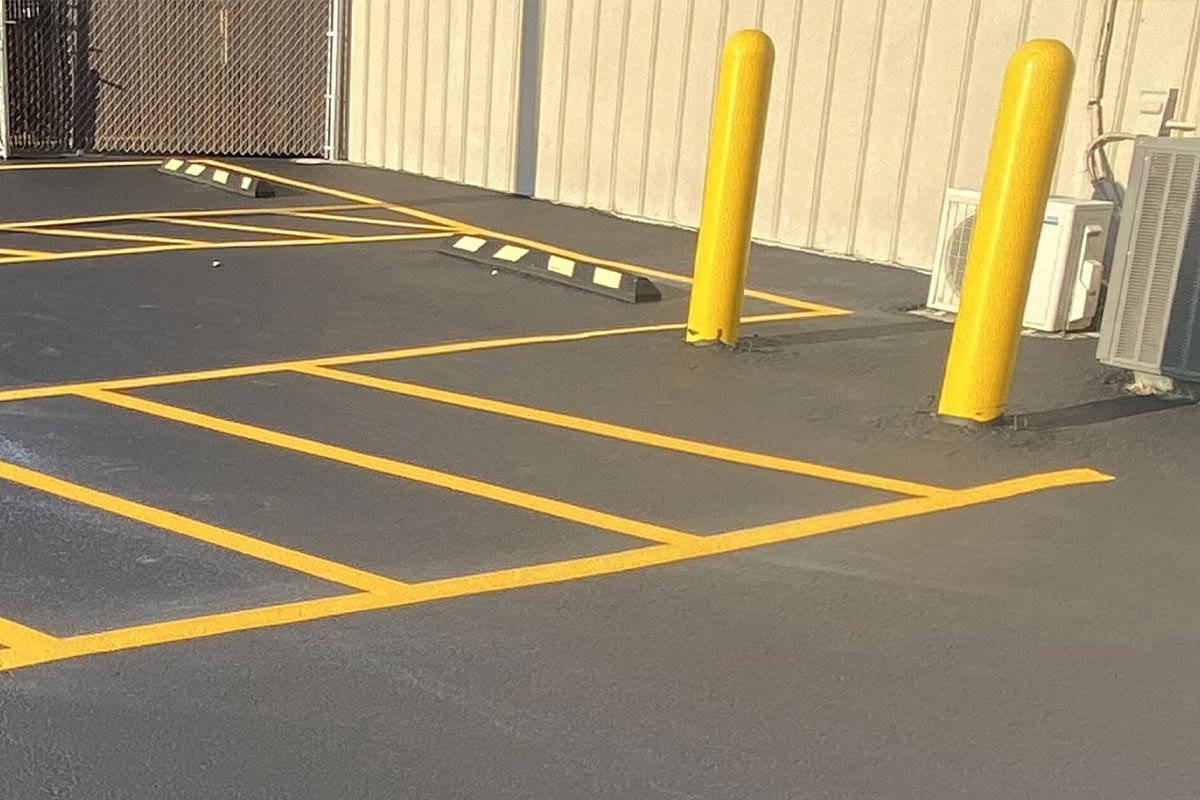
Bollard Types & Where They Belong
Commercial bollards split into five categories. Steel pipe bollards — typically 4-inch, 6-inch, or 8-inch schedule-40 or schedule-80 steel pipe, embedded in a concrete footing and either filled with concrete or left hollow — are the workhorse design for general perimeter protection. Embedded pipe bollards are standard around fuel-pump islands, drive-thru lanes, drive-up ATMs, and any storefront where vehicle strike is a recurring concern.
Concrete-filled steel bollards add interior concrete to a pipe bollard, increasing energy absorption on impact. The concrete fill stiffens the pipe and shifts deformation behavior under strike — a concrete-filled 6-inch pipe at full embedment can stop a passenger vehicle at parking-lot speeds when installed to the right footing geometry. This is the typical baseline for high-exposure locations: storefront columns at retail center anchor stores, glass entries facing a parking row, and pump islands at gas stations.
Bolt-down (surface-mount) bollards anchor through a base plate using anchor bolts into the concrete substrate. They don’t require excavation, install in a single visit, and serve well in light-duty roles — parking-lot perimeter, light pedestrian-zone delineation, sign protection. Bolt-downs do not match the impact rating of an embedded pipe bollard; they are intended for visual delineation and low-energy impact resistance, not vehicle-stopping force.
Removable bollards use a sleeve set in the concrete; the bollard drops into the sleeve and locks. Removable designs serve loading-zone gates, emergency-access lanes that double as pedestrian zones during normal hours, and event-day vehicle-control points. They install once and serve a recurring on/off pattern for years.
Decorative bollards — cast-iron, stainless-steel architectural designs, illuminated bollards with internal LED pathways — cover urban-design and pedestrian-area applications where appearance matters as much as protection. We install decorative bollards to the same structural standard as utility bollards (the cover is decorative; the steel core does the work), with finish materials chosen to match the architectural intent.
Choosing the right type starts with what the bollard is protecting. Vehicle-stopping work uses embedded concrete-filled steel pipe — pump islands, storefront columns, drive-thru menu boards, glass entries facing parking. Pedestrian delineation, sign protection, and decorative perimeter use bolt-down or decorative units. Removable units cover the cases where vehicle access alternates with pedestrian access on the same footprint. On most bollard projects, the driver isn’t the bollard itself — it’s the substrate, the footing depth, and the expected impact load.
The two industry standards we reference for impact-rated bollards are ASTM F3016 — *Standard Test Method for Surrogate Testing of Vehicle Impact Protective Devices at Low Speeds*, which evaluates resistance to passenger-vehicle impact at parking-lot speeds — and ASTM F2656 — *Standard Test Method for Crash Testing of Vehicle Security Barriers*, which evaluates higher-speed crash performance. Most commercial parking-lot bollard work in Fort Myers falls under the ASTM F3016 design regime; ASTM F2656-rated bollards appear at high-security sites (government, financial, certain transportation facilities) where vehicle-ramming is part of the threat model. Where a project calls for a published impact rating, we install bollards tested to the specified ASTM standard at the geometry the test rating depends on — substituting a shorter embedment or thinner pipe for cost reasons invalidates the rating.
Our Installation Process & Service Area
Bollard installation runs through five operational steps. Step 1 — site survey. We walk the site with the property owner or facilities manager, photograph the protection target (pump island, storefront column, ADA route, drive-thru menu, glass entry), measure the available substrate (asphalt versus concrete, slab thickness if known), and identify utility lines below grade. Utility-line identification is non-negotiable on embedded bollard work — Florida’s call-before-you-dig service (Sunshine 811) is the required first step before any excavation in a public or commercial site.
Step 2 — substrate evaluation and footing design. Embedded pipe bollards require a concrete footing sized to resist the moment loads imposed by a vehicle strike at the bollard’s exposed height. A typical 4-foot-tall, 6-inch concrete-filled steel-pipe bollard at an unrated commercial location uses a 36-inch-deep, 18–24-inch-diameter footing — but the exact geometry depends on substrate type, expected impact load, and any project-specific impact-rating spec. On existing concrete slabs, we either core-drill through the slab to the underlying base (for embedment) or use a bolt-down design with epoxy-anchor bolts (for surface-mount).
Step 3 — excavation or core-drilling. For embedded work in asphalt, we excavate the footing hole, dispose of spoil, and prep the hole for the steel post. For embedded work in concrete, we core-drill the hole, removing the cored slug. For bolt-downs on existing concrete, we lay out the base-plate footprint, drill the anchor holes, and clean each hole before setting the epoxy and bolts.
Step 4 — set, fill, finish. Steel-pipe posts go into the footing hole, level and plumb, with the embedded portion buried at the spec depth. Concrete is placed around the post in the footing hole and screed to the surrounding grade — broom-finished on concrete substrate, patched with hot or cold asphalt on asphalt substrate. Concrete-filled bollards get their interior concrete fill at this stage. We let the footing concrete reach initial set before removing bracing, and full design strength (28 days) before exposing the bollard to design-load impact. Bolt-down bollards skip the concrete-cure wait — they’re load-rated as soon as the anchor epoxy reaches its specified cure time, typically 24 hours.
Step 5 — finish coat and verification. We finish bollards with traffic-grade polyurethane paint (yellow being the standard high-visibility color; safety-orange, red, white, and architectural colors available on request). Where the property wants a sleeve cover — UV-stable polyethylene bollard cover, decorative cast-iron sleeve, stainless-steel architectural sleeve — we install the sleeve over the steel post as the final step. We re-walk the install with the property contact, verify spacing against the original site survey, and photograph the finished work for the project record.
Service area covers Lee, Charlotte, and Hendry counties: Fort Myers, Cape Coral, Lehigh Acres, Estero, Bonita Springs, Sanibel, North Fort Myers, Punta Gorda, Port Charlotte, and LaBelle. Common bollard projects in the metro: pump-island protection at fuel retailers, storefront and column protection at retail centers, drive-thru menu-board protection at quick-service restaurants and coffee chains, ADA-route protection at multi-tenant retail entries, and pedestrian-zone delineation at multi-family housing entries and amenity centers. Bollard work coordinates well with restripe, wheel-stop, and sign-installation jobs in a single mobilization — we plan the layout so the protective elements work as a system, not as isolated installs.
For a full list of our pavement marking services, visit our parking lot striping in Fort Myers page.
Businesses We Serve




How it Works

GET A FREE ESTIMATE
Contact us today and we’ll have a quote to you in 24 hours

SCHEDULE AN INSTALLATION
We’ll have your installation scheduled in less than 7 days, without affecting your business hours

GET A PARKING LOT THAT POPS
For a budget-friendly price, you’ll get a parking lot that looks like new
We proudly work with:


We proudly work with: