Warehouse Line Painting
In Maple Grove, MN
OSHA-Compliant Safety Markings
1-800-STRIPER® provides professional warehouse line painting in Maple Grove, MN — striping permanent aisles, pedestrian walkways, staging zones, and equipment areas that OSHA 29 CFR 1910.176(a) requires to be appropriately marked, for distribution centers and industrial facilities.
1-800-STRIPER® of Maple Grove PROVIDes Warehouse Floor Markings Services NEAR YOU
Want your indoor space to operate more efficiently?
Warehouse and interior markings ensure clear traffic lanes, organized storage zones, and designated spaces designed to help your business operate safely and efficiently.
Benefits:
Warehouse Line Painting in Maple Grove, MN
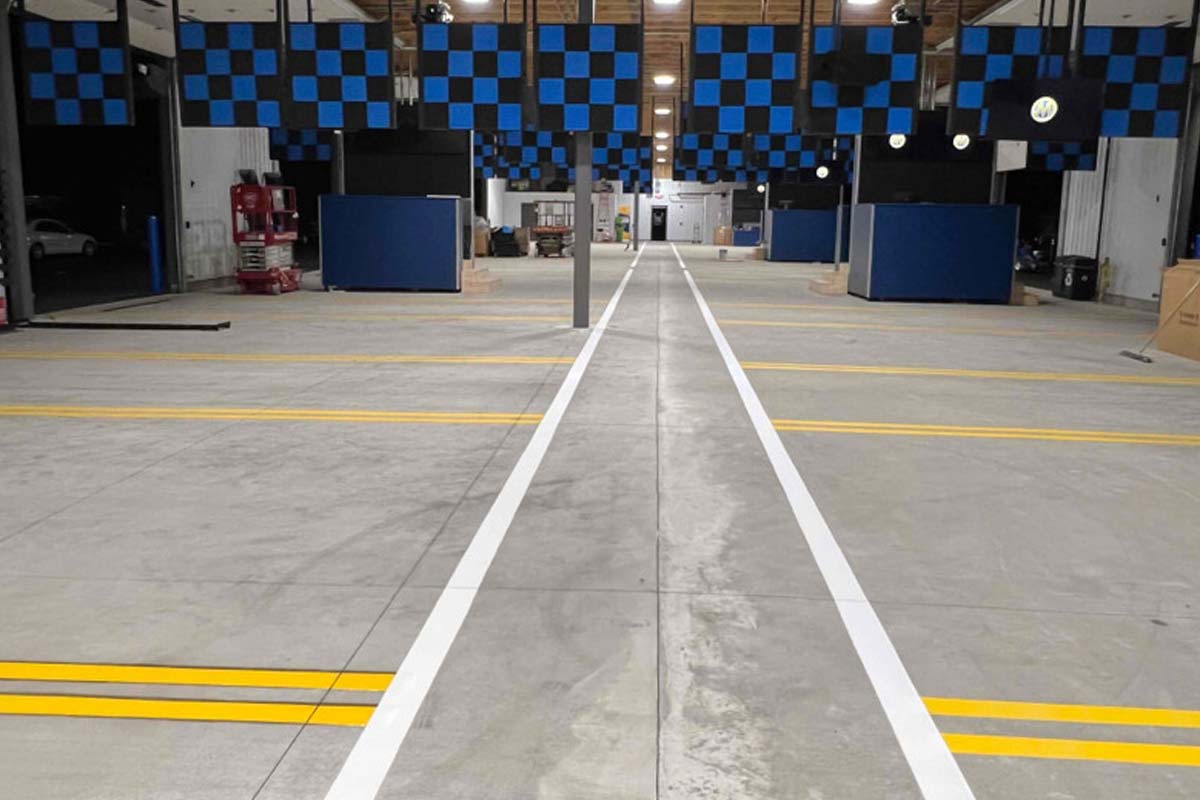
Interior line painting is what turns an open floor into a facility people can move through safely. Aisles get boundaries, pedestrians get a route that is not the forklift route, staging areas stop creeping, and the dock has a defined approach.
We paint warehouse floors, distribution centers, manufacturing floors and back-of-house areas across the northwest metro and out along the Interstate 94 corridor toward St. Cloud, where most of the region’s newer distribution space has been built. The work also covers the exterior side of the same buildings — truck courts, trailer stalls, dock approaches and employee lots.
Interior work is planned around your operation. The floor has to be clear where the crew is working and stay clear while the paint cures, so the sequence gets built around shifts, receiving windows and the aisles you cannot give up.
What OSHA Actually Requires for Aisle Markings
The operative federal rule is short. OSHA 29 CFR 1910.176(a) states that permanent aisles and passageways shall be appropriately marked, and that where mechanical handling equipment is used, sufficient safe clearances shall be allowed for aisles, at loading docks, through doorways and wherever turns must be made.
What that regulation does not say is the part worth knowing. It specifies no line width. It specifies no line color. It specifies no aisle width — only “sufficient safe clearances.” It names no paint or tape product. Anyone quoting you a mandatory OSHA line width or a required OSHA aisle color is quoting something the regulation does not contain.
Two related points. First, the marking duty lives in 1910.176(a), not in 1910.22 — the housekeeping section that is often cited for it. The four subsections of 1910.22 cover surface conditions, loads, access and egress, and inspection, and the word aisle does not appear in them. Second, color does carry a federal rule in one specific case: 29 CFR 1910.144 assigns red to fire protection equipment and danger, and yellow to caution and physical hazards. That is a color-identification rule, not an aisle-width rule.
The practical consequence is that your facility gets to choose a marking scheme that fits how it actually operates, as long as the aisles are marked and the clearances are safe. We will document what we paint so the scheme is legible to a new employee and to an inspector.
Markings We Paint Inside a Facility
| Marking | What it does |
|---|---|
| Aisle lines | Define permanent aisles and passageways, the marking OSHA 1910.176(a) requires |
| Pedestrian walkways | Separate foot traffic from forklift and equipment routes |
| Crosswalks | Mark where a walkway crosses a vehicle aisle |
| Staging and stock zones | Bound the areas where product may sit, so it stops encroaching on aisles |
| Racking footprints | Mark rack lines so pallets are placed inside the rack line, not into the aisle |
| Dock and trailer positions | Guide backing and staging at the dock |
| Equipment and charging zones | Bound forklift charging, battery areas and equipment parking |
| Keep-clear zones | Panels, exits, extinguishers and eyewash stations kept unobstructed |
| Floor lettering and numbering | Bay, dock and zone identification |
Facilities that carry a lot of legacy paint often need old markings removed before the new scheme goes down, for exactly the reason parking lots do: a floor with two schemes on it teaches nobody anything.
Line Colors and What They Communicate
There is no federal aisle color mandate, so most facilities adopt a convention and apply it consistently. A common scheme:
| Color | Typical use |
|---|---|
| Yellow | Aisle boundaries, traffic lanes, physical-hazard caution marking (consistent with 29 CFR 1910.144) |
| White | Equipment, fixtures, racking and general non-hazard boundaries |
| Red | Fire equipment and danger identification, per 29 CFR 1910.144 |
| Blue, green or black | Materials, work in progress, finished goods — facility-defined |
| Black and yellow stripes | Areas that expose people to physical or health hazards |
| Black and white stripes | Areas kept clear for operational reasons rather than safety reasons |
The value of a scheme is consistency, not the specific colors. The ANSI Z535.1 safety color standard is the usual reference where a facility wants an external convention to point at. Pick one and hold it across the whole floor.
Planning Around an Active Facility
Most facilities cannot stop, so the floor gets painted in pieces. We walk the space first and agree three things: which aisles can close and when, how long each painted section needs to stay clear, and how traffic reroutes while it does.
From there the sequence usually follows the operation — the areas that empty during a shift change go first, dock aisles get done between receiving windows, and racking lines get painted where product has already been pulled. Off-shift and weekend work is common on floors where no aisle can close during production.
The constraint that catches people out is cure time, not paint time. A line goes down quickly; what takes the schedule is keeping traffic off it afterwards. Building the sequence around that is the difference between a clean job and a floor with tire tracks through it.
Floor Surfaces and Prep
Interior floors are usually sealed or bare concrete, and both hold paint well when they are clean and dry. Prep is what determines whether the line lasts: dust, forklift tire rubber, oil and old adhesive all keep paint from bonding.
Sealed and coated floors need the surface assessed before anything goes down, because paint bonds to the coating rather than to the concrete, and a failing coating takes the line with it. Where a floor has old tape residue or previous markings, removal comes first.
Exterior concrete and asphalt at the same building — truck courts, trailer stalls, employee parking — take standard traffic paint and can usually be done on the same visit as the interior work.
Facilities We Line Paint in the Northwest Metro
Distribution and fulfillment centers — the highest-traffic floors, where aisle marking and pedestrian separation carry the most weight.
Manufacturing floors — work cells, equipment footprints and material staging bounded so the layout stays where it was designed.
Cold storage and food facilities — floors with wash-down regimes and their own surface conditions.
Third-party logistics warehouses — layouts that change with the customer mix, so re-marking is periodic rather than one-off.
Retail back-of-house and stockrooms — smaller floors with the same aisle and keep-clear requirements.
Municipal and fleet garages — bay marking, equipment zones and vehicle staging.
Buildings along the Interstate 94 corridor between Rogers, Monticello, Big Lake and St. Cloud make up a large share of this work, alongside the industrial parks around Maple Grove, Osseo and Elk River.
For a full list of our pavement marking services, visit our parking lot striping in Maple Grove page.
Businesses We Serve




How it Works

GET A FREE ESTIMATE
Contact us today and we’ll have a quote to you in 24 hours

SCHEDULE A STRIPING
We’ll have your space restriped in less than 7 days, without affecting your business hours

GET A PARKING LOT THAT POPS
For a budget-friendly price, you’ll get a parking lot that looks like new
We proudly work with:


We proudly work with:


Frequently Asked Questions About Warehouse Line Painting in Maple Grove, MN
Does OSHA require warehouse aisles to be marked?
Yes. OSHA 29 CFR 1910.176(a) states that permanent aisles and passageways shall be appropriately marked, and that sufficient safe clearances shall be allowed for aisles, at loading docks, through doorways and wherever turns must be made. Note the provision number: the marking duty sits in 1910.176(a), not in 1910.22, which covers surface conditions, loads, access and egress, and inspection.
What line width does OSHA require for aisle markings?
None. The regulation specifies no line width, no line color and no aisle width — it requires that permanent aisles be appropriately marked and that clearances be sufficient and safe. Any specific width quoted to you as an OSHA requirement is not in the standard. Most facilities choose a width that stays legible under their traffic and then apply it consistently across the whole floor.
What do the different floor marking colors mean?
Most of it is convention rather than regulation. One part is federal: 29 CFR 1910.144 assigns red to fire protection equipment and danger, and yellow to caution and physical hazards. Beyond that, facilities commonly use yellow for aisles, white for equipment and racking, and other colors for materials and work in progress. ANSI Z535.1 is the usual reference standard where a facility wants an external convention.
Can you paint our floor without shutting down operations?
Yes, and that is the normal arrangement. The floor gets painted in sections sequenced around your shifts, receiving windows and the aisles you cannot give up. Off-shift and weekend work is common where no aisle can close during production. The scheduling constraint is cure time rather than paint time — keeping traffic off a finished section is what shapes the sequence.
Do you mark racking and staging areas as well as aisles?
Yes. Aisle lines are the requirement; the rest is what makes the requirement hold. We mark racking footprints so pallets land inside the rack line instead of in the aisle, bound staging and stock zones so product stops encroaching, mark equipment and charging areas, and paint keep-clear zones at panels, exits, extinguishers and eyewash stations. Bay and dock lettering is part of the same visit.
Do you still call this warehouse floor markings?
Same service, two names. Warehouse line painting and warehouse floor markings describe the same work: painting the aisles, walkways, staging zones, racking lines and safety markings inside a facility. Some customers ask for interior line painting, others for floor marking or floor striping. Whichever term you use, it covers the interior work described on this page, and the exterior truck court and employee lot can be done on the same visit.