Wheel Stop Installation
In Nashville, TN
Concrete and Rubber Wheel Stops
1-800-STRIPER provides wheel stop installation in Nashville, TN — anchoring concrete and rubber wheel stops at the head of each stall so parked vehicles stay off sidewalks, storefronts, landscaping, and the accessible routes that ADA Standards section 502.7 requires stay clear, for commercial properties across Middle Tennessee.
1-800-STRIPER® of Nashville PROVIDes Wheel Stop Installation Services NEAR YOU
Need to protect vehicles or walls from accidental damage?
Wheel stops (also called parking blocks) protect your property, enhance safety, and improve parking lot organization.
Benefits:
Wheel stops prevent vehicles from parking too far into a space or overextending into other spots, pedestrian walkways, and other areas, while also helping with vehicle alignment. They can prevent damage to buildings, curbs, or landscaping. Wheel stops also serve as clear visual cues for proper parking and are sometimes used on slopes to prevent cars from rolling.
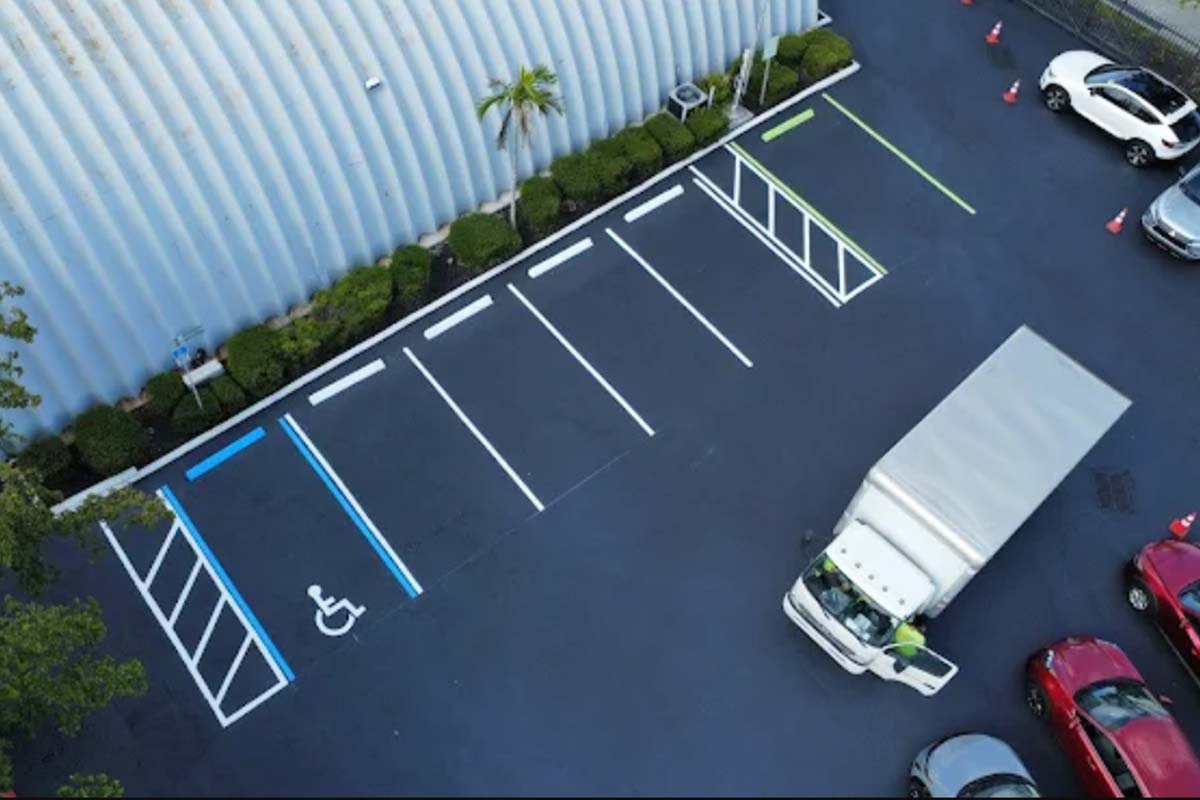
Wheel Stop Installation for Nashville Commercial Lots
A wheel stop is a short concrete or rubber block anchored at the head of a parking stall. It does one job: it stops the front tire where the stall ends, so the bumper doesn’t end up over the sidewalk, against the storefront, or on top of the landscaping. We install, replace, and remove wheel stops for retail centers, offices, medical buildings, churches, apartment communities, and industrial sites across Nashville, Franklin, Murfreesboro, Hendersonville, and the rest of Middle Tennessee.
Most requests start with damage that has already happened: a cracked sidewalk edge, bent downspouts, scraped brick, or a planter bed that cars keep driving into. Stops also keep vehicles aligned in their stalls, give drivers a clear cue for where to pull up, and help hold position on sloped rows where a car could otherwise creep forward.
What the ADA Actually Says About Wheel Stops
This gets overstated a lot, so here is the exact rule. The 2010 ADA Standards for Accessible Design do not require wheel stops. Section 502.7 sets an outcome instead: “Parking spaces and access aisles shall be designed so that cars and vans, when parked, cannot obstruct the required clear width of adjacent accessible routes.” Section 403.5.1 sets that clear width at 36 inches minimum.
The product shows up in the advisory note to section 502.7: “Wheel stops are an effective way to prevent vehicle overhangs from reducing the clear width of accessible routes.” Advisory notes are explanatory. The Department of Justice regulation at 28 CFR 36.406 says advisory notes “explain or illustrate the requirements of the rule; they do not establish enforceable requirements.”
So nothing obligates you to buy a wheel stop. What obligates you is the result. If an accessible route runs along the head of a row and a parked bumper narrows it below the required width, that is a compliance problem, and a wheel stop is the fix the Access Board itself calls effective.
What Metro Nashville’s Parking Code Requires
Inside Metro Nashville and Davidson County, the zoning code goes further than the ADA on overhang, and it isn’t limited to accessible routes. Metro Code section 17.20.060(H) reads: “Curbs or other equivalent means shall be provided to prevent any vehicle using a parking area from encroaching on any public right-of-way, on-site sidewalk, required landscaping area or adjacent property.”
The code doesn’t name wheel stops. It asks for curbs or an equivalent, and a properly anchored wheel stop is the common way to get that result where a curb isn’t practical or a lot was built without one. Whether a given stop layout satisfies your site plan is a call for the Metro reviewer on that plan, so if your project is going through permitting, we install to the approved drawings.
We haven’t found a Tennessee statute or a Metro rule that sets a wheel stop’s height, length, material, or distance from the curb, and we won’t quote one we haven’t read. Towns outside Davidson County, such as Franklin or Murfreesboro, have their own zoning codes, so we check the one that applies to your property before we assume.
Concrete vs. Rubber Wheel Stops
We install both, and the right one depends on the spot.
| Concrete | Rubber | |
|---|---|---|
| Weight and feel | Heavy, rigid, stays put | Lighter, flexes on impact |
| Typical weak point | Can chip or crack from plows and hard hits | Can loosen if anchoring is poor |
| Moving it later | Harder to relocate | Easier to handle and reset |
| Good fit | Permanent rows that rarely change | Busy rows that get bumped, or layouts that may change |
Either way, the stop is only as good as its anchoring. A stop that shifts or rocks becomes a trip hazard rather than a barrier, so we anchor every unit to suit the pavement it sits on, asphalt or concrete. If your architect or property manager has specified a product, we install to that specification.
How We Install and Replace Wheel Stops
- Walk the lot. We look at every stall head that meets a sidewalk, a building, an accessible route, landscaping, or a neighboring property, and note any broken or missing stops.
- Set placement from the stall layout. The stop goes where it keeps the vehicle’s overhang out of what’s in front of it. That depends on stall depth and what sits at the head of the stall, so we set it on site instead of from a table.
- Remove what’s failing. Cracked, loose, or misaligned stops come out along with their old anchors.
- Anchor the new stops and confirm each one sits square to its stall.
- Coordinate with striping. If the lot is being restriped, we place the stops against the new layout rather than the old one.
Get a free estimate and we’ll have a quote to you within 24 hours, with installation scheduled in less than 7 days and planned around your business hours.
For a full list of our pavement marking services, visit our parking lot striping in Nashville page. We also provide parking lot restriping and parking lot sign installation for Nashville properties.















How it Works

GET A FREE ESTIMATE
Contact us today and we’ll have a quote to you in 24 hours

SCHEDULE AN INSTALLATION
We’ll have your installation scheduled in less than 7 days, without affecting your business hours

GET A PARKING LOT THAT POPS
For a budget-friendly price, you’ll get a parking lot that looks like new
We proudly work with:


We proudly work with:


Frequently Asked Questions About Wheel Stop Installation in Nashville, TN
Does the ADA require wheel stops?
No. The 2010 ADA Standards require an outcome, not a product: section 502.7 says parking spaces and access aisles must be designed so parked cars and vans cannot obstruct the clear width of an adjacent accessible route. Wheel stops appear in the advisory note to that section, which calls them an effective way to prevent overhang, and 28 CFR 36.406 states that advisory notes do not establish enforceable requirements. They are a proven way to meet the rule, not the rule itself.
Does Nashville require wheel stops in parking lots?
Not by name. Metro Nashville’s zoning code, section 17.20.060(H), requires “curbs or other equivalent means” to keep vehicles in a parking area from encroaching on the public right-of-way, on-site sidewalks, required landscaping, or adjacent property. An anchored wheel stop is a common way to meet that where there is no curb. If your site is going through Metro plan review, we install to the approved plan.
How far from the curb should a wheel stop sit?
We haven’t found a Tennessee or Metro Nashville figure for that, so we won’t invent one. Placement is functional: the stop goes where it keeps the vehicle’s overhang out of the sidewalk, building, landscaping, or accessible route in front of the stall. That depends on stall depth and what sits at the head of the stall, so we set it on site.
Should I choose concrete or rubber wheel stops?
Concrete is heavy and permanent, which suits rows that rarely change, but it can chip or crack from plows and hard hits. Rubber is lighter, flexes instead of cracking, and is easier to reset if your layout changes. We’ll recommend one for each spot, and if your architect or property manager has specified a product, we install that.
Can you replace wheel stops that are broken or loose?
Yes. A cracked or rocking stop is a trip hazard rather than a barrier. We remove the failing units and their old anchors and set new stops against your current stall layout, not the layout that happened to be there when the originals went in.
Should wheel stops go in at the same time as restriping?
It’s the best time to do it. Stall layout and stop placement are the same decision, so setting stops against freshly painted lines keeps every stall consistent. We can schedule both in one visit.