Warehouse Line Painting
In Bellevue, WA
Indoor Line Striping for Warehouses and Facilities
1-800-STRIPER provides professional warehouse line painting in Bellevue, WA — marking forklift aisles, pedestrian walkways, safety zones, and equipment areas with durable epoxy and traffic paint for distribution centers across King and Snohomish counties.
1-800-STRIPER of Bellevue Provides Warehouse Line Painting in Bellevue, WA Services NEAR YOU
Want your indoor space to operate more efficiently?
Warehouse and interior markings ensure clear traffic lanes, organized storage zones, and designated spaces designed to help your business operate safely and efficiently.
Benefits:
Warehouse Floor Marking Requirements in Washington
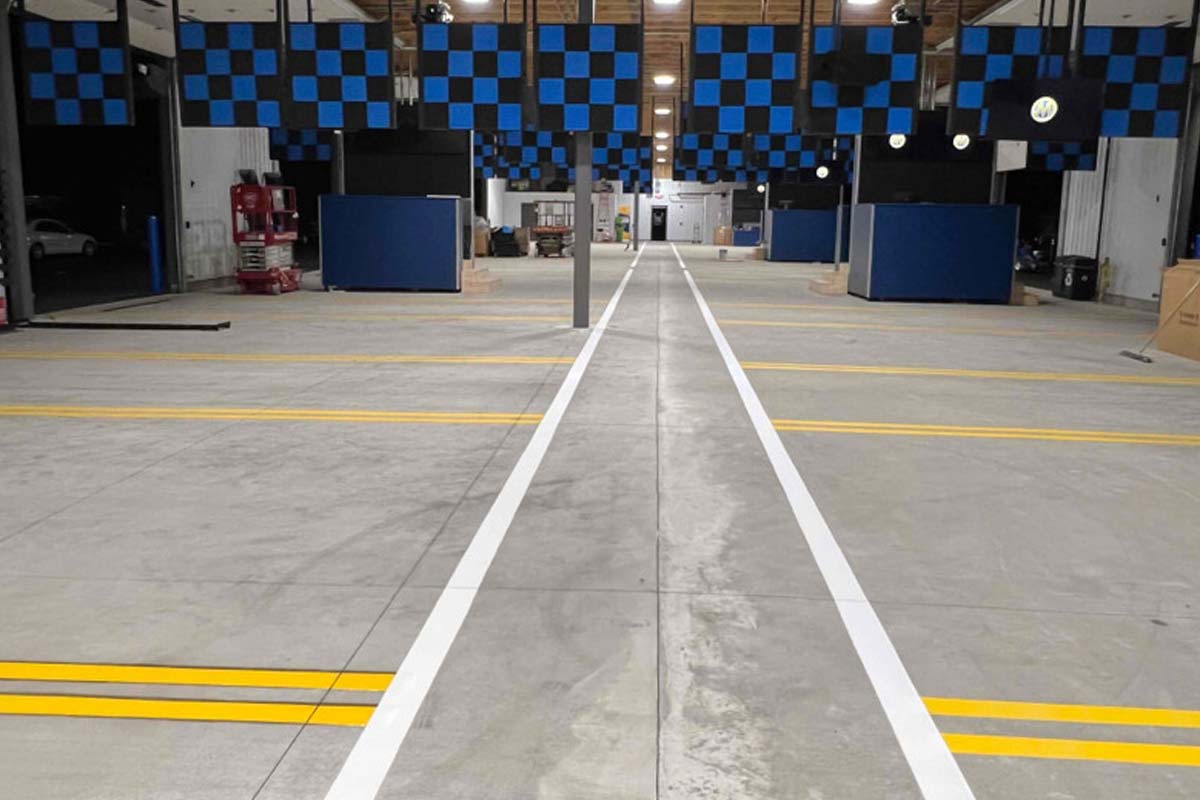
Warehouse floor marking in Bellevue sits under a different regulator than most operators assume. Because Washington runs its own OSHA-approved State Plan through the Department of Labor & Industries under RCW 49.17, a Bellevue distribution center gets inspected against the Washington Administrative Code rather than directly against the federal standard. That distinction matters here, because the state’s own aisle-marking sentence is gone. It was struck from Washington Administrative Code 296-24-73505 effective October 1, 2020. What the current section covers is walking-working surface conditions, load limits, access and egress, and inspection. No marking duty is stated anywhere in it. The honest answer, then: no Washington rule prescribes a line width, a color or an aisle dimension for warehouse floors. Everything below is practice, and it is described as practice.
Aisle, Walkway and Safety-Zone Layout
Good warehouse floor marking starts from how the building actually moves, not from a template. Aisles are laid out around the widest piece of equipment that uses them plus working clearance on each side; pedestrian walkways are routed along the edges of traffic rather than across it, with defined crossings where they must cut through. Safety zones get their own outline — electrical panels, eyewash stations, fire equipment, and battery-charging bays all need standing room that stays clear. Marking those zones on the floor is what keeps them clear once pallets start stacking up.
Forklift Lanes and Pedestrian Separation
Separating forklifts from people on foot is the single highest-value thing floor marking does in a distribution center. That means continuous lane edges rather than intermittent dashes, marked crossings at the points where walkways meet traffic, and clear standoff at blind corners, dock doors, and the ends of racking runs where a lift emerges without warning. Where the building layout forces a shared route, hatching the shared section makes the conflict visible to both parties instead of leaving it to habit and eye contact.
Color Conventions for Warehouse Floor Marking
Color on a warehouse floor is convention, not regulation — it works because a facility applies it consistently, not because a code assigns it. The widely used scheme puts yellow on aisles and traffic paths, red on fire equipment and emergency stops, white on general equipment and work areas, green on first-aid points, and black-and-yellow or black-and-white hatching on hazard zones. The value is in the consistency: one scheme applied across the whole building, and documented so it survives staff turnover.
Epoxy, Polyurea and Traffic Paint on Concrete
Material choice tracks how long the layout will stay put. Two-part epoxy gives the hardest, longest-lasting line and suits permanent aisles under constant lift traffic. Polyurea cures much faster, which matters when a facility cannot give up a weekend. Water-based traffic paint costs least and reapplies easily, making it the sensible choice for zones that will move as the operation changes. Most buildings end up using more than one.
Surface Preparation for Warehouse Line Marking
Adhesion is decided before any material is opened. Concrete has to be clean, dry, and free of curing compound or old sealer, and for epoxy it needs a mechanical profile — shot blasting is the usual method — so the coating keys into the slab instead of sitting on it. Sealed or polished floors that are simply washed will shed their lines early.
For a full list of our pavement marking services, visit our parking lot striping in Bellevue, WA page.
Businesses We Serve




How it Works

GET A FREE ESTIMATE
Contact us today and we’ll have a quote to you in 24 hours

SCHEDULE A STRIPING
We’ll have your space restriped in less than 7 days, without affecting your business hours

GET A PARKING LOT THAT POPS
For a budget-friendly price, you’ll get a parking lot that looks like new
We proudly work with:


We proudly work with:

Frequently Asked Questions About Warehouse Line Painting in Bellevue, WA
What are the floor marking requirements for a Bellevue warehouse?
Washington operates its own OSHA-approved State Plan under RCW 49.17, so a Bellevue warehouse is inspected against the Washington Administrative Code rather than directly against the federal standard. The state’s aisle-marking sentence was struck from WAC 296-24-73505 effective October 1, 2020, and the current section addresses walking-working surface conditions, load limits, access and egress, and inspection — without prescribing floor markings. In practice that means there is no Washington rule setting a line width, a color, or an aisle dimension for warehouse floors; those are engineering and operational decisions for the facility.
What do the different warehouse floor marking colors mean?
Floor marking colors are convention rather than regulation. The widely used scheme assigns yellow to aisles and traffic paths, red to fire equipment and emergency stops, white to general equipment and work areas, green to first-aid points, and hatching to hazard zones. Its value comes entirely from being applied consistently across a building and documented, so the meaning survives staff turnover. A facility may adopt a different scheme provided it is used consistently and people are trained on it.
Is epoxy or paint better for warehouse floor markings?
For high-traffic Bellevue, WA warehouses with heavy forklift use, two-part epoxy is the most durable option — lasting 3–5 years with proper concrete surface preparation via shot blasting. Standard acrylic traffic paint costs less and dries faster but may need repainting annually in heavy-use areas. Polyurea coatings offer a middle ground with faster cure times. We recommend epoxy for permanent lanes and paint for areas that may change.
How wide should warehouse floor lines be?
There is no regulated width in Washington. Common practice runs 2 to 4 inches for general aisle and zone boundaries and 4 to 6 inches where visibility matters most — main forklift lanes, pedestrian crossings, and hazard zones. Wider lines read better from a seated operating position and survive wear longer before they need repainting. The right width is the one that stays legible under the traffic that particular aisle carries.
How long do warehouse floor markings last?
In a typical Bellevue, WA warehouse, epoxy floor markings last 3–5 years while standard traffic paint lasts 1–2 years depending on traffic volume. Polyurea coatings can last 3–4 years. Facilities with heavy forklift traffic or frequent pallet jack use see faster wear. Proper surface preparation on concrete — including cleaning and shot blasting for epoxy — dramatically extends lifespan.
What aisle width should a Bellevue warehouse use?
Aisle width is set by the equipment, not by a Washington regulation. The working approach is to take the widest load or truck that uses the aisle and add clearance on each side for safe maneuvering and for anyone on foot. Standard counterbalance forklift aisles commonly land around 10 to 12 feet; narrow-aisle and reach trucks work in considerably less. Dedicated pedestrian walkways are sized for people to pass one another comfortably.
How do you prepare a warehouse floor for striping?
Proper surface preparation is critical for adhesion in Bellevue, WA warehouse environments. We start by pressure washing or shot blasting the concrete surface to remove dirt, oil, and loose material. For epoxy applications, shot blasting creates the surface profile needed for a strong bond. The floor must be completely dry before applying markings. Clean, profiled concrete ensures lines last years.
How long does a warehouse floor marking job take, and do we have to shut down?
Rarely a full shutdown. Most buildings are marked zone by zone, working around the operation and taking the busiest aisles during a quieter shift or over a weekend. The pacing constraint is cure time rather than application: traffic paint returns to service quickly, polyurea within hours, and epoxy needs the longest before lift traffic runs over it. Sequencing the plan around that is the difference between one visit and several.
Can floor markings be applied over a sealed or coated concrete floor?
Only with the right preparation. A sealer, cure-and-seal compound, or polished finish is exactly what a coating is designed to prevent adhesion to, so lines applied straight onto it will lift under traffic. The fix is mechanical: abrade or shot blast the marked areas to open the surface, then apply. Testing adhesion on a small area before committing to a whole building is worth the extra visit.
How do we mark a floor layout that keeps changing?
Match the material to the expected life. Permanent aisles and safety zones justify epoxy or polyurea; areas that will move with the racking or the season are better in traffic paint, which is cheap to remove and redo. Some facilities use marking tape for genuinely temporary zones. The mistake to avoid is putting a five-year coating under a layout that will change in twelve months.