
Wheel Stop Installation
In Reston, VA
Concrete and Rubber Parking Stops
1-800-STRIPER provides professional wheel stop installation in Reston, VA — anchoring concrete, recycled-rubber, and plastic-composite wheel stops at stall heads to protect sidewalks, storefronts, and ADA accessible routes per the 2010 ADA Standards for commercial properties across Fairfax and Loudoun counties.
1-800-STRIPER® of Reston PROVIDes Wheel Stops Services NEAR YOU
Need to protect vehicles or walls from accidental damage?
Wheel stops (also called parking blocks) protect your property, enhance safety, and improve parking lot organization.
Benefits:
Wheel stops prevent vehicles from parking too far into a space or overextending into other spots, pedestrian walkways, and other areas, while also helping with vehicle alignment. They can prevent damage to buildings, curbs, or landscaping. Wheel stops also serve as clear visual cues for proper parking and are sometimes used on slopes to prevent cars from rolling.
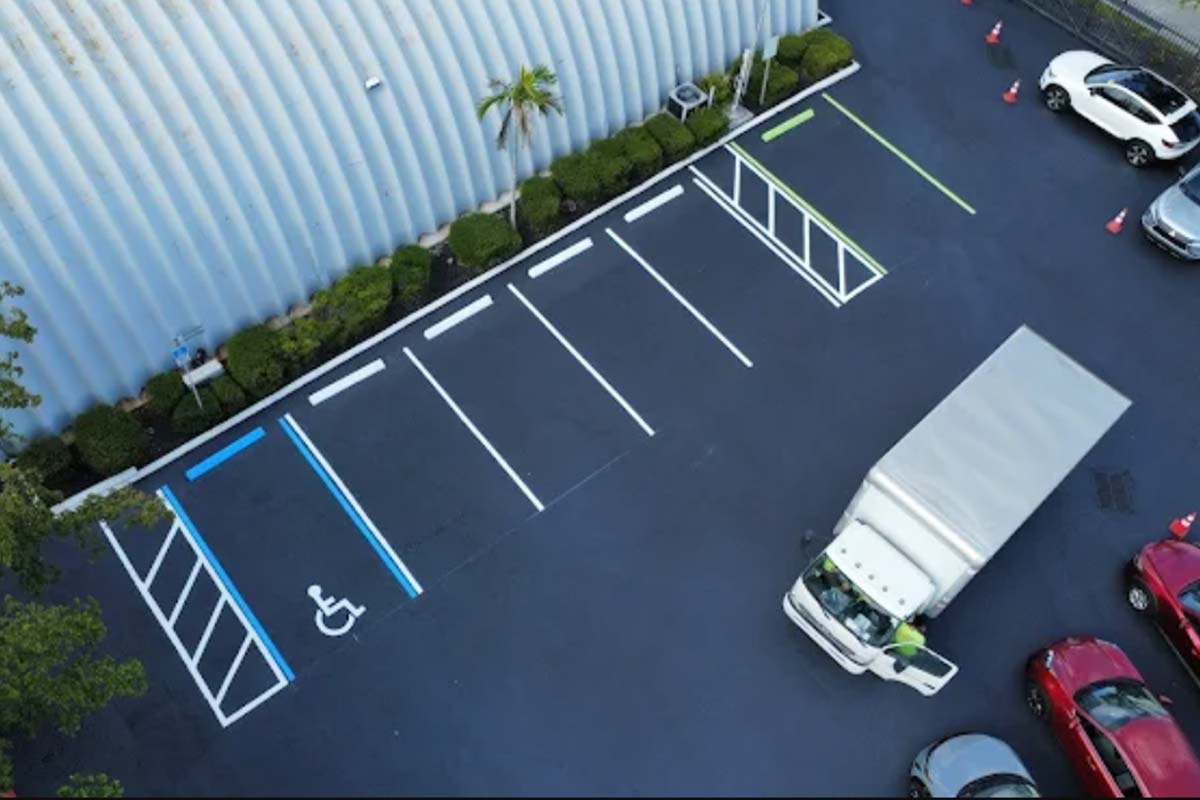
Wheel Stop Installation in Reston, VA
A wheel stop is the low barrier at the head of a parking stall that catches a vehicle’s front tires before the car does any damage. It is a small piece of hardware with a specific job: keep bumpers off the sidewalk, out of the landscaping, and away from the storefront glass, and keep a parked car from overhanging into a walkway a pedestrian — or a wheelchair — needs to use. We supply and install wheel stops on commercial lots across Fairfax and Loudoun counties, anchored so they stay where we put them. The two decisions that matter are what the stop is made of and where it sits, and both carry real consequences in Northern Virginia’s climate.
What Wheel Stops Do
Wheel stops earn their place in a few specific spots. At the head of a stall that faces a sidewalk or building, they stop overhang before a bumper reaches the wall or the glass. Along a landscaped island, they keep tires out of the planting bed. And at accessible spaces they protect the clear route a wheelchair depends on — which is where placement stops being cosmetic and becomes a compliance matter. A stop that is anchored properly does this quietly for years; one that isn’t becomes a loose slab in a drive aisle and a trip hazard of its own.
They are not needed in every stall. The value is highest where a car’s overhang would reach something that matters — a walkway, a storefront, a utility cabinet, or the accessible route — and lower in the middle of an open field of parking. We walk the lot and mark the stalls where a wheel stop actually does work, rather than lining every space with hardware that adds cost and gives snowplows more to catch. Where a stall backs onto another row of parking, curbing or a painted stop bar often does the same job with nothing to trip over.
Material Options: Concrete, Rubber, and Composite
We install three materials, and the right one depends on climate exposure and traffic more than on anything else:
| Material | Character | Freeze-thaw behavior |
|---|---|---|
| Concrete | Most rigid and traditional; heavy | Water works in, freezes, and can crack or spall the surface |
| Recycled rubber | Lighter and flexible; easy to reset | Resists cracking; shrugs off glancing plow contact |
| Plastic composite | Lightweight; won’t absorb water | Won’t crack or spall; holds up through freeze-thaw |
Concrete is the classic choice and the most rigid, but Northern Virginia’s freeze-thaw winters are hard on it — water works into the material, freezes, and spalls the surface over a few seasons. Recycled rubber and plastic composite are lighter, won’t crack the same way, and take a plow blade’s glancing hit without shattering, which is why we often steer Reston-area lots toward them for longevity. We match the material to how exposed the stall is and how much winter maintenance the lot sees.
Placement at ADA Spaces and Anchoring
Placement at accessible spaces follows a rule, not a preference. Under the 2010 ADA Standards for Accessible Design, a parked vehicle’s overhang can’t be allowed to reduce the required clear width of an accessible route or access aisle — so at accessible stalls a wheel stop is set back far enough (commonly about 2 feet from the walkway) that an overhanging bumper still leaves the path fully usable. Get this wrong and the stripe says compliant while the parked car says otherwise.
Anchoring is what makes a wheel stop stay a wheel stop. We anchor each unit with steel pins or rebar driven through pre-formed holes into the pavement — typically two per stop — so tires and plows can’t walk it out of position, using longer pins on asphalt for grip. Proper anchoring is the whole difference between a stop that lasts and one that shifts into a hazard. Call (703) 570-4163 for a free estimate on wheel stop installation.
For a full list of our pavement marking services, visit our parking lot striping in Reston page.
Businesses We Serve




How it Works

GET A FREE ESTIMATE
Contact us today and we’ll have a quote to you in 24 hours

SCHEDULE AN INSTALLATION
We’ll have your installation scheduled restriped in less than 7 days, without affecting your business hours

GET A PARKING LOT THAT POPS
For a budget-friendly price, you’ll get a parking lot that looks like new
We proudly work with:


We proudly work with:


Frequently Asked Questions About Wheel Stop Installation in Reston, VA
What are wheel stops and why install them?
Wheel stops (parking bumpers) are the low barriers at the head of a stall that stop a vehicle’s tires so it doesn’t roll onto sidewalks, landscaping, or storefronts. They protect pedestrians, buildings, and the accessible route, and they keep cars from overhanging into walkways. We anchor them securely so they stay put under daily use.
What are wheel stops made of?
We install concrete, recycled-rubber, and plastic-composite wheel stops. Concrete is the most rigid and traditional; recycled rubber and composite are lighter, won’t crack or spall in freeze-thaw winters, and resist chipping from plows. We recommend a material based on your climate exposure and traffic — Northern Virginia’s freeze-thaw cycles often favor rubber or composite for longevity.
Where should wheel stops be placed at ADA spaces?
At accessible spaces, wheel stops are positioned so a parked vehicle’s overhang can’t reduce the required clear width of the accessible route or aisle, per the 2010 ADA Standards route-clearance rules — commonly a setback of about 2 feet from the walkway. We place and anchor them so the accessible path stays fully usable.
How are wheel stops anchored so they don’t move?
We anchor wheel stops with steel pins or rebar driven through pre-formed holes into the pavement, typically two per stop, so they resist being pushed by tires or plows. On asphalt we use longer pins for grip. Proper anchoring is what separates a wheel stop that lasts from one that shifts and becomes a trip hazard.