
Thermoplastic Striping
In Ogden, UT
Durable Heat-Applied Pavement Markings
1-800-STRIPER provides professional thermoplastic striping in Ogden, UT — heat-applied lane lines, crosswalks, stall markings, arrows, and legends bonded into the pavement with surface-applied glass beads per AASHTO M 249, for commercial properties across Weber, Davis, Morgan, and Box Elder counties.
1-800-STRIPER® of Ogden PROVIDes Thermoplastic Striping Services NEAR YOU
Want to reduce the maintenance requirements for your parking lot?
Thermoplastic pavement markings are a durable, weather and vehicle-resistant striping option for your parking lot or facility.
You can utilize them for stop bars, ADA stalls, no-parking zones, directional arrows, crosswalks, or your entire parking lot.
Benefits:
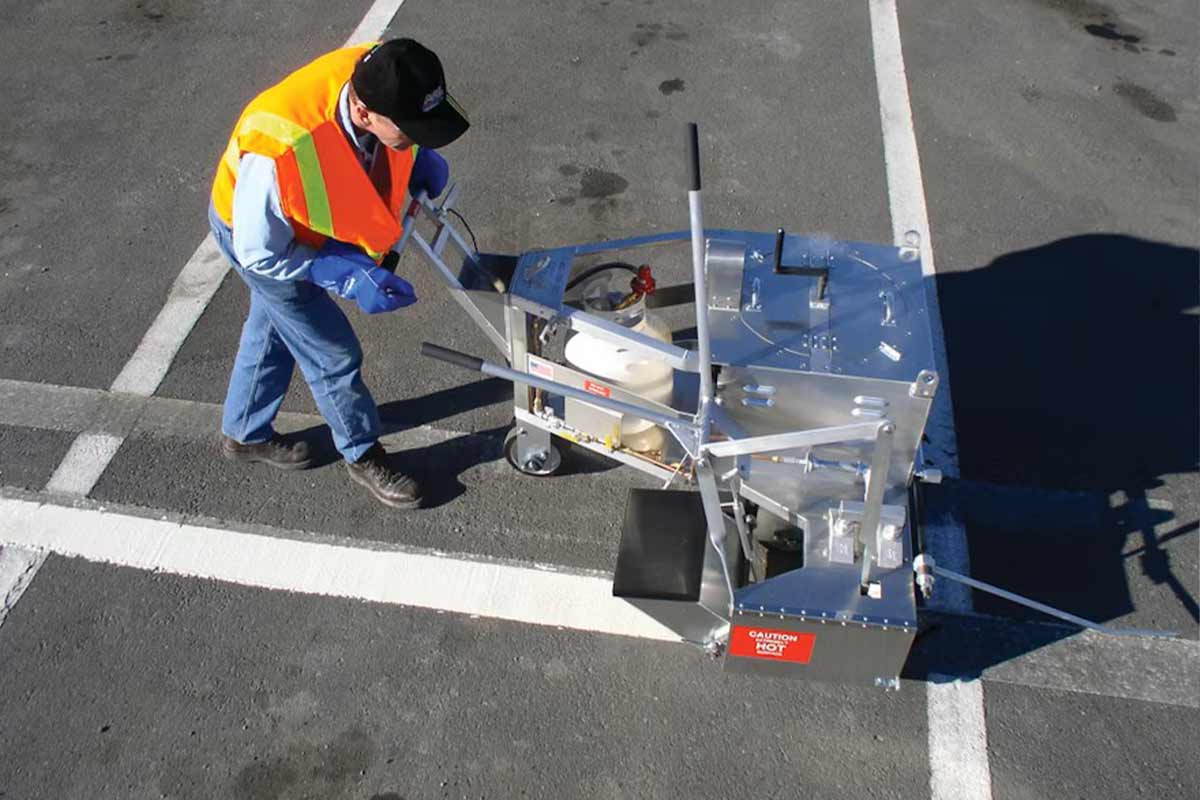
Thermoplastic Striping in Ogden, UT
Thermoplastic is not paint. Paint is a liquid that dries on top of the pavement; thermoplastic arrives as a solid, gets heated until it flows, and is laid down molten so it fuses to the surface as it cools. What you end up with is a marking with real thickness to it — something you can feel with your hand — rather than a film sitting on the asphalt. That difference is the whole reason it exists.
We install thermoplastic markings on retail centers, distribution and warehouse sites, office parks, medical campuses, schools, apartment complexes, and industrial properties around Ogden and the surrounding Weber, Davis, Morgan, and Box Elder county towns. It shows up most often where a marking has to survive traffic that would scrub paint off in a season: main drive aisles, entrances and exits, crosswalks, stop bars, directional arrows, and the ADA symbols at accessible stalls.
It is not the right answer for every line on every lot, and we will say so. Thermoplastic costs more to install than waterborne paint and it is far more work to remove or change. On a lot whose layout is settled and whose drive aisles take a beating, that permanence is exactly what you want. On a lot you expect to reconfigure, or on stall lines that see little more than a parked car, paint often makes better sense. The honest version of this conversation usually ends with a mix — thermoplastic where the wear is, paint where it isn’t.
How Long Thermoplastic Lasts on a Northern Utah Lot
This is where Utah has published its own numbers, and they are worth knowing before anyone sells you on a marking material. The Utah Department of Transportation maintains a life-cycle table for the pavement marking materials it uses on state-maintained routes. Waterborne paint comes in at 1 to 3 years. Epoxy runs 3 to 5. Thermoplastic — both line work and thermoplastic messages — also runs 3 to 5 years. Preformed tape lasts longest at 6 to 9 years, but only when it is placed into grooves cut in the pavement.
Two things follow from that table. The first is that thermoplastic buys you real service life over paint, but the sober framing is roughly double, not the eight-fold numbers that get thrown around in marketing copy. The second is that UDOT’s figures describe highway conditions — constant vehicle passes, plow contact, road salt. A private parking lot is a gentler environment than I-15, so a well-installed thermoplastic marking on a commercial lot often runs at or past the top of that range.
The other half of the picture in this part of the state is snow. UDOT explicitly tracks snowplow frequency as a factor in marking performance and sorts the state into zones: a low plowing zone sees fewer than 13 plowing days a year, a medium zone 14 to 27, and a high zone more than 27. Northern Utah’s benches and canyons sit at the heavy end of that scale, and a plow blade does not care what your markings cost. This is a genuine argument in thermoplastic’s favor — a marking fused to the pavement with thickness to it has more to give up before it stops being visible than a film of paint does. It is also an argument for where a marking sits: a thermoplastic line on a surface that a plow rides across will wear at the contact points first, and that is worth planning around rather than discovering in March.
What Thermoplastic Actually Is
The governing material specification is AASHTO M 249, the Standard Specification for White and Yellow Reflective Thermoplastic Striping Material (Solid Form). It is worth reading past the title, because the spec describes the whole method. The material is applied to the surface in a molten state by mechanical means, with glass beads applied to the surface as it goes down. On cooling to normal pavement temperature, it produces an adherent retroreflective stripe of specified color, thickness, and width that resists deformation by traffic. The resin is either alkyd or hydrocarbon, and the material is made in white and yellow.
The phrase doing the most work there is surface application of glass beads. Those beads are what send your headlights back at you at night, and they are the reason a thermoplastic crosswalk still reads at 10pm in the rain when a worn painted one has gone invisible. Beads are dropped onto the molten material so they seat into the surface rather than sitting loose on top of it. There are also beads distributed through the body of the material in most formulations, which is what keeps a line retroreflective as the top wears down — the surface layer grinds away and fresh beads are exposed underneath.
Because the material has to go down molten and bond as it cools, installation is temperature-dependent in a way paint is not. The pavement has to be dry and warm enough for the material to bond instead of chilling on contact and sitting on top like a sticker. In Ogden that puts a real fence around the calendar. We are candid about that: if the surface conditions are not right, the marking will not bond properly, and we would rather move the date than install something that peels in a year and gets blamed on the material.
Our Thermoplastic Striping Process
- Walk the lot and agree what earns thermoplastic. We look at where the traffic actually goes, where markings have failed before, and what has to stay legible at night. You get a recommendation that mixes materials rather than one that puts thermoplastic everywhere.
- Prepare the surface. The pavement gets cleaned of dirt, dust, and loose material. Thermoplastic bonds to the pavement, not to what is sitting on it, so this step decides how long the marking lasts more than any other.
- Lay out and confirm the marks. Lines, crosswalks, stop bars, arrows, legends, and ADA symbols get positioned and confirmed with you before anything is melted. Thermoplastic is not easy to undo, which is exactly why we agree the layout first.
- Heat and apply. The material is brought to application temperature and laid down molten to a specified thickness and width, with glass beads applied to the surface as it goes.
- Let it cool and walk it with you. Thermoplastic sets as it cools to pavement temperature and is ready for traffic quickly. Before we leave, you see the finished work and we confirm that the accessible stalls, aisles, and routes are intact and correctly marked.
For a full list of our pavement marking services, visit our parking lot striping in Ogden page.
Businesses We Serve




How it Works

GET A FREE ESTIMATE
Contact us today and we’ll have a quote to you in 24 hours

SCHEDULE AN INSTALLATION
We’ll have your installation scheduled restriped in less than 7 days, without affecting your business hours

GET A PARKING LOT THAT POPS
For a budget-friendly price, you’ll get a parking lot that looks like new
We proudly work with:


We proudly work with:

Frequently Asked Questions About Thermoplastic Striping in Ogden, UT
How long does thermoplastic striping last compared to paint?
Roughly double, based on Utah’s own published figures. The Utah Department of Transportation keeps a life-cycle table for the marking materials it uses on state routes: waterborne paint lasts 1 to 3 years, while thermoplastic lasts 3 to 5. Epoxy also runs 3 to 5, and preformed tape reaches 6 to 9 years but only when placed in grooves cut into the pavement. Those numbers describe highway duty — constant traffic, plowing, and salt — so a thermoplastic marking on a commercial parking lot commonly runs at or beyond the top of that range.
What is thermoplastic striping made of?
The governing spec is AASHTO M 249, the Standard Specification for White and Yellow Reflective Thermoplastic Striping Material (Solid Form). The material uses either an alkyd or a hydrocarbon resin, comes in white and yellow, and is applied molten by machine with glass beads dropped onto the surface as it goes down. Once it cools to pavement temperature it forms an adherent retroreflective stripe of specified color, thickness, and width that resists deformation by traffic.
Why is thermoplastic easier to see at night?
Glass beads. They are applied to the surface of the material while it is still molten, so they seat into it rather than sitting loose on top, and they retroreflect headlight beams back toward the driver. Most formulations also carry beads through the body of the material, so as the surface wears down fresh beads are exposed and the marking keeps working. That is why a thermoplastic crosswalk still reads on a wet night when worn paint has effectively disappeared.
Can thermoplastic be installed in the winter in Ogden?
Usually not, and we will not pretend otherwise. Thermoplastic goes down molten and has to bond as it cools, which means the pavement needs to be dry and warm enough for it to fuse instead of chilling on contact and sitting on the surface. Northern Utah’s cold season closes that window for stretches. If conditions are not right we will move the date rather than install a marking that fails early and gets blamed on the material.
Does snow plowing damage thermoplastic markings?
Plowing is hard on every marking material — UDOT tracks snowplow frequency specifically because it affects pavement marking performance, and sorts the state into zones: under 13 plowing days a year is low, 14 to 27 is medium, and more than 27 is high. Northern Utah sits at the heavy end. This is actually one of the better arguments for thermoplastic here, because a marking fused to the pavement with real thickness has more to lose before it stops being visible than a film of paint does. Where a blade rides directly across a marking, expect wear at those contact points first.
Should I use thermoplastic for my whole parking lot?
Usually no, and we would rather tell you that up front. Thermoplastic costs more to install than paint and is considerably harder to remove or change, so it earns its place where wear and night visibility matter — drive aisles, entrances, crosswalks, stop bars, arrows, legends, and ADA symbols at accessible stalls. Ordinary stall lines that only ever see a parked car are often better served by paint. Most lots end up with a sensible mix, and if your layout may change, that permanence works against you.