Bollard Installation
In Ogden, UT
Bollard Installation Services
1-800-STRIPER provides professional bollard installation in Ogden, UT — installing steel, concrete, and crash-rated bollards to protect storefronts, pedestrian walkways, utility infrastructure, and ADA accessible routes per U.S. Access Board guidance on parking lot accessibility for commercial properties throughout Weber and Davis counties.
1-800-STRIPER® of Ogden PROVIDes Bollard Installation Services NEAR YOU
Want to prevent accidents and protect your property?
Bollards provide physical protection for your customers and your property.
Safety and security:
Bollards create a physical barrier between vehicles and pedestrians, protecting people in walking areas from accidental or intentional vehicle intrusions.
Bollards act as a protective barrier around storefronts, gas stations, and other vulnerable areas, minimizing the risk of costly damage from vehicle impacts.
Strategic Placement Locations:
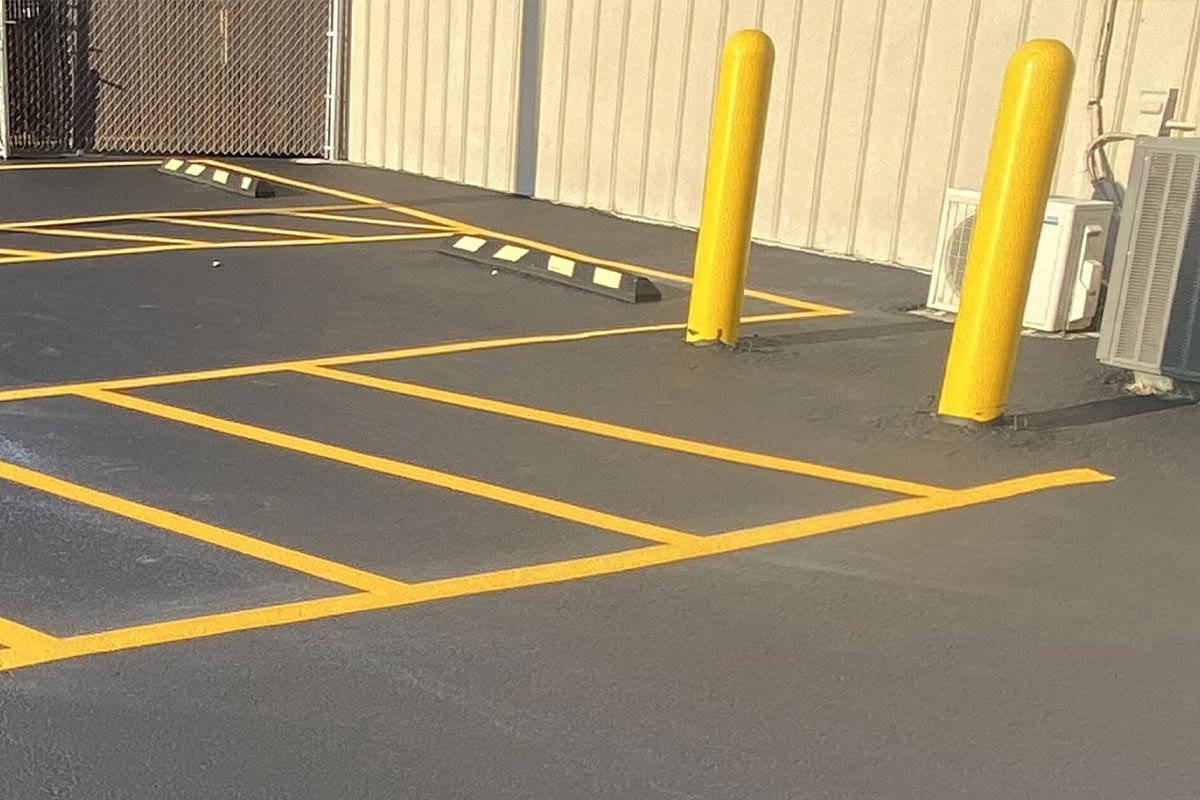
Bollard Installation in Ogden, UT
Bollard installation protects buildings, pedestrians, utility infrastructure, and accessible routes from vehicle impact. For Ogden commercial properties, bollards matter most at four failure points: storefront glass along Historic 25th Street and suburban retail centers, utility pedestals and electrical transformers that vehicles can back into, fire hydrants and Fire Department Connections that must stay accessible, and ADA accessible routes that must stay clear of vehicle encroachment.
1-800-STRIPER of Ogden installs bollards on new construction, retrofit protection on high-loss properties, federal facility perimeters, and historic-district installations where aesthetics matter as much as function. Material and rating selection depends on the threat. Routine parking-lot bump protection uses safety-yellow steel pipe. Federal perimeters at Hill Air Force Base and the IRS Ogden campus use crash-rated K-series bollards. Historic 25th Street installations use decorative cast-iron.
Bollard Types
| Type | Material | Typical use | K-rating |
|---|---|---|---|
| Steel pipe | Schedule 40 steel, concrete-filled | Storefront protection, standard bump guards | None |
| Concrete | Precast reinforced concrete | Heavy-duty perimeter, loading docks | Varies |
| Crash-rated K4 | Reinforced steel, deep footing | Federal facilities, high-security commercial | K4 (30 mph stop) |
| Crash-rated K8 | Reinforced steel, deep footing | High-threat federal perimeters | K8 (40 mph stop) |
| Crash-rated K12 | Reinforced steel, engineered footing | Highest-threat federal installations | K12 (50 mph stop) |
| Removable / fold-down | Steel or aluminum | Delivery access, emergency lanes | Varies |
| Decorative | Cast iron, powder-coated steel, bronze | Historic districts, retail aesthetics | None |
| Bike rack bollard | Steel | Hybrid protection + bike parking | None |
Where Bollards Are Required
Bollards make sense at four categories of Ogden commercial properties:
- Storefront protection. Glass-front retail, restaurants, and service businesses, especially where parking stalls face the building directly. Historic 25th Street, Ogden retail centers like Newgate Mall storefronts, and Layton’s Station Park glass-heavy facades.
- Utility protection. Electrical transformers, gas meters, water-line shutoffs, fire hydrants, and FDC connections. All must stay accessible and uncrushed.
- ADA route protection. Accessible routes must remain clear of vehicle encroachment. Bollards along the route edge prevent overhang from blocking wheelchair width.
- Federal and high-security perimeters. Hill Air Force Base support operations, IRS Ogden campus, federal court buildings, and government office complexes where vehicle-borne threat mitigation is part of the security plan.
K4, K8, and K12 Crash Ratings
K-ratings come from U.S. Department of State testing standards and indicate the speed at which a 15,000-pound vehicle is stopped by the bollard. Lower-number ratings stop lower-speed impacts; higher numbers stop faster impacts. The three common ratings in commercial and federal settings:
- K4: stops a 15,000-lb vehicle traveling at 30 mph. Typical of moderate-security commercial and low-threat federal perimeters.
- K8: stops the same vehicle at 40 mph. Used on higher-threat federal installations.
- K12: stops the same vehicle at 50 mph. Reserved for highest-threat federal perimeters, diplomatic facilities, and critical infrastructure.
K-rated bollards require engineered footings (often 48 to 60 inches deep with reinforced concrete and rebar cages) to transfer impact load into the substrate rather than just bending the bollard. Routine commercial storefront bollards in Ogden retail centers usually don’t need crash ratings. Safety-yellow steel pipe in a 36-inch footing handles parking-lot bump-and-back protection just fine.
Our Bollard Installation Process
- Site assessment. We identify protected assets (storefront, utility, ADA route, perimeter), threat level, expected vehicle speeds, and buried-utility conflicts (Blue Stakes 811 locate).
- Material selection. Steel pipe for routine protection, decorative cast-iron for historic districts, crash-rated K-series for federal or high-threat perimeters.
- Footing layout. Core-drill or excavate footings to depth: 30 to 48 inches for routine bollards, 48 to 60 inches for K-rated.
- Reinforcement. Rebar cages for crash-rated, standard reinforcement for routine.
- Bollard placement. Set bollards plumb, align to the protected asset, and confirm ADA clearance stays within the required minimum of 36 inches clear route (48 inches preferred).
- Concrete pour and cure. Concrete footing poured and allowed to cure 24 to 72 hours before impact-rated service.
- Finishing. Powder-coating, paint, caps, or decorative treatments per specification.
Historic District Considerations
Ogden’s Historic 25th Street district and adjacent overlay zones require decorative bollards that respect the district’s period aesthetic. Powder-coated cast iron with finials, decorative steel with caps, or bronze-finished composites are common. Colors trend toward black, dark bronze, or district-specified period shades rather than generic safety yellow.
The protective function is the same. A decorative bollard stops a vehicle just as well as a yellow steel pipe. Aesthetics are dictated by Historic Preservation review. For 25th Street installations, we coordinate with Ogden City Historic Preservation staff on approved bollard styles before ordering materials.
For a full list of our pavement marking services, visit our back to 1-800-STRIPER of Ogden services page.
Businesses We Serve




How it Works

GET A FREE ESTIMATE
Contact us today and we’ll have a quote to you in 24 hours

SCHEDULE AN INSTALLATION
We’ll have your installation scheduled in less than 7 days, without affecting your business hours

GET A PARKING LOT THAT POPS
For a budget-friendly price, you’ll get a parking lot that looks like new
We proudly work with:


We proudly work with:

Frequently Asked Questions About Bollard Installation in Ogden, UT
What is bollard installation and where is it used in Ogden?
Bollard installation is the anchoring of vertical posts — steel, concrete, or crash-rated — at the edges of parking stalls, storefronts, pedestrian areas, or utility infrastructure to protect them from vehicle impact. For Ogden commercial properties, bollard installation protects glass-front retail stores along Historic 25th Street, utility pedestals and electrical transformers in shopping-center lots, fire hydrants and fire-department connections, and federal facility perimeters at Hill Air Force Base and the IRS Ogden campus.
What types of bollards are available?
Bollard types include steel pipe bollards (most common, concrete-filled steel tube painted safety yellow), crash-rated bollards (K4 / K8 / K12 ratings per ASTM F3016 for federal and high-security applications), removable bollards (lift-out or fold-down for delivery access), decorative bollards (powder-coated, capped, historic-appropriate for districts like Ogden’s 25th Street), and bike rack bollards (hybrid function). Each type has a specific Ogden use case — we match material to the protection need.
What are K4, K8, and K12 crash ratings?
K4, K8, and K12 are vehicle-impact ratings from the U.S. Department of State standard, indicating the speed at which a 15,000-pound vehicle is stopped: K4 = 30 mph, K8 = 40 mph, K12 = 50 mph. These ratings matter for federal facility perimeters — Hill Air Force Base support operations, the IRS Ogden campus — where vehicle-borne improvised explosive device (VBIED) mitigation is required. Routine commercial storefront bollards in Ogden retail centers typically don’t need crash ratings.
How deep are bollards installed in Ogden?
Steel pipe bollards in Ogden are typically installed in 30-to-48-inch concrete footings to clear the frost line (30 to 36 inches depending on location along the Wasatch Front) and provide impact resistance. Crash-rated K-series bollards require deeper, often reinforced footings per manufacturer specification — K12 installations often use 48-to-60-inch footings with rebar cages. 1-800-STRIPER of Ogden verifies frost depth, soil conditions, and any buried utilities before core-drilling bollard footings.
Can bollards obstruct ADA accessible routes?
Yes, if placed incorrectly — which is why bollard installation in Ogden follows U.S. Access Board guidance on parking lot accessibility. Bollards must not reduce the accessible route width below 36 inches (48 inches preferred for passing). Bollard placement near accessible parking must preserve the access aisle and the path from stall to building entrance. 1-800-STRIPER of Ogden reviews every bollard location against ADA clear-width requirements before installation to avoid creating accessibility violations.
Do historic-district bollards differ from standard ones in Ogden?
Yes. Ogden’s Historic 25th Street district and similar historic-overlay zones often require decorative bollards — powder-coated cast iron or decorative steel with finials, caps, or period-appropriate detailing — rather than generic yellow safety pipe. Color is typically black or a district-specified shade. The protective function is the same; aesthetics are dictated by Historic Preservation requirements. For 25th Street installations, we coordinate with Ogden City Historic Preservation staff on approved bollard styles.