Warehouse Line Painting
In Las Vegas, NV
OSHA-Compliant Safety Markings
1-800-STRIPER provides professional warehouse line painting in Las Vegas, NV — marking permanent aisles and pedestrian walkways per OSHA 29 CFR 1910.176(a), plus safety zones, using durable epoxy and traffic paint for industrial facilities across Clark County.
1-800-STRIPER® of Las Vegas PROVIDes Warehouse Floor Markings Services NEAR YOU
Want your indoor space to operate more efficiently?
Warehouse and interior markings ensure clear traffic lanes, organized storage zones, and designated spaces designed to help your business operate safely and efficiently.
Benefits:
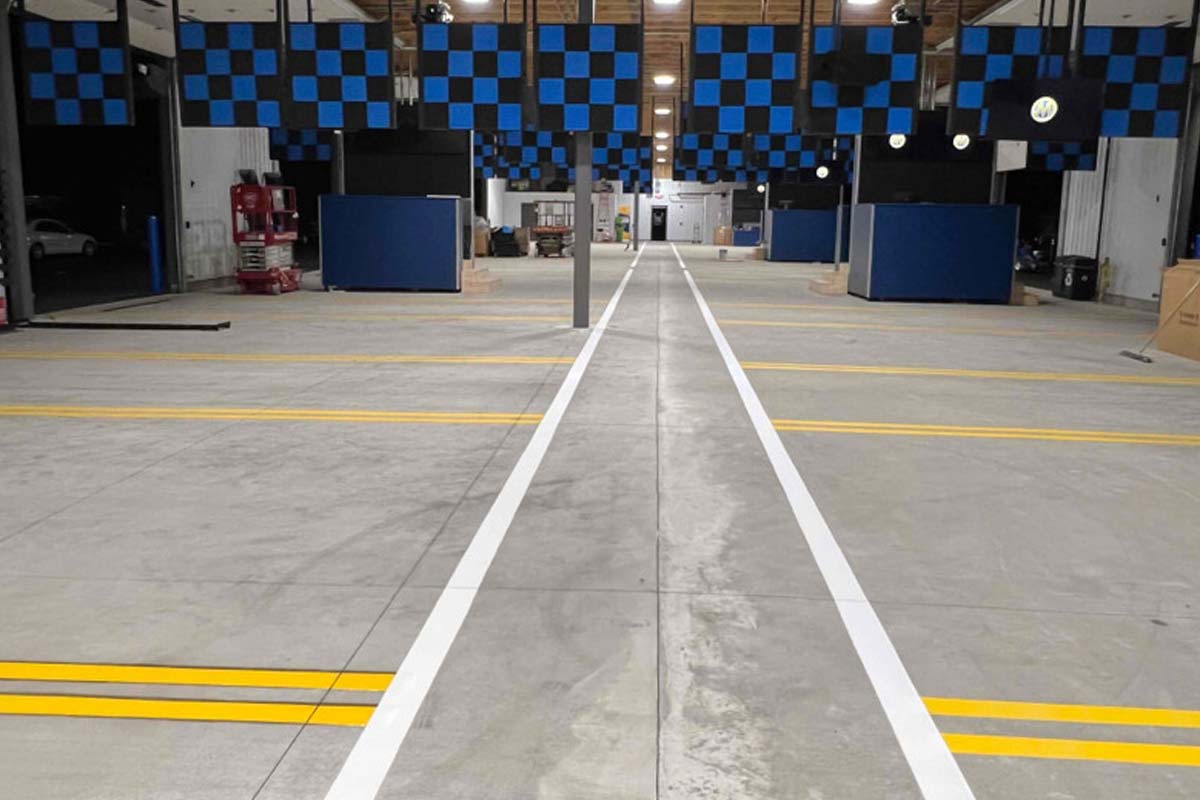
Warehouse Line Painting in Las Vegas, NV
Warehouse line painting is the interior equivalent of striping a lot: aisles, walkways, staging areas, racking bays, dock approaches and hazard zones marked onto a concrete slab so that forklifts and people can share a building safely. We mark distribution centers, cold storage, manufacturing floors and back-of-house areas across Clark County.
The floor is the constraint, not the paint. A sealed slab, a bare slab and a previously coated slab all take markings differently, so we look at the floor before quoting rather than after.
What OSHA Actually Requires
This is where nearly every warehouse marking page on the internet gets it wrong, so here is the rule verbatim.
29 CFR 1910.176(a): where mechanical handling equipment is used, “sufficient safe clearances shall be allowed for aisles, at loading docks, through doorways and wherever turns or passage must be made. Aisles and passageways shall be kept clear and in good repair… Permanent aisles and passageways shall be appropriately marked.“
Read it twice, because of what is not in it. It does not name a color. It does not name a line width. It does not name an aisle width. It says permanent aisles must be marked appropriately, and that clearances must be sufficient, and it leaves both judgments to the facility.
One more thing worth being precise about, because almost nobody quotes it correctly: the whole subsection is titled “Use of mechanical equipment” and opens with “Where mechanical handling equipment is used.” The duty is conditional, not universal. That is not a loophole — if forklifts, pallet jacks or any powered handling equipment run in your building, the condition is met and the duty applies to you. But it does mean anyone quoting the marking sentence on its own, stripped of the clause that conditions it, is overstating what the regulation says. We would rather tell you exactly what it says.
Aisle and Walkway Markings
What we mark is the traffic system: forklift aisles, pedestrian walkways, the crossings where the two meet, staging and racking bays, and dock approaches. The crossings are the part worth spending time on, because that is where the injuries are — an aisle line only matters if it tells a person and a forklift driver the same thing about who is where.
On line width, there is no requirement. You will read that OSHA mandates a 2-inch line; it does not, and that figure has no primary source in 1910.176 or anywhere else in the standard. In practice, line width is chosen for visibility given your lighting, your traffic and your floor color — a wider line on a dark, busy slab is genuinely easier to see, which is the actual point of marking it at all.
Safety Zones and Color Coding
Same story on color, and it is the most repeated myth in this trade.
You will read everywhere that “OSHA requires yellow aisle lines.” That claim has no primary source. It is not in 1910.176, which names no color at all. It appears to have begun as a vendor recommendation and been repeated until it sounded like law.
The nearest real provision is 29 CFR 1910.144, the safety color code — and it governs the marking of physical hazards: danger equipment, stop devices and the like. It is not an aisle-line specification.
None of which makes color arbitrary. Yellow for aisles and white for other boundaries is a genuine industry convention, and consistency inside a building matters more than the specific color, because a marking is only worth anything if it means the same thing in every bay. We will follow whatever your safety program already specifies — we simply will not tell you a regulation requires it when it does not.
How It Works
- Walk the floor with whoever owns the safety program and mark up a plan — aisle routes, pedestrian crossings, equipment zones and dock approaches. Layout is a traffic problem before it is a paint problem.
- Clean and prepare the slab so the marking bonds.
- Apply durable epoxy or traffic paint depending on traffic and the floor’s condition, working section by section and around your shifts — nights and weekends are routine, because an aisle you cannot use is an aisle that is costing you money.
Why Choose Us
1-800-STRIPER of Las Vegas is owned by Matt Roderick and holds a five-star Google rating across 6 reviews. We mark industrial floors across Clark County. We will tell you when a regulation requires something and when it is convention — the difference matters when you are the one signing off the safety program. Call for a free estimate.
For a full list of our pavement marking services, visit our parking lot striping in Las Vegas page.
Businesses We Serve




How it Works

GET A FREE ESTIMATE
Contact us today and we’ll have a quote to you in 24 hours

SCHEDULE A STRIPING
We’ll have your space restriped in less than 7 days, without affecting your business hours

GET A PARKING LOT THAT POPS
For a budget-friendly price, you’ll get a parking lot that looks like new
We proudly work with:


We proudly work with:

Frequently Asked Questions About Warehouse Line Painting in Las Vegas, NV
Does OSHA require warehouse aisle lines to be yellow?
No. This is the most repeated myth in warehouse marking. Where mechanical handling equipment is used, 29 CFR 1910.176(a) requires only that permanent aisles and passageways be “appropriately marked” — it names no color at all. The safety color code at 29 CFR 1910.144 covers marking physical hazards, not aisle lines. Yellow is a widely used convention and a sensible default, but it is a convention, not a regulation, and anyone citing OSHA for it is wrong.
Does OSHA specify a line width for aisle markings?
No. There is no line-width requirement in 1910.176 or elsewhere in the standard. The “2-inch line” figure circulating online has no primary source behind it. In practice, line width is chosen for visibility given your lighting, traffic and floor color — a wider line on a dark, busy slab is easier to see, which is the actual point. We will match whatever your existing markings use so the building stays consistent.
What does 1910.176(a) actually say?
It says that where mechanical handling equipment is used, “sufficient safe clearances shall be allowed for aisles, at loading docks, through doorways and wherever turns or passage must be made,” that aisles be kept clear and in good repair, and that “permanent aisles and passageways shall be appropriately marked.” Two duties: keep clearances sufficient, and mark permanent aisles appropriately. Both judgments are left to the facility.
What does “appropriately marked” mean in practice?
OSHA leaves it to you, which is unhelpful right up until you realize it is also flexible. In practice a marking is appropriate if it is visible under your lighting, durable under your traffic, and consistent across the building. An inspector is asking whether a person can tell where the aisle is — not measuring your line. We mark to that standard and to whatever your own safety program already commits you to.
Epoxy or traffic paint?
It depends on traffic and floor. Epoxy is harder-wearing and suits high-traffic aisles and forklift routes where a painted line would be scrubbed away quickly, but it demands more surface preparation and more cure time. Traffic paint goes down faster and returns the floor sooner, which matters when you cannot give up a bay for long. We look at the slab and tell you which one your floor actually justifies.
Can you mark the floor while we are still operating?
Usually yes. Warehouse line painting in Las Vegas is mostly done around live operations: we work the building in sections so the aisles we are not marking stay live, and we schedule around your shifts — nights and weekends are normal for exactly this reason. The real constraint is cure time: a fresh line needs to be left alone before forklifts run over it, so we phase the work around which routes you need most and give you a sequence before we start.