Sports Court Striping
In Las Vegas, NV
Multi-Sport Court Line Marking
1-800-STRIPER provides professional sports court striping in Las Vegas, NV — marking pickleball courts to USA Pickleball specifications, basketball courts, and tennis courts using durable acrylic traffic paint for commercial properties across Clark County.
1-800-STRIPER® of Las Vegas PROVIDes Sport Court and Playground Markings Services NEAR YOU
Want to get people to come out to play?
Brighten up your faded sport courts or turn your playground into a safe, colorful, and engaging space that entices people to come out and play.
Sport Court Specialties:
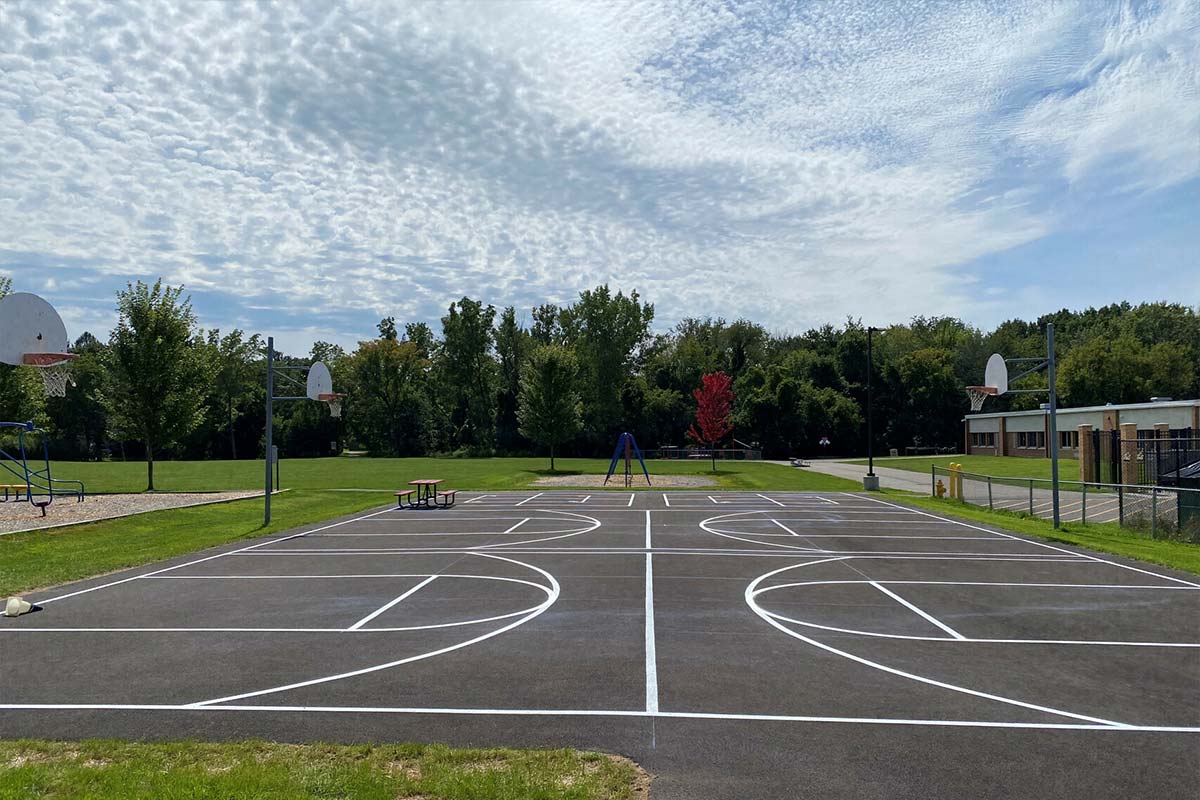
Sports Court Striping in Las Vegas, NV
We line and re-line courts — pickleball, basketball, tennis — for HOAs, apartment communities, schools, churches, hotels and parks across Clark County. Striping a court is not striping a lot. The tolerances are tighter, the geometry is defined by a governing body rather than a code official, and a line in the wrong place is not a cosmetic problem: it changes whether a ball is in or out.
We are a striping company, not a court builder. If your surface is sound and the lines are wrong, faded or need to become a different sport, that is our work. If the slab itself has failed, you need a resurfacer first, and we will tell you that rather than paint over it.
Pickleball Court Layouts
Pickleball is most of what we are asked for now, and most of what gets built wrong.
The court is 20 feet by 44 feet for both singles and doubles, measured — and this catches people — to the outside edge of the lines. The non-volley zone, the kitchen, extends 7 feet from the net on each side. The USA Pickleball rulebook calls for lines two inches wide, and it phrases that as a should rather than a must, which matters if you are matching an existing court.
The number that surprises clients is the total space. The playing surface — the court plus the surrounding margin you need to actually chase a ball — has a recommended minimum of 30 feet by 60 feet. A 20 × 44 court fits in a lot of places where a 30 × 60 playing surface does not, and that is worth knowing before you commit, not after.
Basketball and Tennis Courts
Basketball we line to whatever standard your facility plays to. The key, the three-point arc and the free throw line differ between high school, college and professional geometry, so we ask which one you want before we mark rather than assuming. Tennis we line to the standard court with its doubles alleys, service boxes and center marks.
Both are usually re-lining jobs rather than new ones: the court exists, the lines have gone, and the markings need to come back exactly where they were.
Surface Prep and Paint
Courts are painted, not striped in the parking-lot sense. The surface has to be clean, sound and dry, and any existing coating has to be compatible with what goes on top of it. We use durable acrylic traffic paint formulated for court surfaces. It holds color and resists the abrasion of shoes stopping and pivoting on it, which is a different kind of wear than a tire rolling over a line.
Las Vegas gives us one real advantage here. The NOAA 1991–2020 normals for the Las Vegas airport station record just 4.18 inches of rain a year. Painting a court needs a dry surface and a dry cure, and in most of the country that is the thing that moves your date. Here it rarely is.
How It Works
- Measure the space first — not the old lines, the space — because the most common reason a court plays wrong is that it was laid out to fit rather than to spec.
- Confirm which sport, which standard and which layout you want.
- Mark out and check the geometry before any paint goes down.
- Paint and let it cure.
Court Conversions
Converting a tennis court to pickleball is the most common request we get, and there are two honest answers depending on what you want. You can overlay pickleball lines onto a live tennis court in a contrasting color. That is cheap and fast, and it leaves you with a court carrying two sets of lines, which some players find fine and some find maddening. Or you can convert the surface properly to dedicated pickleball courts, where a single tennis court will usually take more than one. We will lay out both options against your actual dimensions.
Why Choose Us
1-800-STRIPER of Las Vegas is owned by Matt Roderick and holds a five-star Google rating across 6 reviews. We line courts across Clark County. We are a striping company rather than a court builder, which means we will tell you when the honest answer is that your surface needs work before paint. Call for a free estimate.
For a full list of our pavement marking services, visit our parking lot striping in Las Vegas page.
Businesses We Serve




How it Works

GET A FREE ESTIMATE
Contact us today and we’ll have a quote to you in 24 hours

SCHEDULE AN INSTALLATION
We’ll have your play space restriped in less than 7 days, without affecting your playtime

GET A PARKING LOT THAT POPS
For a budget-friendly price, you’ll get a parking lot that looks like new
We proudly work with:


We proudly work with:


Frequently Asked Questions About Sports Court Striping in Las Vegas, NV
What are the dimensions of a pickleball court?
Twenty feet by forty-four feet, for both singles and doubles, per the USA Pickleball Official Rulebook. Measurements are taken to the outside edge of the lines, which is the detail most often missed and the one that puts a court out by a couple of inches. The non-volley zone — the kitchen — runs seven feet from the net on each side. Those numbers are the same everywhere; they are a governing-body spec, not a local code.
How wide should pickleball court lines be?
Two inches, per the USA Pickleball Official Rulebook. The wording is worth being precise about: the rulebook phrases line width as a should, not a must. So two inches is the specification and what we default to, but it is not a rule that invalidates a court which already differs. If you are adding a court next to an existing one, matching the existing line width usually matters more than hitting the number.
How much total space do I need for a pickleball court?
More than the court. The playing surface — court plus the run-off you need to chase a ball — has a recommended minimum of thirty feet by sixty feet, against a court that is only twenty by forty-four. That gap is where most projects come unstuck: the court fits, the playing surface does not. Measure the space you actually have before you decide how many courts go in it, and we will lay it out honestly.
Can you convert our tennis court to pickleball?
Yes, two ways. Overlay pickleball lines onto the live tennis court in a contrasting color. That is fast and cheap, but you end up with two sets of lines, which some players do not mind and some do. Or convert the surface to dedicated pickleball, where one tennis court usually yields more than one pickleball court. Which is right depends on whether anyone still plays tennis on it. We will lay both out against your real dimensions.
What kind of paint goes on a sports court?
Durable acrylic traffic paint formulated for court surfaces. Court wear is not lot wear: shoes stopping, pivoting and dragging abrade a line differently from a tire rolling across it, and the coating has to hold color and edge under that. The existing surface matters too, because whatever is already down has to be compatible with what goes on top, which is one of the things we check before quoting rather than after.
Our court lines have faded — can you just re-line it?
Usually yes, and re-lining is most of the sports court striping we do in Las Vegas. If the surface is sound and only the lines have gone, re-lining puts them back where they were. The exception is a slab that has actually failed — cracking, delamination, ponding. Painting fresh lines onto a failing surface buys you a season at most, so if that is what we find, we will tell you the surface needs addressing first rather than take the job.