Thermoplastic Striping
In Bellevue, WA
Thermoplastic Pavement Markings
1-800-STRIPER provides professional thermoplastic striping in Bellevue, WA — heat-applied stop bars, crosswalks, directional arrows, and fire lane markings in a thick retroreflective material that bonds into the pavement instead of drying on top of it.
1-800-STRIPER of Bellevue Provides Thermoplastic Striping in Bellevue, WA Services NEAR YOU
Want to reduce the maintenance requirements for your parking lot?
Thermoplastic pavement markings are a durable, weather and vehicle-resistant striping option for your parking lot or facility.
You can utilize them for stop bars, ADA stalls, no-parking zones, directional arrows, crosswalks, or your entire parking lot.
Benefits:
Where Thermoplastic Outperforms Traffic Paint
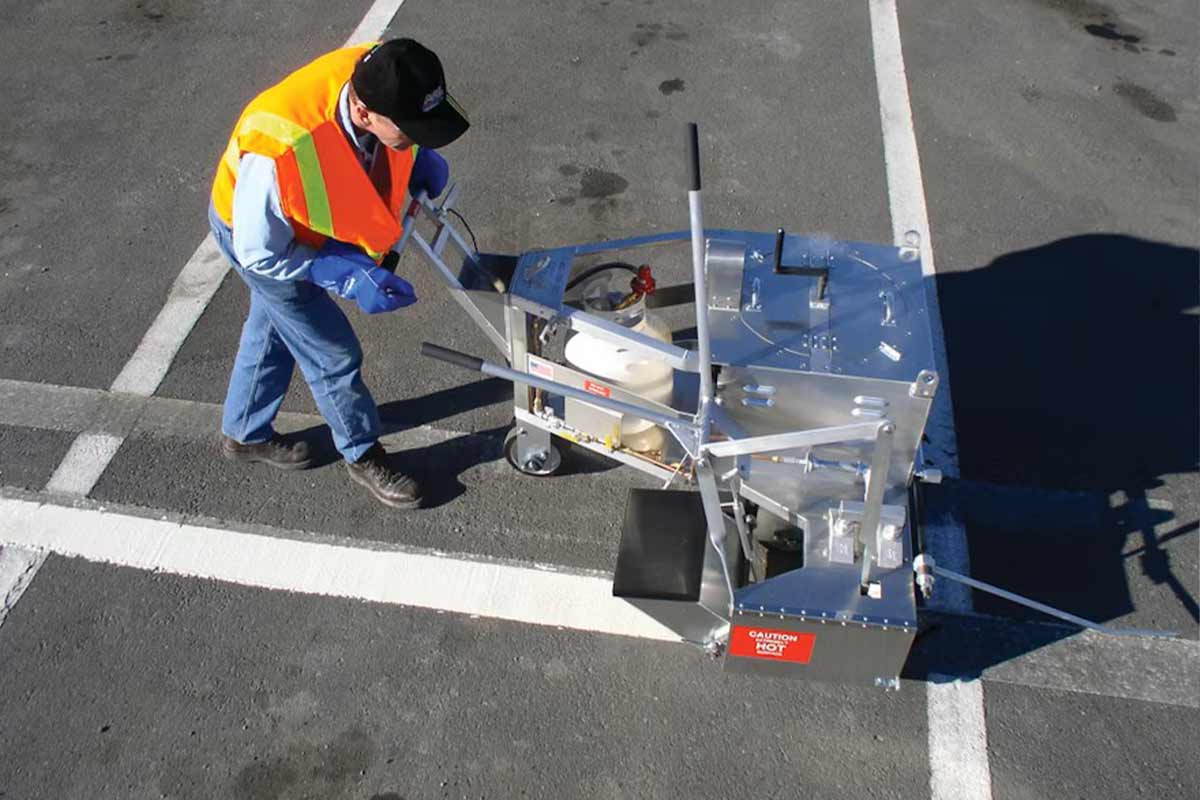
Some parts of a lot wear out long before the rest of it does. Stop bars, crosswalks, directional arrows, entrance lane lines: these take concentrated tire contact and turning loads, and conventional paint fades there noticeably while the far corners still look fresh. That uneven wear is what thermoplastic is for. Construction is what makes the difference. Laid down hot and thick, it fuses into the pavement as it cools instead of drying as a film on top. Glass beads carried in the material and dropped onto its surface send headlight light back to the driver, which counts for a lot on a dark, wet Bellevue evening. Washington’s own transportation department groups thermoplastic with its durable marking materials, reserved for locations carrying the heaviest traffic volumes and turning movements.
Thermoplastic vs Paint: Service Life and Cost Drivers
Compare it over a lifecycle, not a line item. Thermoplastic costs substantially more per foot installed and runs several years per application; water-based traffic paint costs a fraction of that and gets reapplied far more often. What usually decides the question is not material price at all. It is disruption, because every repaint means closing sections of a working lot again. Two conditions have to hold. Pavement needs enough remaining life to justify a marking that outlasts a paint cycle, and the layout has to be settled, since thermoplastic is deliberately hard to remove. Where both are true on a busy lot with sound asphalt, it works out cheaper over time. > Scope note carried on-page: the Washington State Department of Transportation Traffic Manual, Chapter 3 governs state highways. It is cited as evidence of how the material is classified and used, not as a rule binding a private commercial lot.
For a full list of our pavement marking services, visit our parking lot striping in Bellevue, WA page.
Businesses We Serve



How it Works

GET A FREE ESTIMATE
Contact us today and we’ll have a quote to you in 24 hours

SCHEDULE AN INSTALLATION
We’ll have your installation scheduled restriped in less than 7 days, without affecting your business hours

GET A PARKING LOT THAT POPS
For a budget-friendly price, you’ll get a parking lot that looks like new
We proudly work with:


We proudly work with:

Frequently Asked Questions About Thermoplastic Striping in Bellevue, WA
What is thermoplastic striping?
Thermoplastic is a durable pavement marking material applied hot as a molten compound. Unlike traffic paint, which dries as a film on the surface, thermoplastic is laid down thick and fuses into the pavement as it cools, and it carries retroreflective glass beads that return headlight light to the driver — a real advantage on a dark, wet evening. Washington’s transportation department classifies thermoplastic among its durable marking materials, used where traffic volumes and turning movements are heaviest.
How long does thermoplastic striping last?
Thermoplastic striping typically lasts 5 to 8 years, compared to 1 to 2 years for standard water-based traffic paint. The material thickness and its thermal bond to the pavement provide superior wear resistance, even through the Pacific Northwest’s frequent rain and freeze-thaw cycles.
Is thermoplastic striping worth the higher upfront cost?
Thermoplastic costs more per linear foot than standard paint, but its 5-to-8-year lifespan versus 1-to-2 years for paint makes it more cost-effective over time for high-traffic properties. The reduced frequency of reapplication means less business disruption and lower total cost of ownership. It is best suited for lots with 5 or more years of remaining pavement life.
Is thermoplastic better than paint for the Pacific Northwest climate?
Thermoplastic performs well in Bellevue’s wet climate. It offers superior water resistance, better retroreflectivity in wet conditions (especially with embedded glass beads), and resistance to UV degradation. Standard paint fades more quickly in alternating rain and sun cycles. For high-traffic commercial lots, thermoplastic provides a measurable durability advantage.
What conditions are needed to apply thermoplastic?
The pavement must be clean, dry, and warm enough for the material to bond as it cools — which in Bellevue makes late spring through early autumn the dependable application window. Damp pavement is the main obstacle locally; moisture in the surface interferes with the bond even when the air is dry. Application equipment and material specifications vary by manufacturer, so the working temperature range is set by the product data sheet for the material actually being used.
Can thermoplastic be applied over existing paint?
Thermoplastic can be applied over well-adhered existing paint, but loose, flaking, or heavily layered paint must be removed first through grinding or shot blasting. Surface preparation determines adhesion quality and longevity. A professional assessment ensures the existing surface condition supports proper thermoplastic bonding.
What are the best applications for thermoplastic markings?
Thermoplastic is ideal for high-wear markings: crosswalks, stop bars, ADA accessible space symbols, directional arrows, and lane lines in high-traffic commercial lots. The three main application methods are extrusion (direct contact for lines), ribbon (gun held above surface for symbols), and spray (atomized for large areas). Preformed thermoplastic shapes are also available for logos and complex symbols.
Does thermoplastic make sense on an older parking lot?
Usually not. Thermoplastic is chosen because it outlasts several paint cycles, and that only pays off if the pavement underneath will outlast it too. On asphalt that is raveling, cracking, or due for resurfacing within a few years, the marking will be destroyed by the repair rather than by wear. The sensible sequence is to resolve the pavement first, then specify thermoplastic for the high-wear markings on a surface that will hold it.
Can thermoplastic be removed or changed later?
Not easily, and that is by design. Because it bonds into the pavement rather than sitting on it, removal means grinding or shot blasting, which leaves a visible scar on the surface. That makes thermoplastic a poor fit for any layout likely to change and a strong fit for markings that will not move — stop bars, crosswalks, and directional arrows at fixed entrances. Where a lot is still evolving, paint is the more flexible choice.