Sports Court Striping
In Bellevue, WA
Sport Courts, Athletic Fields and Playground Markings
1-800-STRIPER provides professional sports court striping in Bellevue, WA — marking pickleball courts to USA Pickleball specifications, basketball courts, tennis courts, and playground game markings with durable acrylic court paint.
1-800-STRIPER of Bellevue Provides Sports Court Striping in Bellevue, WA Services NEAR YOU
Want to get people to come out to play?
Brighten up your faded sport courts or turn your playground into a safe, colorful, and engaging space that entices people to come out and play.
Sport Court Specialties:
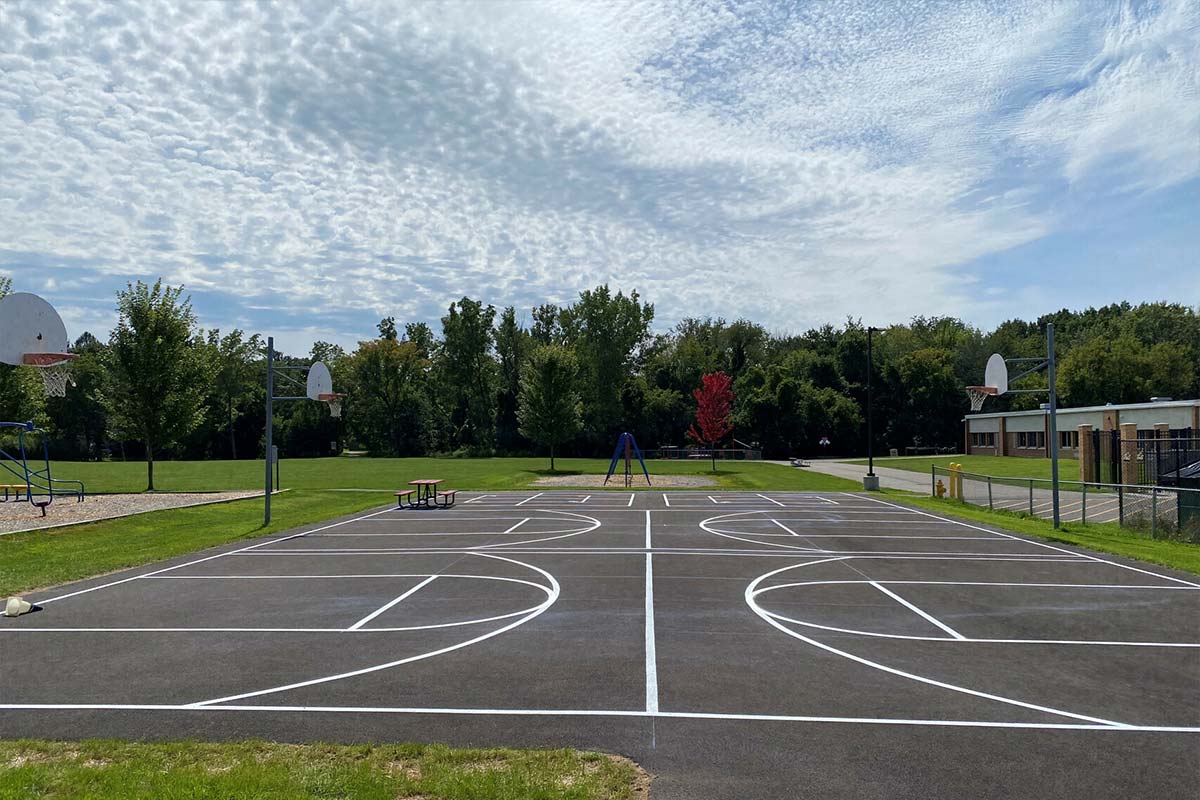
Court Dimensions by Sport
Regulation dimensions are what separate a usable court from a repainted slab. A pickleball court measures 20 feet by 44 feet for singles and doubles alike, with a non-volley zone 7 feet deep and 20 feet wide against each side of the net, and every line 2 inches wide in a color that contrasts clearly with the surface. All of it is set at §3.A of the USA Pickleball Official Rulebook, which goes on to specify the space around the court as well: a minimum total playing surface of 30 feet by 60 feet, with 34 by 64 preferred for new construction. Those overrun figures get skipped more than any other number here, and they explain why a court can measure correctly and still play badly. A full-size tennis court will host up to four pickleball courts. A standard basketball court takes one comfortably, with room to move behind the baseline.
Surface Preparation and Court Paint Systems
Court paint is a system, not a single coat, and it only performs on a surface that has been prepared for it. Asphalt and concrete both need to be clean, sound, and fully dry, with cracks filled and low spots patched — in Bellevue that also means removing the moss and algae film that builds up on any court under tree cover, because acrylic will bond to that film and lift with it. Above the repairs go a resurfacer, then textured acrylic color coats, then the line paint last. Cure time between coats is what makes lines stay crisp, and rushing it in a damp week is the usual cause of early failure.
For a full list of our pavement marking services, visit our parking lot striping in Bellevue, WA page.
Businesses We Serve




How it Works

GET A FREE ESTIMATE
Contact us today and we’ll have a quote to you in 24 hours

SCHEDULE AN INSTALLATION
We’ll have your play space restriped in less than 7 days, without affecting your playtime

GET A PARKING LOT THAT POPS
For a budget-friendly price, you’ll get a parking lot that looks like new
We proudly work with:


We proudly work with:


Frequently Asked Questions About Sports Court Striping in Bellevue, WA
What types of sports courts can you stripe in Bellevue?
We stripe basketball courts, pickleball courts, tennis courts, volleyball courts, four square, hopscotch, and multi-sport combination layouts throughout Bellevue, WA and the Eastside. 1-800-STRIPER serves residential driveways, HOA common areas, school playgrounds, city parks, and commercial recreation facilities with regulation-accurate lines on asphalt and concrete surfaces.
Can you add pickleball lines to my existing basketball or tennis court?
Yes — this is one of our most popular requests in Bellevue, WA. A standard tennis court can accommodate up to four regulation pickleball courts, and basketball courts can host pickleball with contrasting line colors. We use different acrylic paint colors for each sport so players can identify their court boundaries at a glance on the asphalt or concrete surface.
What paint do you use for outdoor sports courts?
We use 100-percent acrylic court paint specifically formulated for outdoor asphalt and concrete surfaces in Bellevue, WA. This paint is textured with fine silica sand for playing surface grip and withstands UV exposure, rain, and temperature swings. It is water-based with low VOCs and available in multiple colors for multi-sport line differentiation.
How long does court paint last in the Pacific Northwest?
Outdoor court paint in Bellevue, WA typically lasts 3–5 years depending on usage and weather exposure. The Pacific Northwest climate — with heavy rain, moss growth, and limited winter sun — can shorten lifespan compared to drier regions. Courts under tree cover may need more frequent cleaning. Annual pressure washing helps extend line life on asphalt and concrete.
What weather conditions are needed for court painting?
Court painting in Bellevue, WA requires a dry surface with ambient temperatures above 50°F during application and for at least 24 hours after. No rain should be forecast for at least 4 hours post-application. The optimal application season in the Puget Sound area runs from May through October.
How long before we can play on a freshly painted court?
After striping a court in Bellevue, WA, light foot traffic is generally safe within 2–4 hours. We recommend waiting at least 24 hours before full play to allow complete curing of the acrylic paint on the asphalt or concrete surface. Waiting the full cure time ensures lines stay sharp and adhere properly.
What are regulation court dimensions for pickleball?
A regulation pickleball court in Bellevue, WA measures 20 feet wide by 44 feet long with a non-volley zone extending 7 feet from each side of the net. Recommended total playing area including overruns is 30 feet by 60 feet. We mark all lines per USA Pickleball official specifications on asphalt and concrete surfaces.
How wide should the lines on a pickleball court be?
Two inches. The USA Pickleball Official Rulebook specifies that all lines should be 2 inches wide and the same color, clearly contrasting with the playing surface — and that court measurements are taken to the outside edge of the perimeter and non-volley zone lines. That last detail is what most repainted courts get wrong: measuring to the inside or the center of a line shifts the whole court by an inch or two in each direction.
What size area do I need for a pickleball court?
More than the court itself. The playing lines occupy 20 by 44 feet, but the rulebook calls for a minimum total playing surface of 30 by 60 feet, with 34 by 64 preferred for new construction and larger again for stadium use. The extra space is the run-out behind the baselines and beside the sidelines. A court squeezed onto a 20-by-44-foot slab measures correctly and still plays badly.