Fire Lane Striping
In South Portland, OR
Fire Lane and Fire Curb Striping Services
1-800-STRIPER provides professional fire lane striping in South Portland, OR — marking compliant fire lanes, curbs, and no-parking zones with traffic-grade paint and lettering per the Oregon Fire Code and the requirements of the local fire authority having jurisdiction for commercial properties across Clackamas, Multnomah, and Washington counties.
1-800-STRIPER® of Portland South PROVIDes Fire Lane Striping Services NEAR YOU
Is your parking lot ready for first responders?
Our team is well-versed in local fire regulations and will parter with you to design a fire lane striping plan that creates unobstructed emergency access to protect your customers and property.
Core Services:
Oregon Fire Code Requirements for Fire Apparatus Access
Oregon runs on the Oregon Fire Code, adopted by the State Fire Marshal through OAR chapter 837, division 40. The adopting rule is titled Adoption of the International Fire Code, which settles a question contractors get wrong in this state: the model code here is the IFC, and NFPA 1 is not the operative fire code in Oregon.
The code sets the road before it sets the paint. Section 503.2.1 requires a fire apparatus access road at least 20 feet wide with at least 13 feet 6 inches of vertical clearance. Section 503.2.2 lets the fire code official modify those dimensions for the site in front of them. That second sentence is the one that decides most jobs, because it means the published minimum is a starting point and the official’s judgment is the requirement.
How Fire Lanes Are Marked, Lettered, and Signed
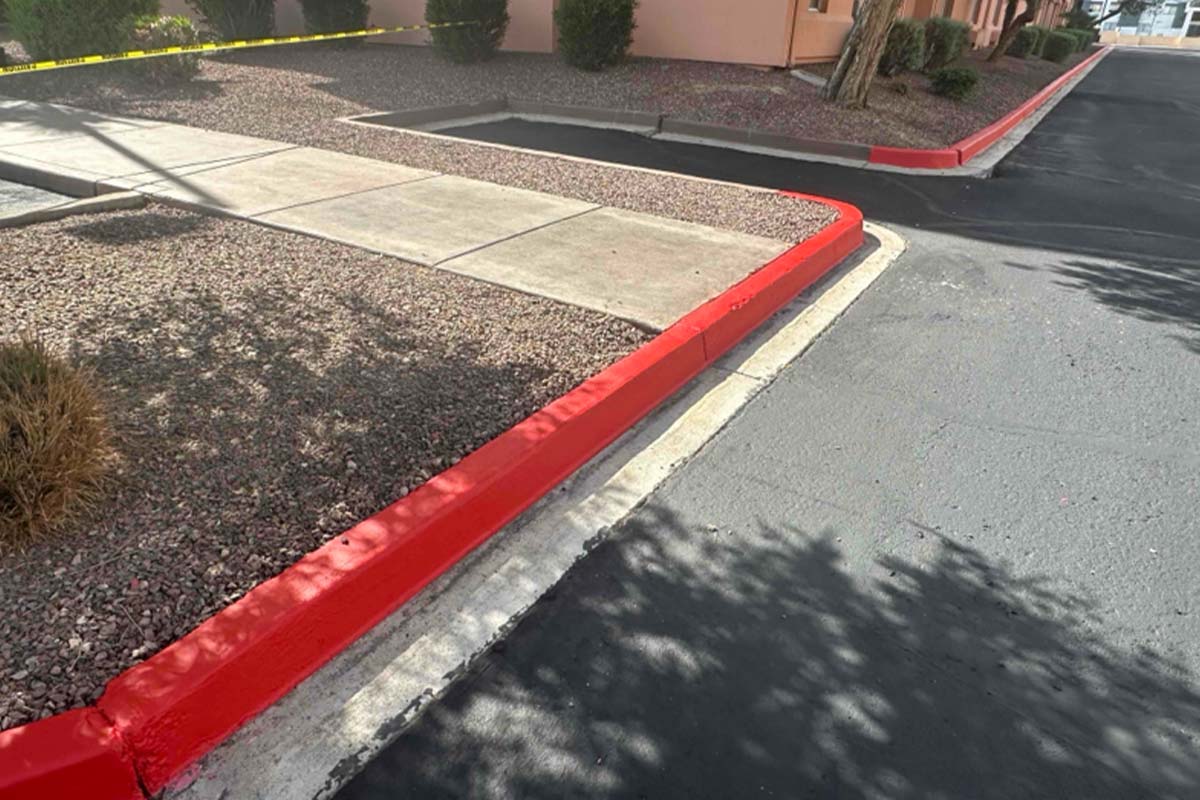
Section 503.3 is shorter than people expect. Where the fire code official requires it, Section 503.3 calls for approved signs or other approved notices or markings that include the words NO PARKING—FIRE LANE, and requires that the means by which fire lanes are designated be maintained in a clean and legible condition at all times and be replaced or repaired when necessary to provide adequate visibility. That is the whole state-level marking duty. It specifies no curb color, no letter height, no stroke width, and no spacing between legends.
Signage is the exception, and it comes from a different place. Appendix D of the Oregon Fire Code is adopted by the State of Oregon, and D103.6 sets fire lane signs at a minimum of 12 inches wide by 18 inches high, with red letters on a white reflective background. Where the access road is 20 to 26 feet wide the signs post on both sides; over 26 and under 32 feet, one side. Those are real numbers with a real citation, and they belong to the appendix — not to Section 503.3, which is silent on all of it.
Who Designates a Fire Lane — Your Local Fire Authority
Section 503.3 requires marking where required by the fire code official, so the agency covering your address makes the call. That matters more here than in most metros, because our territory spans several fire authorities and their published policies do not agree with each other.
Tualatin Valley Fire and Rescue publishes a service area of Beaverton, Durham, King City, Newberg, North Plains, Rivergrove, Sherwood, Tigard, Tualatin, West Linn, and Wilsonville, plus unincorporated portions of Clackamas, Multnomah, Washington, and Yamhill counties. Lake Oswego is not on that list, and neither are Happy Valley, Oregon City, Milwaukie, Gladstone, or Damascus. Clackamas Fire District 1, Portland Fire and Rescue, and other departments cover the rest.
Where they diverge is the curb interval — and the three authorities covering most of this territory each publish a different one:
| Fire authority | Curb lettering interval | Published in |
|---|---|---|
| Tualatin Valley Fire & Rescue | Every 25 feet | Fire Code Application Guide for Commercial Development |
| Clackamas Fire District #1 | At approved intervals | OFC Application Guide, rev. 12/2/2025 |
| Portland Fire & Rescue | Minimum 20 feet | Fire & Life Safety Requirements, 11/2021 |
Letter height diverges too. One agency’s guide carries two different letter-height specifications in the same document — six inches in the body text, three and a half inches in its own appendix detail — both citing the same code section. So a lot marked correctly to the neighboring district’s standard can still fail inspection here, on work that looks right.
We confirm which authority governs your address before we mark anything. That is not a disclaimer — it is the step that keeps the job from being repainted.
Keeping Fire Lane Markings Legible Year-Round
The code’s phrase is clean and legible condition at all times, and legibility is what inspectors actually assess. A fire lane that a driver cannot read at night, in the rain, is not doing the job the marking exists to do.
Our climate works against it. NOAA’s 1991 to 2020 normals for Portland International Airport put roughly 89 percent of the year’s rain between October and May, and painted curbs take the worst of standing water plus winter traffic. Red curb faces and pavement lettering fade first at entrances, turns, and anywhere vehicles track across the line. Planning a refresh before the wet season, rather than after an inspection, is the cheaper order of operations.
For a full list of our pavement marking services, visit our parking lot striping in South Portland page.
Businesses We Serve




How it Works

GET A FREE ESTIMATE
Contact us today and we’ll have a quote to you in 24 hours

SCHEDULE AN INSTALLATION
We’ll have your installation scheduled in less than 7 days, without affecting your business hours

GET A PARKING LOT THAT POPS
For a budget-friendly price, you’ll get a parking lot that looks like new
We proudly work with:


We proudly work with:


Frequently Asked Questions About Fire Lane Striping in South Portland, OR
What code governs fire lanes in Oregon?
Oregon runs on the Oregon Fire Code, adopted by the Oregon State Fire Marshal. The current edition is the 2025 Oregon Fire Code, based on the 2024 International Fire Code, effective 1 October 2025. It is an IFC-based code, not NFPA 1, so a contractor citing NFPA 1 as your fire code in Oregon is citing the wrong instrument. The adopting instrument is OAR chapter 837, division 40.
Who decides where a fire lane goes on my property?
Your local fire authority does. Section 503.3 of the fire code requires marking “where required by the fire code official,” which puts the decision with the agency covering your address. This area is served by several — Tualatin Valley Fire & Rescue covers Beaverton, Sherwood, Tigard, Tualatin, West Linn, and Wilsonville among others, while Clackamas Fire District #1, Portland Fire & Rescue, and other departments cover the rest. We confirm which one applies before marking anything.
Do fire lane marking requirements really differ between agencies here?
Yes, and the reason is in the code. Section 503.3 specifies only that markings include the words “NO PARKING—FIRE LANE” and stay “in a clean and legible condition at all times” — it sets no color, no letter height, and no spacing. Those come from each fire authority’s own policy, and they differ: one district calls for curb lettering at 25-foot intervals, another at a 20-foot minimum, another leaves the interval to approval.
So a lot marked to the wrong district’s standard can fail?
It can. Because the interval, lettering, and sign spacing are a local requirement rather than state code — in some jurisdictions an adopted city fire code, in others the fire district’s own policy — marking a lot to the neighboring district’s specification is a real way to fail an inspection on work that looks correct. We confirm the requirement for your specific address rather than applying one pattern everywhere.
What does fire lane marking include?
Red curb painting, pavement lettering along the access route, marked no-parking and emergency access zones, and the posted signs that make the restriction enforceable. Where your fire code official requires fire lane signs, the spec is state code: Appendix D of the Oregon Fire Code, which Oregon has adopted, sets those signs at a minimum of 12 inches wide by 18 inches high with red letters on a white reflective background, complying with Figure D103.6. Curb color and lettering size come from your fire authority.
Why do fire lane markings need repainting?
Because a fire lane only works if it can be read. Markings that have worn to the point where a driver cannot tell where the lane begins do not protect the access route, and inspectors treat illegible markings as a problem to correct. Our climate accelerates it — NOAA’s normals put roughly 89% of the area’s annual rainfall between October and May, and constant wet plus winter traffic wears painted curbs and lettering steadily.
Can you mark a fire lane before an inspection?
Yes, and it is worth starting with a call. We can walk the lot, identify what has faded or is missing against what your fire authority expects, and get the marking and signage done ahead of the inspection date. If you are unsure which agency has jurisdiction over your address, we can help you work that out. Call (971) 458-1987 for a free on-site estimate.