
Parking Lot Sign Installation
In South Portland, OR
ADA, Fire Lane, and Directional Signage
1-800-STRIPER provides professional parking lot sign installation in South Portland, OR — setting accessible-space signs, fire lane no-parking signs, tow-away zone warnings, and directional and traffic-control signage to code for commercial properties across Clackamas, Multnomah, and Washington counties.
1-800-STRIPER® of Portland South PROVIDes Signage Installations Services NEAR YOU
Are you communicating clearly?
We install new signs in adherence with local regulatory standards and can repair or replace damaged signs so you can clearly communicate your parking requirements.
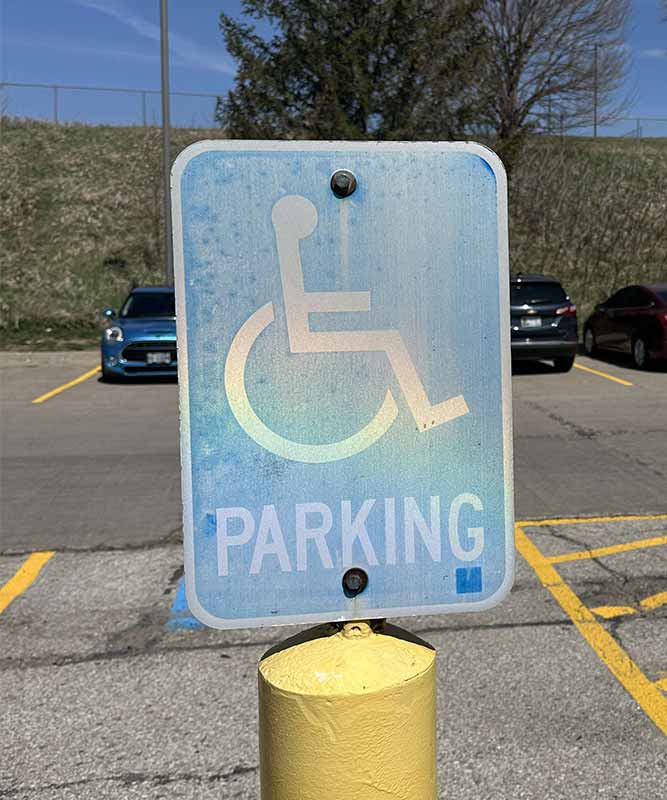
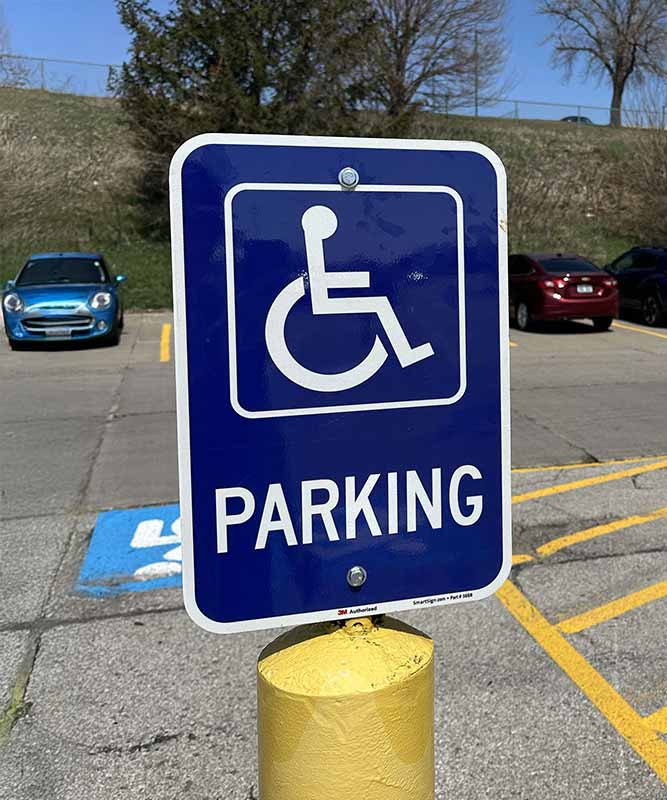
Parking Lot Sign Installation in South Portland
Most of the sign work on a commercial lot is not about buying a sign. It is about knowing which sign type a given spot requires, who requires it, and where it has to be mounted for the restriction to mean anything. A sign shop can print anything you ask for. A striping contractor installs the sign that matches the marking on the pavement underneath it, which is usually where the two halves of the job come apart.
We set signs across Clackamas, Multnomah, and Washington counties on commercial properties, apartment communities, medical and retail sites, and industrial yards. That covers post-mounted signs on new posts, replacements on existing posts, wall-mounted plates where there is no room for a post, and custom plates for site-specific rules that no standard catalog sign covers. Where the sign restricts parking that we also mark on the pavement, the two get designed together, so the painted zone and the posted notice say the same thing.
Sign type matters more than most property managers expect, because the authority behind each one is different. An accessible-space sign answers to Oregon statute. A fire lane sign answers to the fire code and to the fire official who designated the lane. A tow-away sign answers to a statute that treats the sign itself as the trigger for enforcement. Directional and traffic control signage inside the lot is largely yours to design, until a drive aisle meets a public street and the city takes an interest in how that movement is controlled. The table below is the short version of who is asking for what.
| Sign type | Where it is required | Who requires it |
|---|---|---|
| Accessible space, R7-8 | At every accessible parking space | ORS 447.233 (the federal standard exempts sites of 4 or fewer total spaces; Oregon does not) |
| Van Accessible, R7-8P | Mounted below the sign at a van-accessible space | ORS 447.233 and the 2010 ADA Standards |
| Wheelchair User Only, OR7-8c | On the van-accessible space, once 5 or more spaces on the lot are accessible | ORS 447.233, Oregon-only |
| Access Aisle No Parking, OR7-9 | At the striped access aisle beside accessible stalls | Oregon Department of Transportation standard |
| Fire lane no-parking | Along designated fire apparatus access roads | Oregon Fire Code, applied by the local fire authority |
| Tow-away zone | In plain view at the parking facility — placement is a practical judgment, not a statutory spec | ORS 98.810, as the precondition for enforcement on ordinary stalls |
| Directional and traffic control | At entrances, exits, one-way aisles, stop conditions, and speed-restricted drives | Property owner, and the city where a drive meets a public street |
Accessible Parking Signs and What Oregon Requires on Them
Oregon does not leave accessible-space signage to the installer’s judgment. ORS 447.233(2)(e) specifies what has to be on the sign: the International Symbol of Access, notice that the space is reserved for holders of a disabled person parking permit, an additional Van Accessible sign mounted below where the space is van-accessible, and Wheelchair User Only wording where that space is required. That last one has no federal counterpart. Once a lot has five or more accessible spaces, Oregon reserves the van-accessible space for wheelchair users and requires that wording on its sign. It does not add a stall, but a lot signed to the federal standard alone will not carry it.
The Oregon Department of Transportation goes a step further in its Standards for Accessible Parking Places and fixes the actual designations by code. R7-8 goes on every accessible space. R7-8P, reading VAN ACCESSIBLE, mounts below it. OR7-8c reads WHEELCHAIR USER ONLY. OR7-9, reading ACCESS AISLE NO PARKING, marks the striped aisle beside the stalls, which is the sign most often missing on lots we survey.
There is a timing point worth knowing. The same ODOT standard states that all new construction or re-striping of accessible parking spaces and access aisles is required to meet new minimum standards. If you are repainting the accessible corner of a lot, the signage is part of what comes current with it.
Fire Lane and No-Parking Zone Signs
A fire lane exists because the fire code official designated it, and the marking has to survive an inspection by that same official. Oregon Fire Code Section 503.3 requires approved signs or other approved notices or markings that include the words NO PARKING—FIRE LANE, maintained in a clean and legible condition at all times. What Section 503.3 does not do is specify a size, a letter height, or a color. Those come from elsewhere.
Appendix D of the 2025 Oregon Fire Code is adopted by the State of Oregon, and D103.6 carries the numbers: fire lane signs at a minimum of 12 inches by 18 inches, red letters on a white reflective background. Placement depends on the width of the access road. Signs go on both sides where the road is 20 to 26 feet wide, and on one side where it is over 26 feet and under 32 feet.
Beyond the appendix, the details are set by the fire authority having jurisdiction, and the districts in this metro do not all publish the same policy on curb color, letter height, or the interval between signs. A lot marked to a neighboring district’s spec can fail its inspection. We confirm the AHJ for the address before ordering anything, which is the part of this work no sign catalog can do for you.
Tow-Away Zone Signs — What the Sign Actually Buys You
In Oregon a tow-away sign is a legal instrument, not a product. ORS 98.810(1) prohibits parking on a parking facility without permission if there is a sign displayed in plain view at the parking facility prohibiting or restricting public parking. On the ordinary stalls of your lot — the parts where a driver would reasonably assume parking is allowed — that posted sign is what puts the restriction on statutory footing, and ORS 98.812 and ORS 98.818 carry the towing authority and the lien that follow from a properly posted facility.
The sign is not the only door, and it is worth knowing the other two. ORS 98.810(2) reaches what the statute calls proscribed property — any part of private property where a reasonable person would conclude parking is not normally permitted at all — and there the prohibition applies whether or not a sign is posted. That covers the fire lane, the loading apron, the landscaped island. Separately, ORS 98.830 and ORS 98.840 give a parking facility owner a route for an abandoned vehicle that does not depend on site signage at all. Signage is what makes a general restriction enforceable across an ordinary lot.
What the statute does not do is dictate the sign. ORS 98.810 sets no dimensions, no letter height, and no mounting height for tow-away signage, and anyone telling you Oregon law requires specific wording on your tow sign is describing something the statute does not contain. What it requires is a sign, in plain view, prohibiting or restricting parking.
So the design question becomes practical rather than statutory: plain view from where a driver actually enters off the street, legible at the speed people take your entrance, and consistent with the no parking zones marked on the pavement inside. We offer custom plates where a property has rules a standard sign does not cover, and we set them at the entry points and interior locations that make the plain-view test easy to satisfy. Call for a free estimate.
For a full list of our pavement marking services, visit our parking lot striping in South Portland page.
Businesses We Serve




How it Works

GET A FREE ESTIMATE
Contact us today and we’ll have a quote to you in 24 hours

SCHEDULE AN INSTALLATION
We’ll have your installation scheduled in less than 7 days, without affecting your business hours

GET A PARKING LOT THAT POPS
For a budget-friendly price, you’ll get a parking lot that looks like new
We proudly work with:


We proudly work with:


Frequently Asked Questions About Parking Lot Sign Installation in South Portland, OR
What parking lot signs do you install?
Accessible parking signs including van accessible and wheelchair user only variants, fire lane and no-parking zone signs, tow-away zone signs, directional and one-way signs, speed and stop signs, reserved and customer-only signs, and custom signage for a specific property. We install signage as part of a striping project or as standalone work, mounted on posts or on existing structures across Clackamas, Multnomah, and Washington counties.
Does a sign actually let us have a vehicle towed in Oregon?
For an ordinary lot, the sign is what puts the restriction on statutory footing. ORS 98.810(1) states that a person may not park on a parking facility without the owner’s permission “if there is a sign displayed in plain view at the parking facility prohibiting or restricting public parking on the parking facility,” and ORS 98.812 carries the towing authority that follows. Two carve-outs are worth knowing: ORS 98.810(2) applies to “proscribed property” — areas where a reasonable person would conclude parking is not normally permitted — whether or not a sign is posted, and ORS 98.830 and 98.840 give a separate route for an abandoned vehicle that does not rely on site signage.
What must an accessible parking sign say in Oregon?
State law is specific. Under ORS 447.233(2)(e) each accessible space needs a sign clearly visible to a person parking in it, marked with the International Symbol of Access and indicating the space is reserved for people with disabled person parking permits. A van accessible space carries an additional “Van Accessible” sign below, and a space reserved for wheelchair users needs one reading “Wheelchair User Only.” Oregon’s transportation standards designate these as R7-8, R7-8P and OR7-8c, with OR7-9 marking an access aisle.
Why use an installer rather than just buying signs?
Because the sign only does its job if it is the right sign, saying the right thing, in the right place. Accessible-space wording is set by state law, fire lane signage is set by your local fire authority, and a tow-away restriction depends on the sign being displayed in plain view at the facility. We install to those requirements and coordinate signage with the pavement markings, so the painted stall and the posted sign agree with each other.
Can you replace damaged or faded signs on an existing lot?
Yes. We replace signs that have faded, been hit, or gone missing, straighten and re-anchor leaning posts, and bring older signage up to current wording where the requirements have moved on since it was installed. Accessible-parking signs are the ones worth auditing first, since wording and the required van and wheelchair user designations are set by statute. We can survey the whole property and give you a written scope.