Parking Lot Sign Installation
In Chattanooga, TN
ADA, Fire Lane, and Directional Signage
1-800-STRIPER provides professional parking lot sign installation in Chattanooga, TN — installing ADA accessible-space signs with the International Symbol of Accessibility, van-accessible designations, fire lane no-parking signs, and directional signage per the 2010 ADA Standards for Accessible Design and the 2018 International Fire Code for commercial properties across Hamilton County.
1-800-STRIPER of Chattanooga PROVIDes Parking Lot Sign Installation Services NEAR YOU
Are you communicating clearly?
We install new signs in adherence with local regulatory standards and can repair or replace damaged signs so you can clearly communicate your parking requirements.
Parking Lot Signs Chattanooga Properties Are Required to Post
Two authorities govern the signs in your lot. They are not the same authority, they do not answer to each other, and a property can satisfy one while failing the other.
Accessible parking signage is federal. The 2010 ADA Standards govern what the sign says, what symbol it carries, and how high it sits, and because the ADA reaches private commercial property through Title III, none of it depends on anyone from the city ever looking at your lot. What it does depend on is a trigger. New construction and alterations bring the Standards with them; a lot that is simply already there carries a standing duty to remove barriers to the extent that is readily achievable. The Department of Justice’s own compliance brief on restriping says that because restriping is relatively inexpensive, it is readily achievable in most cases — informal guidance with no force of law, but a fair account of how the obligation tends to land on a lot that is being repainted anyway.
Fire lane signage is local, and in Chattanooga it is unusually specific. The city adopted its own fire code by ordinance and then amended the appendix that governs access roads, which means the requirement on your property is written in a Chattanooga document rather than a national one.
Everything else — directional arrows, one-way markers, stop signs, tow-away notices, reserved and visitor spaces — is discretionary. Those signs exist because the lot works better with them, and they should be chosen for how the property actually moves rather than bought by the bundle.
ADA Accessible Parking Signs
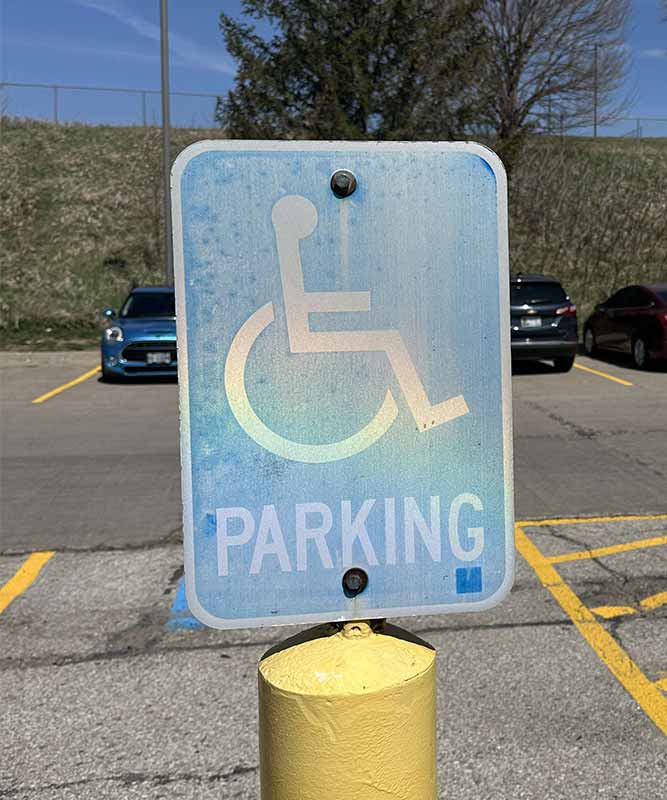
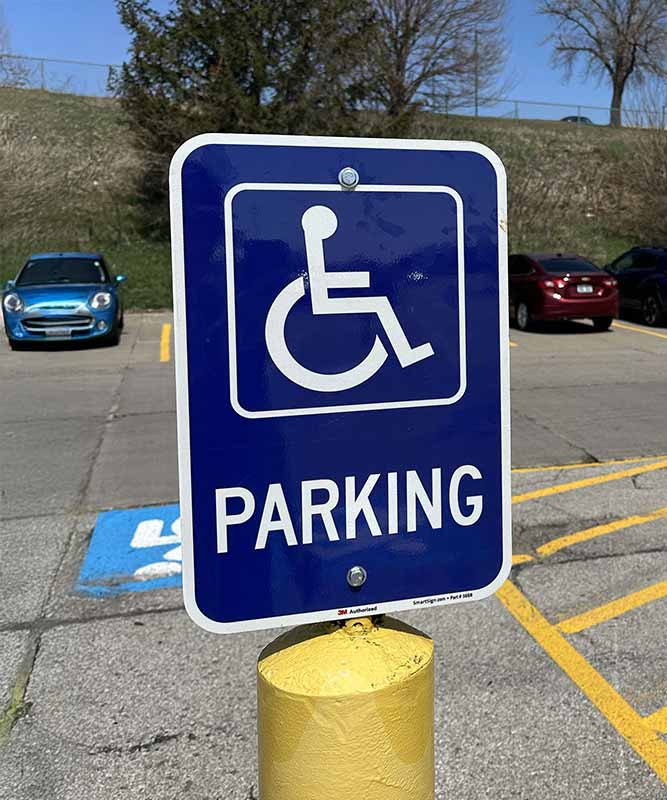
Two sections do two different jobs here, and mixing them up is how most lots get this wrong. Section 216.5 is what makes the sign necessary: parking spaces complying with Section 502 *shall be identified by signs.* Section 502.6 is what the sign then has to be — and it sets three requirements, which are the three most missed on an older lot.
First, the sign must carry the International Symbol of Accessibility. Second, a sign identifying a van space must contain the designation “van accessible.” Third — and this is the one that catches people — signs must be 60 inches minimum above the finish floor or ground surface, measured to the bottom of the sign. That is a floor, not a ceiling, and it is measured to the bottom edge, so a sign mounted at a comfortable eye level is usually mounted too low.
The reason for the height is simple: a sign at bumper height disappears the moment a van parks in front of it, and an enforcement officer cannot cite a space nobody can see is reserved.
How many spaces need signs follows from Table 208.2, which scales with lot size — 1 accessible space for the first 25, 2 up to 50, and upward from there — and Section 208.2.4, which requires at least one van space for every six accessible spaces, or fraction of six. Section 216.5 then puts a sign on each of them.
Section 216.5 carries an exception worth knowing about, and in Tennessee it mostly does not help you. Federally, a site with a total of four or fewer parking spaces does not have to identify its accessible space with a sign. But Tennessee Code Section 55-21-105 requires any business serving the public from a permanent location to provide a specially marked space starting at the 1-to-25 band — and subsection (c) says that marking *”may be by a sign on a pole.”* So a four-space Tennessee lot still owes a marked accessible space; the federal exception excuses the federal sign, not the state’s marking duty.
Where the two instruments differ, they differ in opposite directions, so neither is simply the stricter one. On the van count Tennessee asks for more: Section 55-21-105(b)(3) sets two van-accessible spaces per eight designated spaces — one in four — where the federal rule is one in six. Above 400 spaces the comparison flips, because the state table stops at nine and the federal one carries on. Take the larger of the two numbers on each count, and a sign goes on every accessible space either way.
Fire Lane Signs and the Chattanooga Fire Code
Both sides. That is the phrase to remember, and it is the one most properties miss.
Chattanooga writes its own fire code rather than deferring to the state’s, and the city’s adopted Section D103.6.1 puts the posting duty in plain terms: fire access roads 22 feet to 26 feet in width shall be posted on both sides as a fire lane. Sign one side, and the lane is not posted — no matter how good the sign is.
The road itself has to be at least 22 feet wide before that clause is even reached, and the city allows 8-foot pulloffs, approved by the City Engineer, on streets narrower than 24 feet. Which of those applies to your property is a site question rather than a catalog question, and it is worth settling before anyone orders posts.
A note on where the number comes from, because it is the part contractors get wrong: this is a city requirement, adopted by ordinance, and it applies inside Chattanooga. Properties in the surrounding counties answer to their own fire marshal, whose posting interval and sign spec may differ. We confirm the jurisdiction before we quote, and if you have an inspection notice we work to what it says.
Signage is only half of a fire lane. The painted lane, curb, and legend are the other half, and Chattanooga handles those very differently from how it handles signs — our fire lane striping page covers what the city does and does not specify about paint.
Directional, Traffic, and Wayfinding Signs
Beyond the required signage, the signs worth installing are the ones that resolve a decision a driver has to make anyway.
Entry and exit markers matter most on lots with more than one curb cut, where a driver committing to the wrong lane creates the conflict. One-way and do-not-enter signs pair with directional arrows on the pavement — the sign is what a driver reads at distance, the arrow is what they read at the bumper, and they need to agree. Stop and yield signs belong where an aisle meets a through lane or a pedestrian crossing.
Reserved, visitor, and tenant signs do a different job: they make the lot’s rules legible without anyone having to enforce them in person. Tow-away notices are what make private enforcement possible at all, and they need to be posted where a driver sees them before they park, not after.
The test for any discretionary sign is whether it changes what a driver does. If it doesn’t, it is clutter — and clutter makes the required signs harder to see.
Sign Materials, Posts, and Mounting
When a sign stops working, the panel is rarely what broke. Three components carry the job, and each one fails in its own way.
The face is usually aluminum with a reflective sheeting grade chosen for how the lot is lit. Reflective sheeting is what makes a sign readable under headlights in an unlit lot at 10pm, and it is the component that quietly degrades — a sign can look fine at noon and be effectively invisible at night years before anyone replaces it.
The post takes the abuse. U-channel and square tube both work; what matters is that it is set deep enough and plumb, because a leaning sign reads as a lot nobody maintains. On a lot with wheel stops or curbs, post placement has to clear vehicle overhang or the post becomes the thing bumpers find.
The mounting is where compliance lives. The ADA’s 60-inch minimum is measured to the bottom of the sign, so the post has to be specified for the sign stack it will carry — an accessible space with a “van accessible” plate below it needs more post than a single panel does. Getting this wrong is the most common reason a technically correct sign sits at a non-compliant height.
Signs and Pavement Markings Work Together
A sign and a stripe answer the same question at different distances, which is why installing one without the other leaves a gap.
An accessible space is a worked example. The stall and its access aisle are pavement markings; the ISA symbol is usually painted in the space; and the identification sign is what Section 216.5 puts on a post above it, built to Section 502.6. Take away the sign and the painted space is not identified. Take away the paint and the sign labels a space with no defined boundary.
Fire lanes work the same way. Chattanooga’s ordinance addresses posting; the painted curb or lane marking is what a driver sees while looking at the pavement for somewhere to leave the car.
This is why we plan signage alongside striping rather than as a separate trade. If your lot is being restriped, that is the cheapest moment to correct sign heights, replace faded reflective faces, and add the fire-lane posting the ordinance calls for — the layout work and the site visit are already happening.
Our Sign Installation Process
- Site survey. We inventory what is posted, measure sign heights against the 60-inch requirement, check accessible space and van counts against Table 208.2, Section 208.2.4 and Tennessee’s own 2-per-8 van ratio, and note where fire access road posting is missing.
- Plan and confirm. You get a marked-up plan showing what is required, what is discretionary, and what is already fine. Where a fire-lane question depends on the AHJ, we say so instead of guessing.
- Fabricate or source. Faces, plates, and sheeting grade are specified to the lot’s lighting.
- Set posts. Posts are set plumb to the depth the surface needs, clear of vehicle overhang.
- Mount and verify. Every accessible sign is measured to the bottom edge after mounting, not before.
- Coordinate with markings. If striping or stenciling is part of the job, the paint follows the posts so signs and pavement agree.
Most lots finish in a day, and we can stage the work so the property stays open.
For a full list of our pavement marking services, visit our parking lot striping in Chattanooga page.
Frequently Asked Questions About Parking Lot Sign Installation in Chattanooga, TN
How high do ADA parking signs have to be mounted?
Section 502.6 of the 2010 ADA Standards requires the sign to be a minimum of 60 inches above the finish floor or ground surface, measured to the bottom of the sign. Two details cause most failures: it is a minimum rather than a target, and it is measured to the bottom edge rather than the center. A sign hung at a comfortable reading height is usually too low, and it disappears entirely once a van parks in front of it.
What has to be on an accessible parking sign?
Under Section 502.6 the sign must include the International Symbol of Accessibility, and a sign identifying a van space must carry the designation “van accessible.” Tennessee Code Section 55-21-105 separately requires the space to be marked and maintained with the wheelchair symbol and allows that marking to be a sign on a pole. A sign missing the van designation on a van space is the single most common defect we find.
How many accessible parking signs does my lot need?
One per accessible space — that is Section 216.5 of the 2010 ADA Standards, which requires spaces complying with Section 502 to be identified by signs. The number of accessible spaces comes from Table 208.2: 1 for the first 25, 2 up to 50, 3 up to 75, and scaling from there. Section 216.5 does excuse the sign on a site with four or fewer spaces in total — but that exception buys a Tennessee business little, because Tennessee Code Section 55-21-105 still requires a specially marked accessible space from the 1-to-25 band up.
Does Chattanooga require fire lane signs?
Yes, and the requirement is a city one rather than a state one. Chattanooga Ordinance No. 13930 adopted the 2018 International Fire Code and Appendix D, and the city’s amended Section D103.6.1 states that fire access roads 22 to 26 feet in width shall be posted on both sides as a fire lane. Signing only one side is the usual mistake. Properties outside the city limits answer to a different authority, so confirm your fire marshal before ordering.
What color and size does a fire lane sign have to be?
No dimension table appears in Chattanooga’s adopting ordinance, so the answer comes from your fire code official rather than from a published spec. Inside the city that is the Chattanooga Fire Department’s Fire Prevention Bureau; outside it, your county marshal. Treat any contractor who recites firm sign dimensions without naming a jurisdiction with suspicion, because several of the figures circulating in this market were lifted from other counties and do not govern here.
Can you install signs without restriping the parking lot?
Yes. Sign installation stands on its own. It is worth combining when the lot is already due for striping, because a sign and its pavement marking answer the same question — an accessible space needs both the painted stall and aisle and the identification sign above it, and doing them together means one site visit and no mismatch between the two.
How long do parking lot signs last?
The post and the aluminum face outlive the reflective sheeting, which is the part that determines whether the sign works at night. A sign can read perfectly at noon and be effectively invisible under headlights years before anyone thinks to replace it. If your lot is unlit or lightly lit, checking sheeting condition after dark is worth more than inspecting the signs during the day.
How much does parking lot sign installation cost in Chattanooga?
It depends on how many signs the lot needs, whether posts are being set or existing posts reused, and the sheeting grade your lighting calls for — so we do not quote from a rate sheet. Send us the address and we will survey what is posted against what is required and give you a free estimate within 24 hours. Call (423) 922-9559.
Businesses We Serve




How it Works

GET A FREE ESTIMATE
Contact us today and we’ll have a quote to you in 24 hours

SCHEDULE AN INSTALLATION
We’ll have your installation scheduled in less than 7 days, without affecting your business hours

GET A PARKING LOT THAT POPS
For a budget-friendly price, you’ll get a parking lot that looks like new
We proudly work with:


We proudly work with: