Warehouse Line Painting
In Lakeland, FL
Indoor Line Striping for Warehouses and Facilities
1-800-STRIPER provides professional warehouse line painting in Lakeland, FL — OSHA-compliant aisle lines, pedestrian walkways, and safety zone markings per OSHA 1910.22 requirements using durable epoxy and traffic paint for distribution centers and industrial facilities along the I-4 / CSX rail corridor.
1-800-STRIPER® of Lakeland PROVIDes Warehouse Floor Markings Services NEAR YOU
Want your indoor space to operate more efficiently?
Warehouse and interior markings ensure clear traffic lanes, organized storage zones, and designated spaces designed to help your business operate safely and efficiently.
Benefits:
How It Works
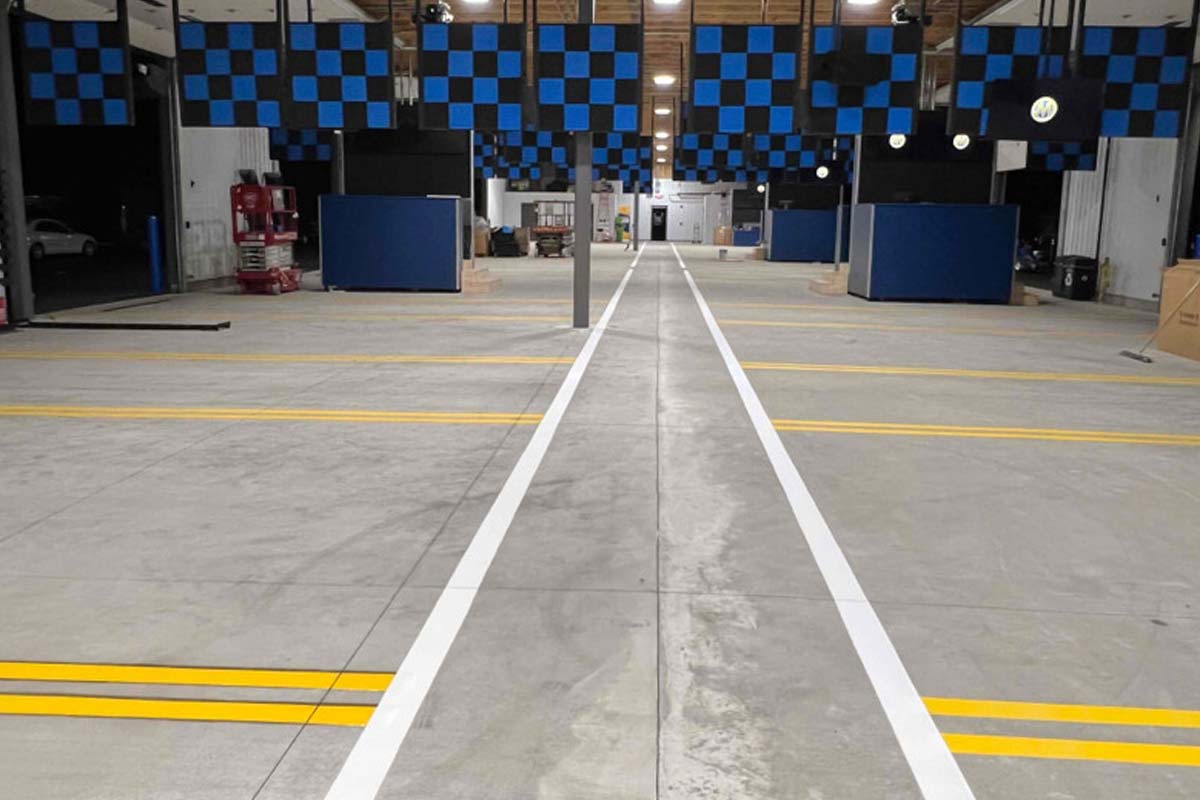
- Layout scoping. We walk the facility identifying primary forklift aisles, pedestrian walkways, loading dock zones, staging areas, hazardous-material storage boundaries, exit-path markings, and safety-zone demarcations around electrical panels, fire extinguishers, and emergency eye-wash stations.
- Surface preparation. We clean slab surfaces, remove loose material, and. Where existing markings are flaking or severely worn — grind or shot-blast to bare slab so new coatings bond directly to the concrete.
- Primer application. For epoxy scopes on older slabs or porous concrete, we apply a bonding primer before the color coat to extend the service life of the markings.
- Color application. We apply OSHA-compliant traffic colors following ANSI Z535 conventions: yellow for caution zones (forklift aisles, pedestrian crossings), red for fire-protection equipment and emergency stops, green for first-aid and safety equipment, blue for information.
- Stencil work. We stencil directional arrows, text labels for specific zones (“LOADING,” “NO ENTRY,” “EYE WASH”), and hazard warnings where applicable.
- Cure and sign-off. Water-based paints cure to forklift traffic in 2-3 hours; epoxy coatings need 24-48 hours. We document every element applied and leave a site map matching markings to OSHA 1910.22 coverage.
I-4 & CSX Rail Distribution Hub Demand
The I-4 corridor between Tampa and Orlando. With Lakeland as the midpoint — hosts one of the densest warehouse and distribution center concentrations in the Southeast United States. Publix Lakeland (one of Publix’s primary distribution centers), Amazon FTX5 fulfillment, Saddle Creek Logistics, and numerous 3PL operators run 24/7 shifts handling regional and national throughput. These facilities require OSHA 1910.22-compliant aisle markings, ANSI Z535 color-coded safety zones, and. For the cold-storage and bonded-warehouse tenants — additional marking scopes for hazardous-material zoning.
Florida humidity, slab-moisture considerations, and occasional salt-air exposure on Tampa-adjacent facilities all affect coating selection. Epoxy and methacrylate-based coatings outperform water-based traffic paint on high-traffic forklift aisles but require careful slab prep, especially on older concrete where residual moisture can compromise bond. For 24/7 operations, warehouse line painting is typically phased section by section during planned maintenance windows rather than during full facility shut-downs.
Why Choose Us
Warehouse line painting is a safety scope, not a cosmetic scope. Faded forklift aisles, missing pedestrian walkways, and worn safety-zone markings create real-world injury risk on active distribution floors and can surface in OSHA inspections as §1910.22(b) citations. 1-800-STRIPER of Lakeland scopes warehouse line work against OSHA 1910.22, ANSI Z535 color conventions, and any facility-specific marking protocols in the tenant’s safety management plan, and we schedule the work during off-shift windows that minimize operational disruption. For Central Florida facilities running 24/7 shifts, we phase the work section by section and coordinate with facility safety managers so shift changes and forklift routing aren’t affected.
For a full list of our pavement marking services, visit our all Lakeland striping services page.
Businesses We Serve




How it Works

GET A FREE ESTIMATE
Contact us today and we’ll have a quote to you in 24 hours

SCHEDULE A STRIPING
We’ll have your space restriped in less than 7 days, without affecting your business hours

GET A PARKING LOT THAT POPS
For a budget-friendly price, you’ll get a parking lot that looks like new
We proudly work with:


We proudly work with:

Frequently Asked Questions About Warehouse Line Painting in Lakeland, FL
What are the OSHA requirements for warehouse floor markings?
OSHA 29 CFR 1910.22(b) requires all permanent aisles and passageways in workplaces — including warehouses, distribution centers, and industrial facilities — to be marked. The markings must be distinguishable, durable under expected traffic, and maintained in visible condition. ANSI Z535 color-coding conventions (yellow for caution, red for emergency, green for safety, blue for information) are widely adopted alongside the OSHA requirement. 1-800-STRIPER of Lakeland provides OSHA-compliant warehouse line painting across the I-4 and CSX rail distribution corridor.
What warehouse markings does a distribution center along the I-4 corridor need?
Most Lakeland warehouses need a combination of forklift aisle lines, pedestrian walkways, loading dock zones, staging areas, hazardous-material storage boundaries, exit-path markings, and safety-zone demarcations around electrical panels, fire extinguishers, and emergency eye-wash stations. Distribution centers along the I-4 corridor — many of them Publix, Amazon, and cross-dock tenants — also mark trailer parking positions and yard-traffic flow. 1-800-STRIPER of Lakeland scopes the full marking set on site before application.
What paint lasts longest for warehouse floor markings in Florida?
Epoxy and methacrylate-based coatings hold up longest on warehouse floors because they resist forklift traffic, chemical spills, and the slab-moisture common to Central Florida concrete. Water-based traffic paint is cheaper but wears faster under constant forklift traffic. For cold-storage facilities in the Lakeland area, low-temperature-cure coatings are used because standard epoxy won’t set below the slab surface temperature. The right specification depends on forklift traffic volume, chemical exposure, and slab condition.
How often should warehouse floor markings be repainted?
Most Lakeland warehouses repaint floor markings every 18 to 36 months, faster than the paint’s theoretical service life because forklift traffic, pallet-jack scraping, and occasional chemical spills wear the coating sooner. High-volume distribution centers along the I-4 corridor may need annual touch-ups on the highest-traffic forklift aisles. A visual inspection of the primary aisles, dock lines, and pedestrian walkways once each quarter catches fading before it creates a workplace safety issue under OSHA 1910.22.
Can warehouse line painting be scheduled without shutting down operations?
Yes. Most warehouse line painting work in Lakeland is scheduled during off-shift windows — weekends, overnight shifts, or planned maintenance days — so operations continue during normal business hours. Water-based traffic paint dries to light forklift traffic within two to three hours and fully cures in 24 hours; epoxy coatings need longer cure times and are typically scheduled around full shut-downs. For facilities that run 24/7, we phase the work section by section to avoid full-facility closure.
Does OSHA require specific colors for warehouse floor markings?
OSHA 1910.22(b) requires floor markings to be distinguishable and durable but does not mandate specific colors. The widely adopted ANSI Z535 color-coding convention assigns yellow to caution zones (forklift aisles, pedestrian crossings), red to fire-protection equipment and emergency stops, green to first-aid and safety equipment locations, blue to information signs, and black-and-white striping to no-go zones. Most Central Florida distribution centers follow ANSI Z535 because it matches what their workforce and OSHA inspectors expect to see.