Thermoplastic Striping
In San Antonio, TX
Long-Lasting Pavement Markings
1-800-STRIPER® provides professional thermoplastic striping in San Antonio, TX — heat-applied pavement markings that last four to eight times longer than standard traffic paint, built for Texas heat and high-traffic commercial lots across Bexar County. Our veteran-owned, SBA-certified franchise brings military-grade precision and accountability to every project.
1-800-STRIPER® of San Antonio PROVIDes Thermoplastic Striping NEAR YOU
Want to reduce the maintenance requirements for your parking lot?
Thermoplastic pavement markings are a durable, weather and vehicle-resistant striping option for your parking lot or facility.
You can utilize them for stop bars, ADA stalls, no-parking zones, directional arrows, crosswalks, or your entire parking lot.
Benefits:
Thermoplastic vs. Paint: Which Is Right for Your Lot?
Thermoplastic and standard traffic paint serve the same purpose — creating visible pavement markings — but differ significantly in durability, application method, and long-term value. For San Antonio’s high-heat environment, the comparison is especially relevant because Texas UV and surface temperatures affect each material differently:
| Feature | Thermoplastic | Traffic Paint |
|---|---|---|
| Lifespan | 4–8 years | 12–18 months |
| Cure Time | 3–5 minutes | 1–2 hours |
| Application | Heat-applied at 400°F+ | Spray or roller |
| Durability | Resists tire wear, UV, chemicals | Subject to fading and peeling |
| Retroreflectivity | Glass beads embedded during application | Glass beads sprayed on surface (wear off faster) |
| Best For | High-traffic lots, roadways, long-term value | Standard lots, lower budgets, frequent re-layouts |
On a cost-per-year basis, thermoplastic often proves more economical for San Antonio properties despite its higher upfront cost. A lot that would need restriping every 12 to 18 months with paint may only need thermoplastic replacement every 4 to 8 years — reducing total lifecycle cost and minimizing disruption to business operations.
Types of Thermoplastic Markings
Thermoplastic pavement markings come in two application types, each suited to different marking needs:
- Preformed thermoplastic. Factory-cut symbols, arrows, letters, and specialized markings that are placed on the pavement and heated in place. Preformed thermoplastic is used for ADA symbols, directional arrows, STOP text, speed numbers, and other discrete markings that require precise shapes. Each piece is manufactured to exact dimensions and melted onto the surface with a propane torch or infrared heater.
- Extruded thermoplastic. Applied in continuous lines using a heated applicator that melts and deposits the material as the machine moves forward. Extruded thermoplastic is used for lane lines, edge lines, crosswalks, and other long continuous markings. Glass beads are embedded during application for immediate retroreflectivity.
Our Thermoplastic Application Process
- Surface preparation. The pavement surface is cleaned of dust, oil, and debris. For San Antonio lots with existing paint, old markings are removed or primed to ensure thermoplastic adhesion. Surface temperature must be at least 50°F for proper bonding — rarely an issue in San Antonio.
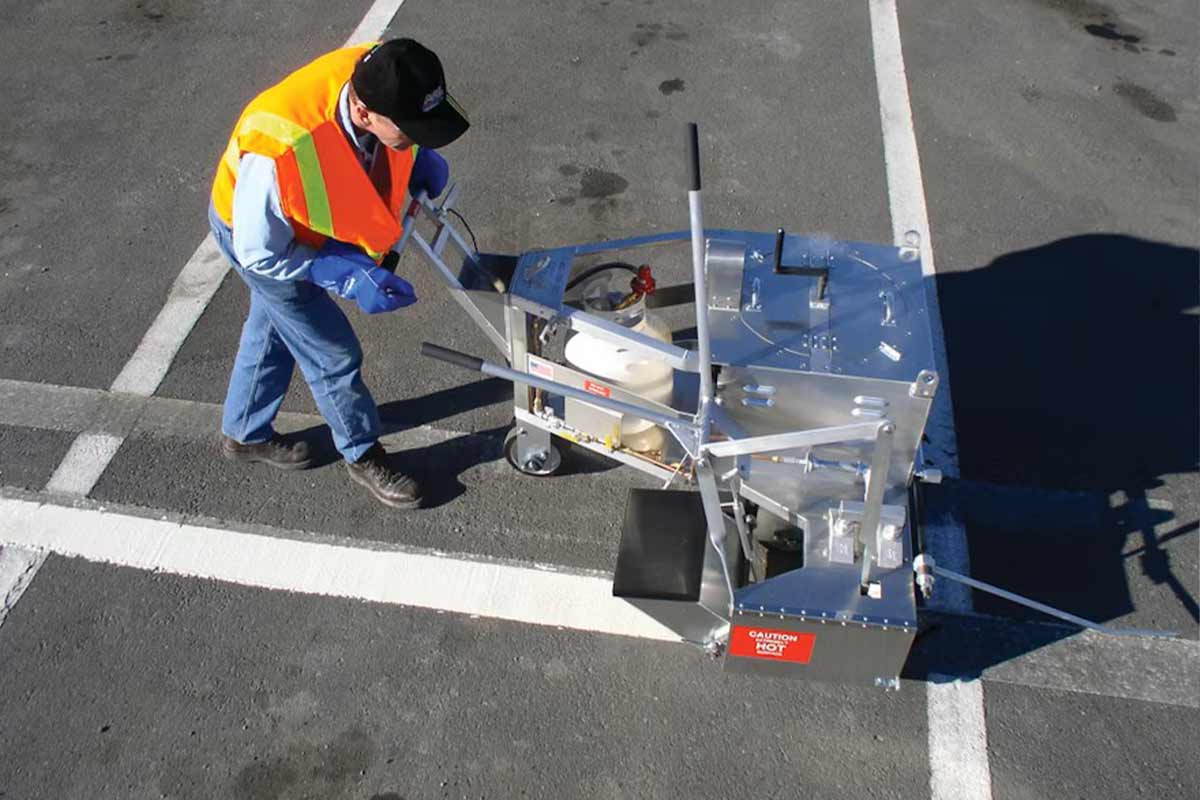
- Material heating. Thermoplastic material is heated to 400°F or higher in a temperature-controlled kettle. Overheating degrades the material; underheating prevents proper flow and adhesion. Our crew monitors temperature throughout the application to maintain optimal consistency.
- Application. For extruded lines, the heated material is applied through a calibrated die that controls line width and thickness. For preformed markings, symbols are positioned on the pavement and heated with a propane torch until they melt and bond to the surface.
- Glass bead embedding. While the thermoplastic is still molten, glass beads are broadcast onto the surface and sink partially into the material. This creates retroreflectivity — the beads reflect headlight illumination back toward drivers, making markings visible at night. San Antonio’s nighttime visibility is significantly improved by properly embedded glass beads.
- Cool and cure. Thermoplastic sets within 3 to 5 minutes of application — significantly faster than paint. Once cooled, the markings are immediately ready for traffic. No extended cure time or lot closures required.
Retroreflectivity and Nighttime Visibility
One of thermoplastic’s key advantages over paint is superior nighttime visibility through retroreflective glass bead technology. When glass beads are embedded into the molten thermoplastic during application, they create a durable retroreflective surface that bounces headlight illumination back toward the driver’s eyes. This makes lane lines, crosswalks, and symbols clearly visible in low-light conditions. For San Antonio properties with nighttime traffic — especially retail, restaurant, and entertainment venues — the safety improvement from thermoplastic retroreflectivity is significant.
For a full list of our pavement marking services, visit our parking lot striping in San Antonio page.
Businesses We Serve




How it Works

GET A FREE ESTIMATE
Contact us today and we’ll have a quote to you in 24 hours

SCHEDULE AN INSTALLATION
We’ll have your installation scheduled restriped in less than 7 days, without affecting your business hours

GET A PARKING LOT THAT POPS
For a budget-friendly price, you’ll get a parking lot that looks like new
We proudly work with:


We proudly work with:

Frequently Asked Questions About Thermoplastic Striping in San Antonio, TX
How long does thermoplastic striping last compared to regular paint?
Thermoplastic pavement markings typically last 4 to 8 years in San Antonio, compared to 12 to 18 months for standard traffic paint. The exact lifespan depends on traffic volume, surface type, and exposure conditions. High-traffic areas may see wear toward the lower end of that range, while lower-traffic lots can maintain thermoplastic visibility for the full 8-year span.
Is thermoplastic striping worth the higher upfront cost?
On a cost-per-year basis, thermoplastic is often more economical than repeated paint applications. A San Antonio lot that requires restriping every 12 to 18 months with paint would accumulate 4 to 6 paint applications over the same period that a single thermoplastic application would last. When factoring in labor, lot closure time, and material costs for each repaint, thermoplastic frequently delivers lower total lifecycle cost.
What is the difference between preformed and extruded thermoplastic?
Preformed thermoplastic comes as factory-cut symbols, arrows, and letters that are placed on the pavement and melted in place with heat. Extruded thermoplastic is applied as continuous molten lines using a heated applicator machine. Preformed is used for discrete markings like ADA symbols and directional arrows. Extruded is used for continuous lane lines, edge markings, and crosswalks.
How is thermoplastic applied to a parking lot surface?
Thermoplastic material is heated to over 400°F in a temperature-controlled kettle, then applied to the pavement surface using either a die-cut applicator (for lines) or a propane torch (for preformed symbols). Glass beads are embedded into the molten surface for retroreflectivity. The material sets within 3 to 5 minutes and is immediately ready for traffic — no extended cure time required.
Does Texas heat affect thermoplastic pavement markings?
Texas heat actually benefits thermoplastic adhesion — warm pavement surfaces promote better bonding between the thermoplastic and the pavement. However, application temperature must be carefully managed because the material is also heated during installation. In San Antonio’s hottest months, our crews schedule applications during early morning hours when surface temperatures allow optimal material flow without overheating. Once cured, thermoplastic withstands San Antonio’s summer temperatures without softening or deformation.