Wheel Stop Installation
In Boca Raton, FL
Concrete and Rubber Wheel Stops
1-800-STRIPER provides professional wheel stop installation in Boca Raton, FL — anchoring concrete and recycled-rubber parking bumpers per ADA Section 502.7 projection requirements and ASTM D573 weather-resistance standards to protect sidewalks, storefronts, and accessible routes throughout the surrounding South Florida region.
1-800-STRIPER® of Boca Raton PROVIDes Wheel Stops Services NEAR YOU
Need to protect vehicles or walls from accidental damage?
Wheel stops (also called parking blocks) protect your property, enhance safety, and improve parking lot organization.
Benefits:
Wheel stops prevent vehicles from parking too far into a space or overextending into other spots, pedestrian walkways, and other areas, while also helping with vehicle alignment. They can prevent damage to buildings, curbs, or landscaping. Wheel stops also serve as clear visual cues for proper parking and are sometimes used on slopes to prevent cars from rolling.
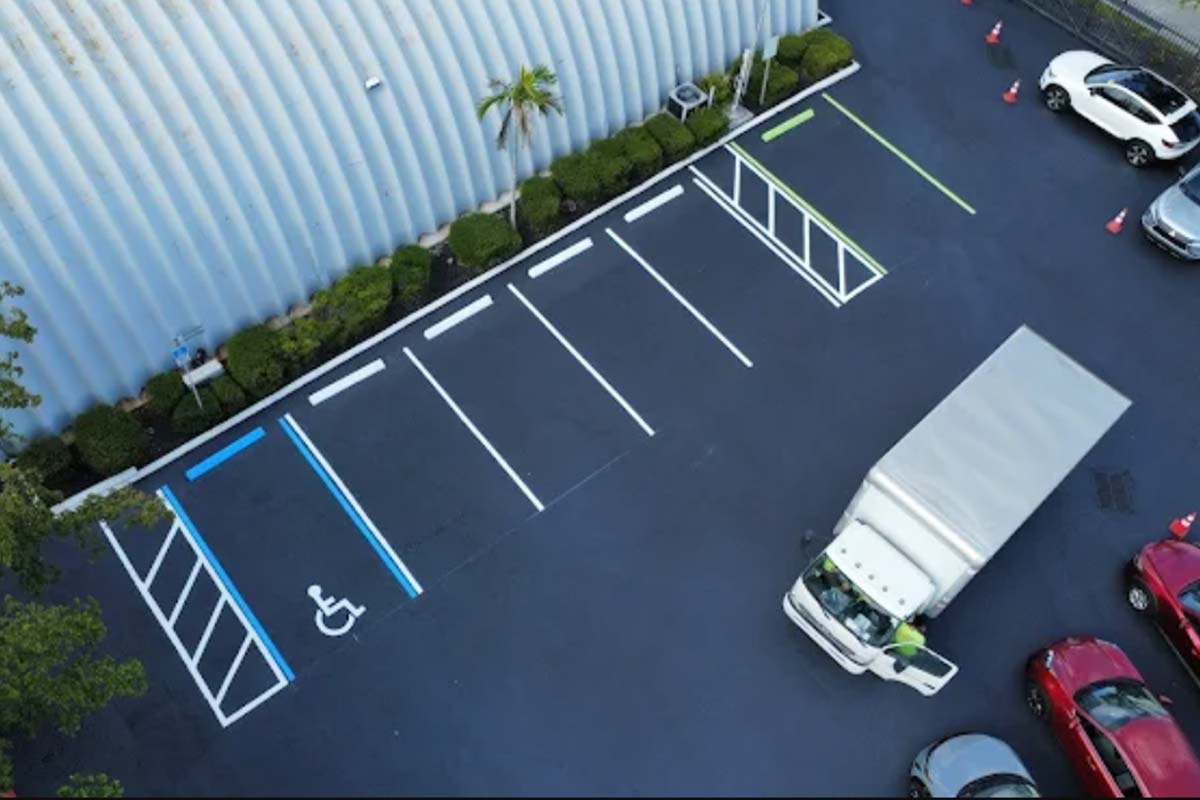
Wheel Stop Installation Services in Boca Raton, FL
Wheel stops, also called concrete parking bumpers, protect storefronts, sidewalks, accessible routes, and landscape features from vehicle overhang. We install concrete, recycled-rubber, and plastic-composite wheel stops for retail centers, multi-tenant office complexes, hotels, medical and dental properties, schools, churches, and HOA-governed communities across South Florida. Free estimates document material, anchor specification, and stall placement against ADA accessible-aisle clearance rules.
ADA Section 502.7 — wheel-stop projection rule for accessible parking
ADA 2010 Standards Section 502.7 requires wheel stops to be located so no portion projects more than the depth of the access aisle, and so they do not reduce the clear width of accessible routes. In practice, this means wheel stops at the head of an accessible stall must be set back so a wheelchair user opening a vehicle door has the full 60-inch (or 96-inch van-accessible) access aisle clear from front to rear of the stall. Section 502.7 is one of the more commonly missed ADA compliance points at older Boca commercial properties.
Concrete vs. recycled rubber — material comparison
Concrete wheel stops are heavier, longer-lasting, and lower upfront cost: the traditional commercial standard. Recycled-rubber stops are lighter, easier to relocate during layout changes, more forgiving on tires, and weather-resistant against South Florida UV exposure per ASTM D573 (rubber heat-aging test). Plastic-composite stops are the lightest and easiest to install on asphalt but have the shortest UV service life. Material choice depends on traffic volume, layout permanence, substrate condition, and budget. We size and price each option during the site walk.
Anchor specifications — asphalt vs. concrete substrate
Anchor specifications differ by substrate. On concrete: typical anchor specifications include #4 or #5 rebar pin embedment 6 to 12 inches deep, or epoxy anchors using a system like Hilti HIT-RE 500. On asphalt: 14 to 18 inch spike anchors driven through the stop into the substrate, or surface-mount adhesive bonds for recycled-rubber and plastic-composite stops. Anchor choice depends on the stop material, substrate condition, traffic load, and how often the layout is expected to change. We confirm spec on the site walk based on what the substrate can hold.
Florida heat and UV — choosing weather-resistant materials
South Florida’s UV index of 10+ during summer months and 130°F+ asphalt surface temperatures accelerate UV degradation and heat-induced softening of rubber and plastic-composite wheel stops. ASTM D573 (rubber heat-aging test) and manufacturer-published UV-resistance data are the relevant durability benchmarks. Concrete is largely immune to UV degradation but can spall over time at edges and anchor points. For Boca commercial properties, choose materials specced for hot, sunny climates rather than national-average temperate-zone products.
Where to install wheel stops (storefronts, accessible routes, stall heads)
Wheel stops belong at stall heads where a vehicle could otherwise overhang and impact a sidewalk, storefront, accessible route, landscape bed, or another stall. They protect storefronts in retail centers along Federal Highway and Glades Road, sidewalks at office complexes, and accessible routes adjacent to ADA stalls. Per ADA Section 502.7, they cannot project into accessible aisles. We layout placement during the site walk based on stall geometry, adjacent obstacles, and the ADA constraint.
Our wheel-stop installation process
The process starts with a site walk that documents existing wheel-stop condition, identifies where new stops are needed, and verifies ADA Section 502.7 compliance at accessible stalls. The free estimate quotes material, anchor specification, and removal of any failing existing stops. Crews mark stall heads, drill anchor holes (concrete) or drive spike anchors (asphalt), set the stops, and verify alignment. Where an existing stop encroaches on an accessible aisle, removal and re-set to spec is included.
At a Glance
| Material | Weight (typ) | UV / heat | Cost | ADA-compatible | Best for |
|---|---|---|---|---|---|
| Concrete | 200-300 lb | Excellent | Lowest | Yes (with §502.7 setback) | Permanent installs |
| Recycled rubber | 30-40 lb | ASTM D573 verified | Mid | Yes (with §502.7 setback) | Layout flexibility, tire-friendly |
| Plastic-composite | 15-25 lb | Shortest UV life | Highest | Yes (with §502.7 setback) | Asphalt anchors, light traffic |
For a full list of our pavement marking services, visit our full Boca Raton service list page.
Businesses We Serve




How it Works

GET A FREE ESTIMATE
Contact us today and we’ll have a quote to you in 24 hours

SCHEDULE AN INSTALLATION
We’ll have your installation scheduled restriped in less than 7 days, without affecting your business hours

GET A PARKING LOT THAT POPS
For a budget-friendly price, you’ll get a parking lot that looks like new
We proudly work with:


We proudly work with:


Frequently Asked Questions About Wheel Stop Installation in Boca Raton, FL
What does ADA Section 502.7 say about wheel stops?
ADA 2010 Standards Section 502.7 requires that wheel stops be located so no portion projects more than the depth of the access aisle, and that they not reduce the clear width of accessible routes. Practically, this means wheel stops at the head of an accessible stall must be set back so a wheelchair user opening a vehicle door has the full 60-inch (or 96-inch van-accessible) access aisle clear from front to rear of the stall.
Concrete vs. recycled rubber — which wheel stop should I choose?
Concrete wheel stops are heavier, longer-lasting, and lower upfront cost — the traditional commercial standard. Recycled-rubber stops are lighter, easier to relocate during layout changes, more forgiving on tires, and weather-resistant against South Florida UV per ASTM D573 rubber heat-aging standards. Plastic-composite is the lightest and easiest to anchor on asphalt but has the shortest UV life. Material choice depends on traffic, layout permanence, and substrate.
How are wheel stops anchored to asphalt vs. concrete?
On concrete: typical anchor specs include #4 or #5 rebar pin embedment 6-12 inches deep, or epoxy anchors using a system like Hilti HIT-RE 500. On asphalt: 14-18 inch spike anchors driven through the stop into the substrate, or surface-mount adhesive bonds for recycled-rubber and plastic-composite stops. Anchor choice depends on substrate condition, stop material, and how often the layout might change. We confirm spec on the site walk.
Why do Florida wheel stops fail faster than northern markets?
South Florida’s UV index of 10+ during summer months and 130°F+ asphalt surface temperatures accelerate UV degradation and heat-induced softening of rubber and plastic-composite stops. ASTM D573 (rubber heat-aging test) and manufacturer-published UV-resistance data are the relevant durability benchmarks. Concrete is largely immune to UV degradation but can spall over time at edges and anchor points. Choose materials specced for hot, sunny climates rather than national-average temperate-zone products.
Where should wheel stops be installed in a parking lot?
Wheel stops belong at stall heads where a vehicle could otherwise overhang and impact a sidewalk, storefront, ADA accessible route, landscaping bed, or another stall. They protect storefronts in retail centers along Federal Hwy and Glades Rd, sidewalks at office complexes, and accessible routes adjacent to ADA stalls. Per ADA §502.7 they cannot project into accessible aisles. We layout placement during the site walk per stall geometry and adjacent obstacles.
Do you handle ICC-ES-rated wheel stops for code-aware specifiers?
Yes. ICC-ES (International Code Council Evaluation Service) issues acceptance criteria and product-specific Evaluation Service Reports (ESRs) for precast concrete and recycled-rubber wheel stop products. For projects with architects or general contractors who require code-listed components — typically larger commercial developments and government work — we source product with current ESR documentation and provide submittal packages with the install.