
Bollard Installation
In West Fort Worth, TX
Safety and Security Bollards
1-800-STRIPER provides professional bollard installation in West Fort Worth, TX — installing safety bollards, pipe bollards, and protective barriers that shield storefronts, pedestrian walkways, and utility equipment per ASTM F3016 impact-resistance specifications for commercial properties across Parker and Tarrant counties.
1-800-STRIPER® of West Fort Worth PROVIDes Bollard Installation Services NEAR YOU
Want to prevent accidents and protect your property?
Bollards provide physical protection for your customers and your property.
Safety and security:
Bollards create a physical barrier between vehicles and pedestrians, protecting people in walking areas from accidental or intentional vehicle intrusions.
Bollards act as a protective barrier around storefronts, gas stations, and other vulnerable areas, minimizing the risk of costly damage from vehicle impacts.
Strategic Placement Locations:
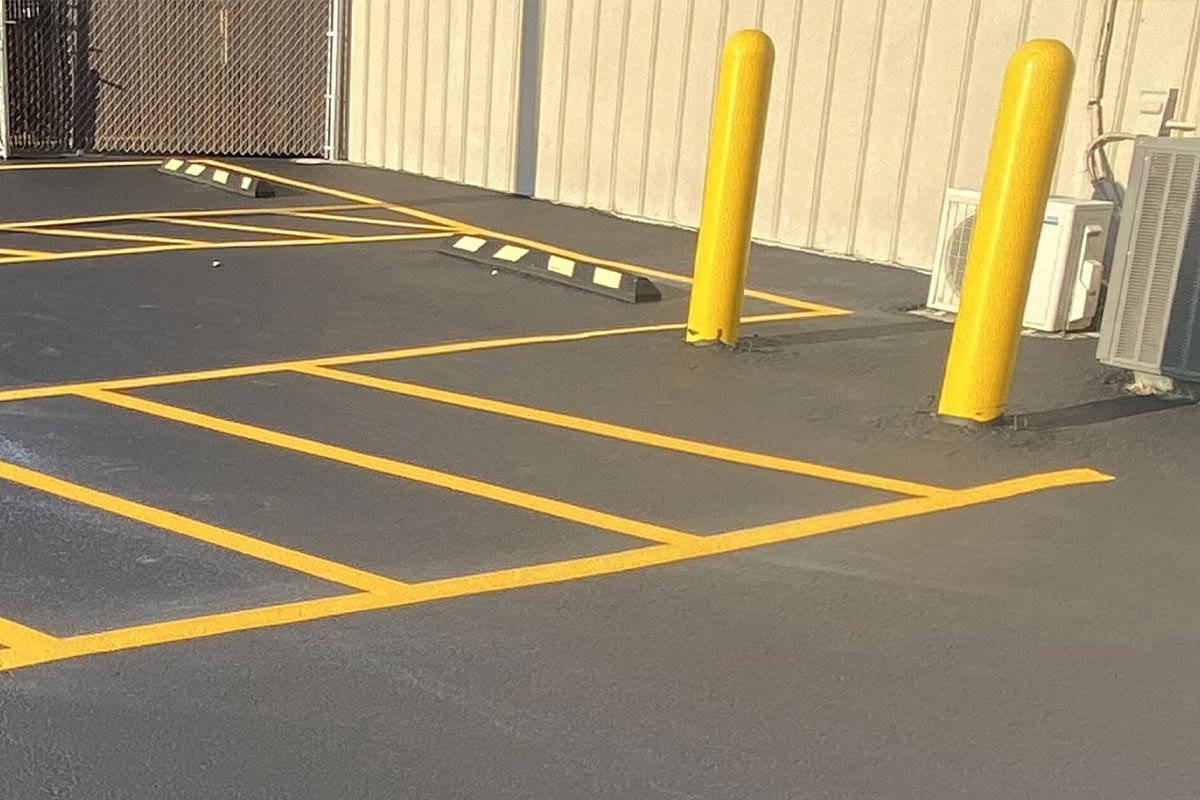
What Bollards Protect on a Commercial Property
Bollards stop a moving vehicle before it reaches the thing you cannot afford to lose — your storefront glass, your pedestrians, and your gas or electrical equipment. They are short, sturdy posts set into the pavement at the edge of a vulnerable area, and they absorb or deflect impact so a stray vehicle does the least possible damage.
The most common job 1-800-STRIPER handles in West Fort Worth, TX is storefront protection. A driver mistakes the gas pedal for the brake, jumps a curb, and a row of bollards is the only thing between that vehicle and a plate-glass entrance full of customers. Building corners take the same kind of hit, especially the corners closest to a busy drive aisle where delivery trucks turn tight.
Pedestrian walkways are the second category. Anywhere foot traffic crosses or runs parallel to vehicle traffic — a sidewalk along a fire lane, a striped crosswalk between a parking field and an entrance — bollards mark the line and physically hold vehicles out of it. The third category is utility and gas equipment: meter banks, transformers, propane tanks, and backflow assemblies that a single backing maneuver could rupture. Many gas suppliers and local fire codes require protective posts around that equipment, and a bollard is the standard fix.
Fixed, Removable, and Crash-Rated Bollards — Which One You Need
Pick the bollard type by the threat you are defending against, not by looks. There are three working categories, and they are not interchangeable.
A fixed bollard is set permanently in concrete and is the right answer for the vast majority of storefront, walkway, and equipment-protection jobs. A removable bollard drops into a flush-mounted ground sleeve and lifts out when you need the opening — useful for fire-lane access points, loading zones, and seasonal pedestrian plazas that must occasionally admit a service vehicle. A crash-rated bollard is engineered and tested to stop a vehicle traveling at a known speed and weight, and it carries an independent impact rating rather than a manufacturer’s guess.
| Type | Best for | Anchoring | Impact reference |
|---|---|---|---|
| Fixed pipe bollard | Storefronts, building corners, equipment | Concrete footing, embedded post | ASTM F3016 (S-rating) |
| Removable bollard | Fire-lane access, loading zones, plazas | Flush ground sleeve | ASTM F3016 (S-rating) |
| Crash-rated bollard | High-security entries, government, data centers | Engineered foundation per drawing | ASTM F2656 (M-rating) |
If your need is everyday low-speed protection — keeping parking-lot vehicles off a sidewalk or a gas meter — a fixed or removable pipe bollard tested under ASTM F3016 is the correct, cost-sensible choice. If you are protecting a high-security entrance against a deliberate high-speed ram, that is a crash-rated barrier engineered to ASTM F2656, and we will tell you plainly which category your site falls into during the estimate.
Concrete Footing and Embedment Depth — Why It Decides Everything
A bollard is only as strong as the footing it stands in, so the concrete below grade matters more than the steel above it. A post bolted to the surface or set in a shallow hole will simply lever out of the ground on the first real impact, taking a chunk of pavement with it.
The industry baseline for a standard fixed pipe bollard is a drilled or formed footing roughly 36 inches deep, with the bollard embedded about one-third of its total height and surrounded by poured concrete on all sides. The hole is widened at the base on demanding sites so the footing resists overturning, and the concrete is allowed to fully cure before the post takes any load. On expansive North Texas clay soils — common across Parker, Johnson, and Hood counties — footing depth and width get extra attention, because seasonal soil movement can heave a shallow footing over time.
Embedment depth is the single biggest difference between a bollard that performs and one that fails. We size the footing to the post diameter, the expected impact, and the soil, then set each post plumb and verify alignment before the concrete sets. Get this step right and the bollard does its job for decades; cut it short and the first bump pops the post loose.
Impact Ratings, ASTM F3016, and ASTM F2656
Match the bollard’s tested rating to the speed and weight of the vehicle you expect to hit it. Two ASTM standards govern this, and they cover very different threat levels.
For everyday commercial sites, the governing standard is ASTM F3016, the low-speed vehicle-impact test for security bollards. It uses a surrogate test vehicle and rates products in speed tiers — S10, S20, and S30, corresponding to roughly 10, 20, and 30 mph — along with a P-rating (P1, P2, P3) that grades how far the vehicle penetrates past the bollard line after impact. A lower P-number means less penetration, which is what you want in front of a storefront full of people. Most parking-lot, sidewalk, and equipment-protection jobs in West Fort Worth land squarely in the F3016 range.
For high-security applications — government buildings, utility substations, data centers, and any entrance with a credible ram-attack threat — the standard steps up to ASTM F2656, the crash-rated test for vehicle-security barriers. F2656 tests against heavier vehicles at highway speeds and assigns M-ratings (M30, M40, M50 for 30, 40, and 50 mph) along with a penetration designation. These barriers require an engineered foundation built to the manufacturer’s tested drawing — you cannot achieve an F2656 rating with a standard pipe-bollard footing. We will tell you honestly when a site needs F2656 versus when F3016 is the right, proportionate spec.
Bollard Spacing That Keeps an ADA Accessible Route Clear
Space bollards close enough to stop a vehicle but never so tight that they block a wheelchair. The two goals coexist, and getting the spacing right is part of every layout we install.
A common spacing for vehicle protection runs about 3 to 5 feet on center, which is tight enough that a car cannot slip between two posts. The constraint is the accessible route: under the ADA Standards for Accessible Design, a pedestrian access route must keep a minimum clear width of 36 inches, and any gap a wheelchair passes through needs at least 32 inches clear at a single point. So wherever a line of bollards crosses or borders a sidewalk, crosswalk, or entrance approach, we widen the appropriate gap to preserve that clear width while still holding the rest of the line tight against vehicles.
The other detail is the bollard itself. We keep posts out of the required clear width, avoid creating a protruding-object hazard along the route, and confirm the finished layout leaves a continuous, unobstructed accessible path from the parking field to the door. Pipe bollards we fabricate are typically schedule-40 steel pipe, set over the footing, filled with concrete for added mass, capped, primed, and finished in a high-visibility color — safety yellow is standard, and Sherwin-Williams paint over a proper primer holds that color against the Texas sun far longer than an unprimed coat. For a site walk, you can reach our West Fort Worth team at (682) 262-7612.
For a full list of our pavement marking services, visit our parking lot striping in West Fort Worth page.
Businesses We Serve




How it Works

GET A FREE ESTIMATE
Contact us today and we’ll have a quote to you in 24 hours

SCHEDULE AN INSTALLATION
We’ll have your installation scheduled in less than 7 days, without affecting your business hours

GET A PARKING LOT THAT POPS
For a budget-friendly price, you’ll get a parking lot that looks like new
We proudly work with:


We proudly work with:


Frequently Asked Questions About Bollard Installation in West Fort Worth, TX
How deep does a bollard footing need to be?
The industry baseline for a standard fixed pipe bollard is a footing around 36 inches deep, with the post embedded roughly one-third of its height in poured concrete. We size each footing to the post diameter, the expected impact, and the soil. On the expansive clay soils common across Parker, Johnson, and Hood counties, we widen and deepen footings as needed so seasonal soil movement does not heave the post. Embedment depth is the single biggest factor in whether a bollard survives a real hit, so it is never a place to cut corners.
What is the difference between ASTM F3016 and ASTM F2656?
ASTM F3016 is the low-speed impact test for security bollards, rating products in S10, S20, and S30 tiers (about 10, 20, and 30 mph) plus a P-rating for how far a vehicle penetrates past the line. It covers everyday commercial protection — storefronts, walkways, equipment. ASTM F2656 is the crash-rated standard for high-security barriers, testing heavier vehicles at highway speeds with M30, M40, and M50 ratings. F2656 barriers need an engineered foundation built to a tested drawing. Most commercial sites need F3016; F2656 is for ram-attack threats like government or utility facilities.
Should I use fixed or removable bollards?
Use fixed bollards for permanent protection — storefronts, building corners, pedestrian walkways, and utility equipment that never needs an opening. Removable bollards drop into a flush ground sleeve and lift out when you need access, which makes them the right choice for fire-lane access points, loading zones, and plazas that occasionally admit a service vehicle. Many sites use both: a fixed line along the storefront and a removable post at the one spot the fire marshal needs to keep openable. We map which is which during the site assessment.
How far apart should bollards be spaced?
For vehicle protection, posts commonly sit about 3 to 5 feet on center — tight enough that a car cannot pass between them. The limit is the accessible route. Under the ADA Standards for Accessible Design, a pedestrian access route must keep at least a 36-inch clear width, and a single passing gap needs a minimum of 32 inches clear. So wherever a bollard line crosses a sidewalk or entrance, we widen that gap to preserve the accessible path while keeping the rest of the line tight against vehicles. The layout balances both goals on every install.
Can bollards protect my gas meter and utility equipment?
Yes — that is one of the most common reasons commercial properties install them. Meter banks, transformers, propane tanks, and backflow assemblies are easy targets for a backing vehicle, and a single hit can rupture a gas line. Many gas suppliers and local fire codes actually require protective posts around that equipment. We set fixed pipe bollards around the equipment footprint at a spacing that stops a vehicle while still leaving room for meter reading and service access. This is standard work for us across commercial sites in West Fort Worth, TX.
What are your pipe bollards made of and how are they finished?
We fabricate pipe bollards from schedule-40 steel pipe, set over a poured concrete footing and embedded for strength. Once the post is plumb and the footing cured, we fill the pipe with concrete to add mass and impact resistance, cap the top to keep water out, then prime and finish the steel. Safety yellow is the standard high-visibility color, applied as Sherwin-Williams paint over a proper primer so it holds against Texas sun and weather. High-visibility color also matters for ADA — it keeps the posts from becoming an unseen hazard along a pedestrian route.